


The Upper Danube. Part 9
Description
This section is from the book "The Upper Danube - John L. Stoddard's Lectures", by John L. Stoddard. Also available from Amazon: John L. Stoddard's Lectures 13 Volume Set.
The Upper Danube. Part 9
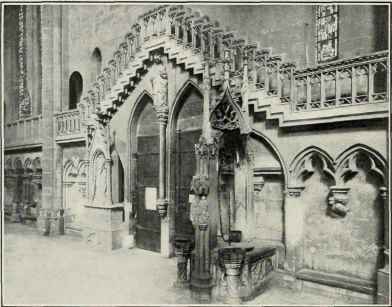
The Well In The Cathedral.
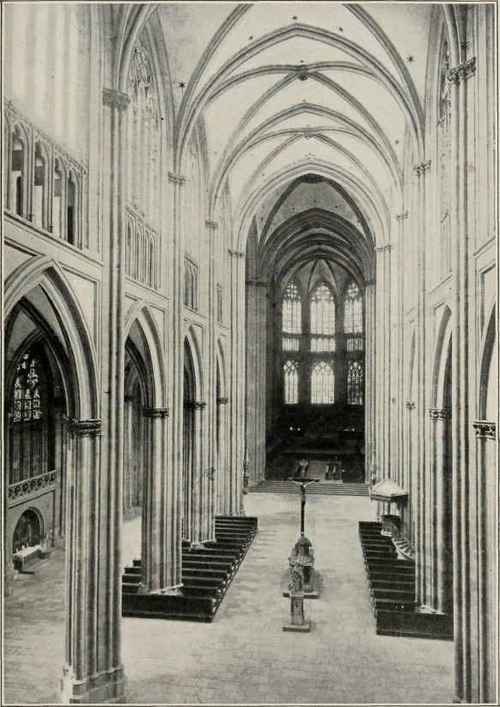
The Nave Of The Regensburg Cathedral.
Hence, only when alone, or with, at most, one perfectly congenial friend, should one thus use a great cathedral. Unfortunately, however, most tourists are now in too much haste for proper observation on their travels, not to speak of meditation! "Give me a list of all that I must absolutely see in Switzerland and Italy," recently exclaimed one of the rapidly increasing class of frivolous visitors to the Old World, " so that, when those are once checked off, I can return as soon as possible to . . . Paris!" It is related of the philosopher, Schopenhauer, that every day for years he laid beside his plate at dinner a gold piece, destined for some charity the first time he should hear a sensible remark from any of the officers eating at his hotel table. I often wonder whether a similar gold piece would not wait as long unclaimed, were one to make the gift of it dependent on discovering an American, who, unless actually ill, was not in Europe "pressed for time," and in a hurry to move on. This motorlike rapidity in sightseeing is not always the result of lack of appreciation. It is caused principally by that national fever of incessant restlessness, known as "Ameri-canitis," augmented by the fact that many of those who come to Europe fail to realize the enormous amount of scenic, artistic, and historic treasures contained within a geographical area which seems to them comparatively small.

The Portal Of The Cathedral.
Hence they attempt to cover too much space in insufficient time; for many of the lesser towns are so replete with interesting and instructive features, that to ignore them would be folly.
In the immediate neighborhood of Regensburg, for example, there stands a structure of great beauty and historical significance, which scarce a hundred English and Americans visit annually, yet which really ranks among the finest architectural achievements of the modern world. This edifice, known as the Walhalla, crowns an imposing bluff, which rises from the Danube in a series of receding terraces. Upon the loftiest of these, two hundred and eighty feet above the river, the noble building glitters in the sun. Constructed in pure Doric style in imitation of the Parthenon, this marble temple is a vast Teutonic Hall of Fame, erected here, in 1842, by Ludwig I. of Bavaria, assisted by the genius of the celebrated architect Klenze. Its name recalls the legendary " Hall of the Chosen," in old Scandinavian mythology, where Odin welcomed to his banquets all the warriors who, having fallen bravely on the field of battle, were brought by the Valkyries to that northern paradise. Thus somewhat similarly did the founder of this building plan to introduce within its walls statues and busts of all the sons and daughters of the Fatherland who had contributed either directly to the welfare of their country or to the general progress of mankind. Not without rigid scrutiny, however, are they admitted to these sacred precincts. For in the temple's vaults is an apartment, called the Hall of Expectation, where busts of the most recent of distinguished applicants are placed, until their right to representation in the intellectual pantheon above shall have been proven by the test of time. The exterior of the Walhalla is characterized by the sublime simplicity of the antique. It therefore leaves upon the mind an ineffaceable impression of repose and strength. The motif of the entire structure is lofty patriotism and legitimate heroworship. Upon the northern pediment a group in high relief portrays the old Germanic chieftain, Herrmann, - or Arminius, as the Romans called him, - in his desperate struggle with Rome's legions in the ninth year of the Christian era, when he annihilated the imperial troops, drove their commander, Varus, to find death by suicide, and freed the country of its would-be conquerors. It was this terrible disaster to the Roman arms that caused the well-known lamentation of Augustus : "O Varus, Varus, give me back my legions!" The German nation is not slow to recognize the virtues of its heroes, and certainly this brave defender of Teutonic liberty has not been forgotten. For not alone does the Walhalla thus perpetuate his fame, but many plays and poems in the German tongue preserve his memory to millions. Moreover, on the impressive site of the battle itself, near Detmold, on the river Werra, there rises from the Teutoberger Forest a monster statue of Arminius, entirely made of hammered copper, and measuring one hundred and eighty-six feet from the base of the pedestal to the tip of the uplifted sword!
Continue to:


My Books

