


The Upper Danube. Part 10
Description
This section is from the book "The Upper Danube - John L. Stoddard's Lectures", by John L. Stoddard. Also available from Amazon: John L. Stoddard's Lectures 13 Volume Set.
The Upper Danube. Part 10

An Old Doorway, Regensdurg.

The Walhalla And The Danube.

The Southern Approach To The Walhalla.
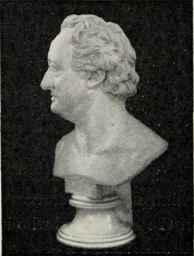
Bust Of Goethe.

The Northern Front.
If the exterior of the Walhalla is severe in its simplicity, the interior is by contrast all the more magnificent. A glittering floor of inlaid marble stretches from the entrance to the opposite wall, two hundred and fifty feet away. Surmounting this, a richly gilded roof, sixty-three feet in height, is upheld by imposing statues of the mythical Valkyries. Beneath them the entire hall is bordered by a sculptured frieze, which typifies the progress of the German race; while over this are many marble tablets, on which in gilded letters gleam the names of those whom Germany delights to honor, yet of whom no authentic likeness could be found. Below these ranged in beautiful relief against resplendent walls of polished marble are busts of famous benefactors of the race, arrayed in chronological order, so that by no possibility could partiality decide their places. These busts already number more than one hundred, and represent such varied types of genius as Kepler, Gutenberg, Luther, Albrecht Durer, Beethoven, Mozart, Goethe, Schiller, Lessing, Kant, and Humboldt. Kings, as a rule, are here conspicuous by their absence, save as they stood for som e th i n g more than royalty. It is true, the bust of Frederick the Great enjoys an honored place; but, aside from his unquestionable achievements, he merited perhaps a representation here for his remarkable declaration: "Kings are the first servants of the State." Among these portraits of illustrious men six noble statues by the sculptor, Rauch, are also worthy of especial admiration, portraying winged Victories, which in distinctly dignified yet graceful attitudes extend their wreaths of fame and crowns of immortality.
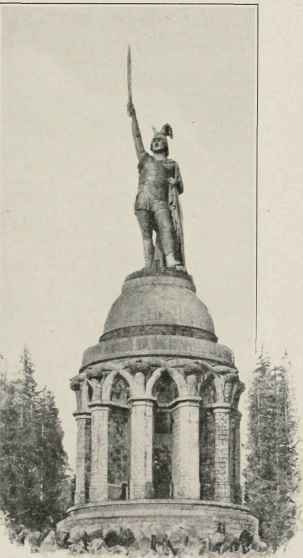
Statue Of Arminius In The Teutoberger Forest.
In look-ing round this spacious hall, one feels, a little sadly, that there is probably ample room for all who shall deserve memorial here for several centuries. Men of sufficient greatness to obtain admission to this Court of the Immortals are rare in any nation; and in the German Fatherland, as elsewhere, the appeal goes forth :
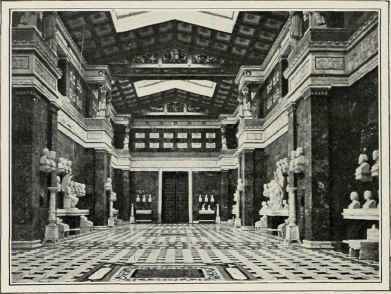
The Interior, Looking South.

The Interior, Looking North.
'•God give us men! A time like this demands Strong minds, great hearts, true faith, and ready hands; Men whom the lust of office does not kill; Men whom the spoils of office cannot buy; Men who possess opinions and a will; Men who have honor, men who will not lie".
Yet, not content with this magnificent Walhalla, as a source of inspiration to his people, King Ludwig I., a few years after its construction, caused still another edifice to be erected on a loftier height above the Danube, fourteen miles from Regens-burg. This structure, in the form of a rotunda one hundred and ninety-one feet in altitude, is scarcely less imposing than its predecessor, and is designed to keep forever in the national mind one grand, specific episode in history, - the War for German Independence in the struggle with Napoleon. Accordingly, the inauguration of this "Hall of Liberation" took place, in 1863, upon the fiftieth anniversary of the "Battle of Nations" at Leipzig, whence the "sublime adventurer" began his slow retreat from German soil. Within the glittering mosaic pavement, therefore, of this solemn shrine, encircled by a multitude of winged ministrants of fame, have been inscribed these stirring words: "May Germans never forget what a struggle for freedom necessitates, and by what means it is gloriously won!"
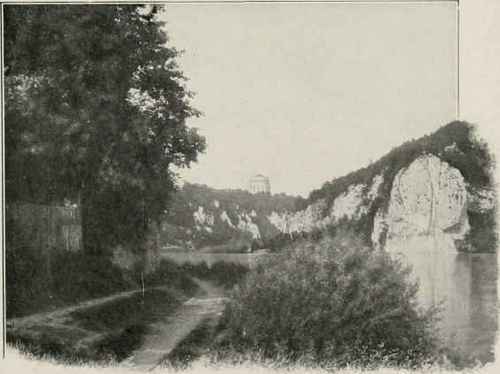
The Hall Of Liberation, Above The Danube.
Continue to:


My Books

