


The Upper Danube. Part 2
Description
This section is from the book "The Upper Danube - John L. Stoddard's Lectures", by John L. Stoddard. Also available from Amazon: John L. Stoddard's Lectures 13 Volume Set.
The Upper Danube. Part 2
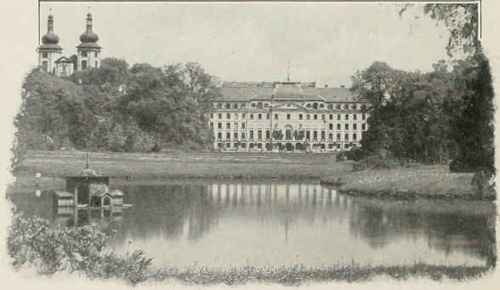
Residence Of Prince Furstenberg At Donau-Eschingen.
"Standing with reluctant feet Where the brook and river meet, Womanhood and childhood fleet".
One fancies here that, if the statue of Germania could address her youthful offspring, it would be in words like these: My child, the hour has come for you to leave your cradle in the sheltering forest. A long life-journey lies before you. In length of course and magnitude of volume you will rank as Europe's second river. Only one other can in these respects surpass you, - the Russian Volga. Four hundred affluents will, one by one, pay tribute to you as their queen, and travel humbly in your train. You will behold magnificently varied scenery. Your banks will be adorned with castles, palaces, and churches, more beautiful than any which surround your early home. You will see splendid cities on your route, beside which Donau-Eschingen, however fine it looks to you to-day, will sink to insignificance. The history of the lands through which you glide will have for you absorbing interest, and many different nationalities will link their destinies to yours. A fleet of ships and steamers will eventually float upon your bosom. Finally, closing a momentous course of nearly eighteen hundred miles, you will bring all the wealth and power of your grand maturity to the inevitable terminus of every stream, - the open sea. There even your strong individuality will be as wholly lost as that of any rivulet which may have shyly crept to you along your route, and been absorbed within your mighty flood.

"Standing with reluctant feet".
What may become of your disintegrated mass, when once ingulfed by the Black Sea, I cannot tell. Nor is it probable that you yourself will know. Yet it may be that some day your essential entity will once more pass in radiant clouds above this region of your birth. If you should thus return, remember that these dear old trees will faithfully stretch up their arms to you, to woo you downward from the heights. Be not unmindful of their welcome, but descend again to bless Germania. Now, Auf Wiedersehen! About two hundred feet from this, its source, the youthful river joins a little brook, known as the Brigach; and these, at a short distance farther on, find a third comrade in the Brege. On this account some challenge the correctness of the claim that the true origin of the Danube is the spring within the castle's courtyard. They say that, on the contrary, the Brigach and the Brege are its real progenitors. Let us not press the point too closely. For my part, I prefer - if only on the ground of sentiment - to cast my vote in favor of the palace fountain. Moreover, it is said that both the Brigach and the Brege have once or twice run dry in times of drought, but that the rill which rises in the garden of Prince Furstenberg has never failed.
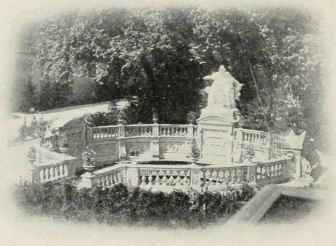
The Cradle Of The Danube.

Characteristic Danubian Scenery.
The town of Tuttlingen, not many miles below the birthplace of the Danube, is famous from the fact that there once lived the author of the German national song, " The Watch on the Rhine." Strange, is it not, that those inspiring stanzas should have been composed by a mere youth of twenty-one, whose residence, after all, was not beside the Rhine, but by the Danube? Still stranger is the circumstance that, though the song was given to the world in 1840, the fire in its words lay smoldering, unobserved, for thirty years. Its origin is said to have been due to the attempt of the French statesman, Thiers, to have the Rhine acknowledged as the eastern boundary of France; but it was not till 1870 that its tremendous power was seen. Then suddenly it burst volcanically forth to thrill the heart of Germany; moved thousands to defend the glorious river of the Fatherland; and led unnumbered heroes to keep valiantly in life, and hallow by their death, their watch beside the Rhine. The writer of those lines, Max Schneckenburger, died at the age of thirty in obscurity. But now a monument at Tuttlin-gen commemorates his influence upon the nation; and if it be that dwellers on this earth can subsequently, from some other spiritual plane, perceive the progress of terrestrial events, his soul must have rejoiced to see the wonderful effect produced by his exhilarating words, as half a million soldiers sang upon the march, or by their bivouac fires, the stirring song, which in the English language may be rendered thus :
Continue to:


My Books

