


The Upper Danube. Part 4
Description
This section is from the book "The Upper Danube - John L. Stoddard's Lectures", by John L. Stoddard. Also available from Amazon: John L. Stoddard's Lectures 13 Volume Set.
The Upper Danube. Part 4
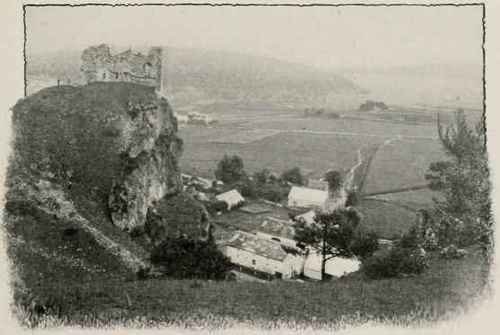
A Remnant Of Feudal Days.
We think our ways are better Than the cruel ways of old. Till we see that men now fetter Not with iron, but with gold;
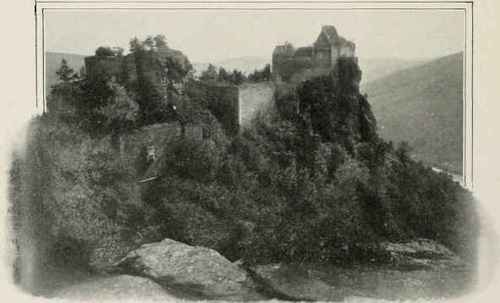
An Ancient Stronghold On The Danube.
Till - our consciences upbraiding -We perceive that ancient crimes Were in some ways less degrading Than the sins of modern times.
A great philosopher and thinker, at the close of his long life, wrote recently these words: "We are about to pass through evil days. Moral worth is depreciating. Self-sacrifice has almost disappeared".
In view of all the sickening revelations of rascality which have marked the opening of the present century, one feels that all the moral force remaining in society must speedily assert itself, or these prophetic words and gloomy apprehensions will be justified. But though the sun of humanity be temporarily clouded, our souls in their best moments cannot doubt that it will shine again, and that a day will come when, on the borders of the stream of time, the reputations of such plutocrats as have amassed their wealth by bribery, political corruption, and financial fraud shall lie as thoroughly demolished as these ruined castles, serving as warnings to all future navigators, and emblematic of an outgrown age.

From War To Peace.
In traveling down the Danube, should one pause to note attentively each interesting town and picturesque locality, a year would be required for the journey. But happily the art of sight-seeing, like that of living, consists in choosing wisely. For what indeed is life but the nice equipoise between selection and rejection? We can make no mistake, however, in halting at the first large city on the Danube's banks, - the ancient town of Ulm. Here the expanding stream, enlarged by the addition of the Blau and I IIer, first becomes navigable for small steamers; and stone inscriptions of the second century, discovered near this point, prove that the Romans recognized the increased depth and power of the Danube here, and worshiped its divinity. So many prominent routes converge at Ulm, that its position is considered of immense strategic value, and would undoubtedly in time of war serve as the base of operations for a German army in the rear of the Black Forest. So strongly also is it fortified that we may feel quite sure the world will never see repeated here the ignominious scene, when General Mack, in 1805, surrendered to Napoleon the citadel of Ulm, together with thirty thousand men, - the flower of the Austrian army. Napoleon had again employed the strategy of Marengo; only this time, instead of toiling over the Saint Bernard, to fall upon his unsuspecting enemies in Italy, he had with unexpected swiftness crossed the Rhine, and, sweeping southward to the Danube, cut off all the Austrian forces from Vienna. It was after the campaign which opened with this brilliant stroke at Ulm, and ended with the overwhelming victory at Austerlitz, that the Tsar Alexander said to his disheartened Austrian ally: "Truly in fighting with that man we are all children assailing a giant." The glory of Ulm is its cathedral, whose stately spire is discernible at a distance of some miles. Begun in 1377 and left unfinished during many generations, it was at last completed in 1890, and is, with the exception of the cathedral at Cologne, the largest Gothic church in Germany. Its principal, richly sculptured tower, which has a height of five hundred and twenty - eight feet, and therefore lacks but twenty - seven feet of rivaling the Washington Monument, is of course one of the loftiest structures in the world. Even the organ of this spacious minster, furnished with one hundred stops, outranks in size all others in the Fatherland. Yet quality has not here been sacrificed to quantity. There are few finer specimens of stonework in existence than are found in parts of its exterior; and its long rows of choir stalls, within, and their elaborate busts of sculptured oak, are in their way no less remarkable. The exquisitely carved ciborium, also, ninety-three feet high, shows what consummate skill, combined with love and patience, could achieve half a millennium ago. Yet, though originally designed to hold the Eucharist, this masterpiece is used no longer for that purpose, since the cathedral is at present in the hands of Protestants. I hope to be acquitted of intolerance if I say that such an edifice seems properly to belong to the old section of the Church which reared it. The age which planned its grand proportions, and raised its graceful shafts so fearlessly toward heaven, was one of spiritual aspiration and a simple faith, yet of a rich, imposing ceremonial. The men who filled these storied windows with their iris-ated glass, through which has streamed the garnered sunlight of five hundred years, were pious souls who questioned nothing, and rejoiced to symbolize in art the mysteries which they adored. Hence, any form of worship, other than the solemn pageants of those early days, appears un-suited to so grand a background. I chose to see it, therefore, when there was no service there, and I could study it merely as a work of art, - a mausoleum of departed ritual. Even as such, apart from all considerations of religion, it is a wonderfully impressive sanctuary. Its space and silence elevate the soul. So vast are its dimensions, that at times it seems almost a work of nature, rather than of man; and as the gaze ascends its clustered columns to the interlacing arches, well-nigh lost in gloom, one feels that the material is merging into the spiritual, and the sublimely finite mingling with the infinite.
Continue to:


My Books

