


Chapter XIV. Other American Furniture
Description
This section is from the book "The Practical Book Of Period Furniture", by Harold Donaldson Eberlein And Abbot McClure. Also available from Amazon: The Practical Book Of Period Furniture.
Chapter XIV. Other American Furniture
UNDER the general heading "Other American Furniture" are included all the sorts other than the local phase of the Empire style considered in the preceding chapter. Most of the "other American furniture," however, needs no special technical comment because everything in the foregoing pages specifically relative to English furniture applies equally to the furniture of the American Colonies. For this reason the term "Colonial Furniture," as it is ordinarily used, means nothing and is distinctly misleading and mischievous. William and Mary or Queen Anne furniture was just as much William and Mary or Queen Anne on one side of the Atlantic as on the other; so, also, was Chippendale (Key XVIII, 6; XIX, 2 and 4) or Adam, Hepplewhite or Sheraton (Key XIX, 6).
It must be remembered that a good deal of London-made furniture was fetched overseas and that it did not lose one jot of its distinctive character in the process of crossing. It must also be remembered - and this is quite as important - that there were in the Colonies many competent cabinet- and chair-makers, some of British birth and training but mostly American born, with a nice sense of proportion, who patterned their work accurately after the pieces sent from England. Sometimes, it is true, they omitted the more elaborate carved ornamentation, but with rare good judgment and artistic discrimination, they either carefully preserved identity of contour and proportion - would that all modern reproducers might be like minded! - or else made but slight variations that were absolutely true to the spirit of the original design. There were, to be sure, a few minor differences in detail or structure that occasionally appeared between British pieces and those made in the Colonies and, in one or two instances, the American makers developed new features, but these rare exceptions to a virtual identity of type have all been noted in the several chapters preceding.
Key Plate XVII. Other American Furniture - 1640-1800
Materials Oak, Walnut, Mahogany. Maple, Etc. See Text Pages 302-314

Fig. 1. Philadelphia Slat-back, C. 1710, Ball Turning, Ball Feet.

Fig. 2. New England Splat-Back, C. 1715, Vase and Ball Turning, Spanish Feet, Dutch Influence.

Fig. 3. Philadelphia Comb-back Windsor, C. 1740, Turned Legs and Stretchers.

Fig. 4. Philadelphia Mahogany Lowboy of Chippendale Pattern.
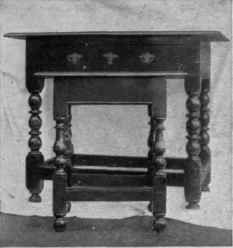
Fig. 5. Philadelphia Turned Walnut Table and Joint Stool, C. 1695, Ball and Vase Turning, Stuart Influence.

Fig. 6. Philadelphia Mahogany Highboy of Chippendale Pattern.

Fig. 7. Late Mahogany Ladder - back, Showing Sheraton Influence.

Fig. 8. Bonnet-Top NewEngland Highboy of Persisting Queen Anne Pattern. Cabriole Legs and Club Feet.
The later cabinet- and chair-work, particularly that executed in Philadelphia, quite equalled in workmanship and general excellence of proportion and grace of detail (Key XVIII, 6) the best that was done in England.
In addition to the general characteristics common to both British and American furniture, there are certain special points relative to furniture in the Colonies to which attention ought to be directed. For the sake of convenience and clearness these will be noted by geographical divisions, beginning with New England in the north and ending with the Southern Colonies.
We shall also note afterwards, in separate sections, several phases of American furniture - one of which may be properly termed "Colonial" - that are of local development and not to be classed with the period styles.
New England
New England furniture, for the most part, thanks to the thrifty character of the people, has generally been well preserved and in consequence there are still to be seen in good condition pieces dating from Jacobean times. The New England Jacobean furniture is usually of the simpler type that found favour during the Crom-wellian era, but there are enough of the more ornate pieces - chiefly court cupboards, settles and chests - to make a fairly representative showing. Generally speaking, the more ornate articles were brought from England. There were, however, some ambitious attempts on the part of local joiners and carvers that are by no means discreditable to their makers, although the execution is noticeably cruder than in the pieces brought out from England.
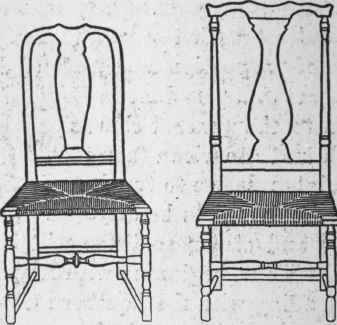
Fig. I. Two Early American Chairs Formerly the Property of James Pierpont, President of Yale College. Both Show Dutch Influence.
By Courtesy of Mrs. William Channing Russell, Philadelphia.
When we come to the William and Mary and Queen Anne furniture the workmanship is conspicuously better. Indeed, the New England joiners, cabinet-makers and chair-builders had become so proficient in their craft that the product of their shops rivalled the output of British makers in staunchness and accuracy of contour.
In nearly all of this furniture of early New England make there is an exquisite simplicity combined with fascinating grace of line giving it a permanent artistic value. The cabriole leg and cow, club, or hoof foot, characteristic of the Queen Anne period, were much favoured by New England cabinet-makers and their customers and continued to be made long after other mobiliary fashions had become well recognised. Indeed, it is no uncommon thing to find tables, lowboys, and highboys (Key XVIII, 8) with delicately proportioned cabriole legs of distinctly Queen Anne lines made well on towards the latter part of the eighteenth century.

PLATE XLIII. BLOCK FRONT MAHOGANY SECRETARY OR BUREAU BOOKCASE, AMERICAN, LATE EIGHTEENTH CENTURY.
By Courtesy of Richard A. Canfield, Esq., New York City.
This persistence of furniture types is very noticeable in other particulars as well and we discover it not only in New England but in other parts of the Colonies likewise. It is comparable to the conservatism that has perpetuated in America many old forms of speech, so that to-day really better and purer English is spoken in Philadelphia, Boston, Virginia, Maryland and parts of the Carolinas, Kentucky and Tennessee, than in London.
By the time that the Chippendale styles were established, so many New England families were in affluent circumstances that fairly elaborate pieces, as well as articles of plainer type, were found in large numbers. All of the Chippendale, Adam, Hepplewhite and Sheraton furniture of New England ownership or provenance comes well within the general types set forth in the foregoing chapters devoted to those mobiliary modes. One point must be especially noted, however, with reference to the material used, and this applies to all other American furniture also. During the troubles with the Mother Country a wood called bilsted 1 was very frequently used as a substitute for mahogany, against which there was a prejudice, inasmuch as it had to be imported from the British Colonies that remained loyal to the Crown. In appearance and general character it is very similar to mahogany, the distinguishing features being its slightly lighter colour and grain. When there was no mahogany in the cabinetmaker's stock of material on hand, and none elsewhere that he could readily come by, in those troublous times, he would fall back upon bilsted, and usually with such satisfactory results that it is now commonly mistaken for mahogany.
1. Bilsted or Blisted was a local name applied to the wood of the sweet gum or liquidambar tree.
Continue to:


My Books

