


Other American Furniture. Part 3
Description
This section is from the book "The Practical Book Of Period Furniture", by Harold Donaldson Eberlein And Abbot McClure. Also available from Amazon: The Practical Book Of Period Furniture.
Other American Furniture. Part 3
Virginia, Maryland And The Carolinas
If one were to search the Southern States over, it is more than probable that he would be rewarded by finding scarcely one piece of furniture of Jacobean date. That the early Virginians had Jacobean furniture, particularly state bedsteads, by which they set great store, we know from numerous old inventories of household goods. Likewise, a search for pieces of William and Mary date would prove almost as fruitless in results. A search for Queen Anne and early Georgian furniture would be somewhat more successful, but the results would probably not be commensurate with the expectations based on a knowledge of the culture and wealth existing in the Southern Colonies in the early eighteenth century. The explanation of this dearth of early pieces is to be found in the fact that when better furniture and furniture that was more in accord with prevailing styles was acquired, the earlier pieces were discarded and given to dependents and, we fear, sometimes broken up for kindling. The wealth of the South was to blame for this deplorable vandalism, as we must consider it.
There was no need for preserving the furniture, something more to the taste of the possessors had taken its place, so why keep it to clutter and cumber the attic or store-room? The early New Englander, with proverbial thrift, and dislike of wasting anything that might be turned to good account, saved all his old furniture and found some use for it, while the Virginian in the abundance of his prosperity parted with it without one qualm of regret.
Owing to the fact that nearly all the furniture of the South was either imported from England or made by the most modish cabinet-makers in Philadelphia, who closely followed English traditions, little or no furniture of purely local character was developed.
Wooden Furniture
Under this general heading must be included the plainer cottage, farmhouse or kitchen furniture that was to be found everywhere through the American Colonies. In New England we find a perpetuation of the banister-back chair and find it in far greater numbers than in England. The type seems to have thrived on American soil. It is not improbable that the banister-back chair of the latter part of the seventeenth century was first made a substitute for the more elegant and expensive caned-back.
In Pennsylvania, New Jersey, and New York the slat-backed chair (Key XVIII, 1; Fig. 4) with turned stretchers and sometimes turned legs enjoyed particular favour. The chair shown in one of the illustrations is supposed to have belonged to William Penn (Fig. 4) and is now preserved in the collection of the Pennsylvania Historical Society. It is quite certain that from the beginning of the eighteenth century onward this type of chair, arm (Fig. 4) or side (Key XVIII, 1) was in common use in the vast majority of houses. It was found even in the houses of the wealthy, and the more elegant furniture was reserved for the best rooms. The favourite form of turning was vase and ball (Key XVIII, 1; Fig. 4) and stretchers, legs, arm supports and the finials of back uprights were so adorned. The cross-slats of the back were plain and usually slightly bowed (Key XVIII, 1; Fig. 4) or arched on the top. This type flourished in New England as well as elsewhere.
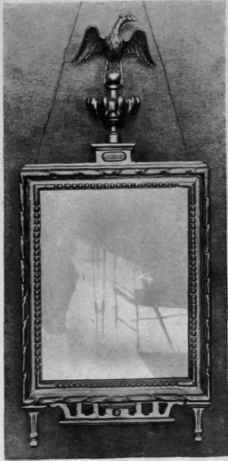
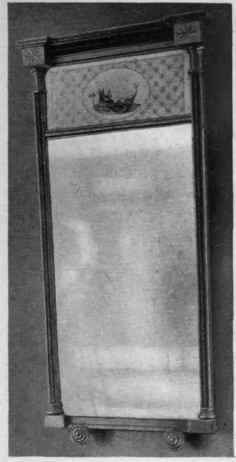
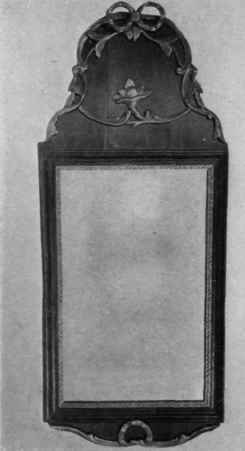
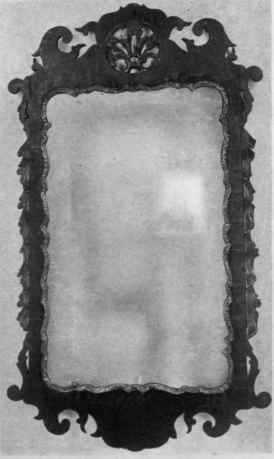
PLATE XLV. EIGHTEENTH CENTURY AMERICAN MIRRORS By Courtesy of Miss Mary H. Northend, Salem, Mass.
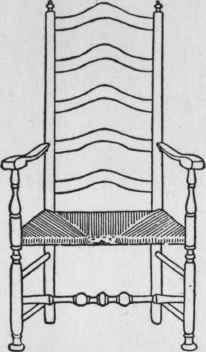
Fig. 4. William Penn Slat-Back, Rush-Bottom Chair. In Collection of Pennsylvania Historical Society.
Still another type of chair that received a special development all over America was the Windsor chair (Key XVIII, 3; Fig. 5) and many graceful varieties and shapes were evolved, including the bamboo turnings that came into vogue about the end of the seventeenth century. Windsor chairs of both the fan-or comb-backed (Key XVIII, 3; Fig. 5, B) and hooped-back (Fig. 5, A) type were in particular favour. Another type of plain wooden chair had a broad top rail which was tenoned into the uprights, and there were four or five spindles with widened panels in the back. Its first inspiration seems to have come from Holland. The settees of both this type and of Windsor affinities were often very graceful in shape and were of purely American development.
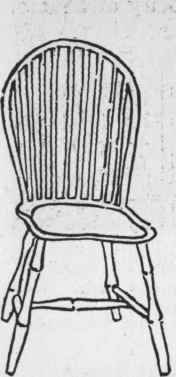
A
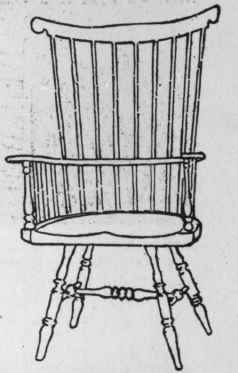
B
Fig. 5. A, Fan-back Windsor Chair; B, Comb-back Windsor Chair.
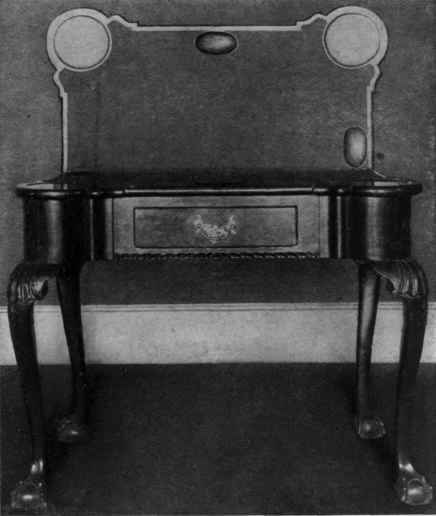
MAHOGANY CARD TABLE, DISHED CORNERS, MONEY WELLS, ROUND PROJECTING CORNERS.
Formerly the Property of the Honourable Jaaper Yeates, Justice of the Supreme Court of Pennsylvania.
By Courtesy of Jasper Yeates Brinton, Esq., Philadelphia.
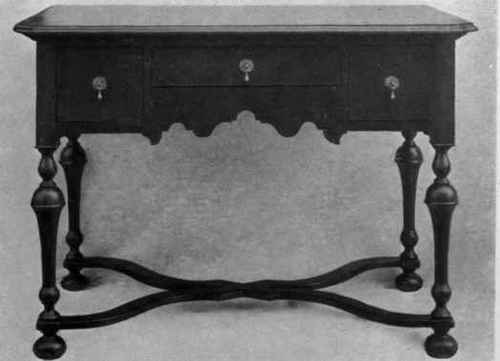
WALNUT WILLIAM AND MARY TABLE OF PHILADELPHIA MAKE. TRUMPET TURNED LEGS, BUN FEET.
By Courtesy of Mr. James Curran, Philadelphia.
PLATE XLVI.
Continue to:


My Books

