


Thomas Sheraton. 1750-1806. Part 4
Description
This section is from the book "The Practical Book Of Period Furniture", by Harold Donaldson Eberlein And Abbot McClure. Also available from Amazon: The Practical Book Of Period Furniture.
Thomas Sheraton. 1750-1806. Part 4
Chests Of Drawers
Chests of drawers were of two types, those made in one section with four or five drawers and used as dressing stands (Key XIV, 2) and those made in two sections which took the place of highboys. The upper section as in the Hepplewhite chests of similar type had two or three small drawers at the top. The cornice was embellished with characteristic Sheraton decorative motifs (Fig. 8, B, and Fig. 7). The mouldings were not bold but extremely refined (Key XIV, 5; Fig. 8, A and B; Fig. 7). Tops were both straight and surmounted with pediments of various descriptions (Fig. 7; Fig. 8; Plate XXXII, p. 240). The low chests were made both with the French foot (Key XIV, 2; Fig. 7) and swell (Key XIV, 2) fronts, quite similar to those of Hepplewhite pattern, or else with turned reeded legs which extended as pillars all the way to the top (Plate XXXI, p. 236). Some of the chest fronts were straight. The high chest fronts were habitually straight.
Cabinets And Cupboards
Three-cornered cupboards were of similar structure to those noted in earlier chapters. The tops were usually surmounted by swan-neck pediments, centred in graceful vase-shaped finials. China cabinets were made with glazed and traceried doors (Fig. 7) in the upper part and panelled doors in the lower. Some cabinets were supported on slender legs and had only the upper part arranged in cupboard form (Plate XXXIV, p. 248). Other cupboards were made with two doors in the upper section and two smaller doors in the lower section as shown in Plate XXXII, p. 240.


Detail of Cornice.
Fig. 7. Sheraton Cabinet with Characteristic Tracery in Doors.
Writing Furniture
The writing furniture of Sheraton design comprised all the types noted in the Hepplewhite chapter and also some additional types of ingenious contrivance. As most of these, however, were designed for special instances it will be unnecessary to notice any of them except the oval writing table which had cupboard doors around the ends and in the middle an open space to accommodate the legs of the sitter. The writing furniture of other types when it differed from that of Hepple-white make did so only in the matter of Sheraton types of finish and embellishment.
Bookcases
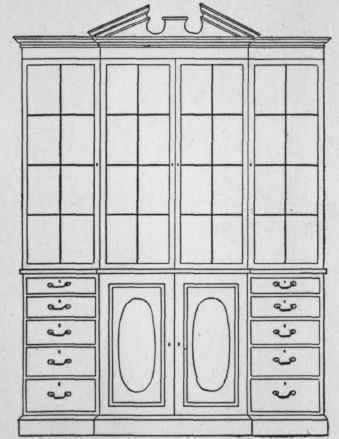
The bookcases of the Sheraton pattern, like those of Hepplewhite pattern, were of impressive design and finish. They were usually made with cupboard doors or drawers in the lower part (Fig. 8, A) and glazed traceried or square paned doors above (Fig. 8, A). The upper part generally receded several inches, allowing the lower part to stand forward as a substantial base. Some of these bookcases were of great length and were made in three sections (Fig. 8, A), the middle section projecting beyond the two side sections. The tops were almost invariably surmounted by gracefully proportioned pediments. Oftentimes the central section of these bookcases was fitted with writing accommodations. Occasionally the central sections had drawers in the lower part and the side sections cupboard doors. Then again there were other bureau bookcases with panelled doors in the upper portion and drawers in the lower section, the deep top drawer containing the writing accommodations, having a pull down front supported by quadrants (Plate XXXII, p. 240).
A
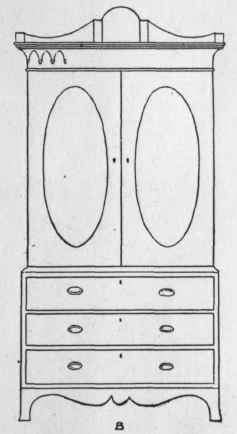
Fig. 8. A, Sheraton Three-sectional Bookcase. B, Sheraton Clothes Press or Wardrobe.
Continue to:


My Books

