


The Fifteenth Century. Part 3
Description
This section is from the book "French Furniture", by Andre Saglio. Also available from Amazon: French Furniture.
The Fifteenth Century. Part 3
We will not pause to describe the armoires, or wardrobes, which are, as a general rule, nothing more than a chest set upon a bench or two chests one on top of the other. From them we may, however, deduce the fact that the more valuable ones were decorated in the style alluded to above, whilst those intended for humbler purposes had no other embellishment than the iron bands or hinges, the chief purpose of which was to add to the strength of the chests. As very perfect examples of the latter we may quote those lining the walls of the Treasury of St. Germain l'Auxerrois at Paris.
The dresser was the most distinctive article of furniture in the houses of the nobility in the fifteenth century. "Mme. de Charolais," says a writer of the time, "only had four shelves to her dresser, whilst Mme. la Duchesse, her daughter, had five. . . . I have often heard it said," he adds, "that no princess, except the Queen of France, should have five shelves. The dressers of countesses should have three shelves, on which should be ranged dishes, pots, flagons, and large drinking-cups, whilst on the broadest part of the dresser there should be two large wax candles, to be lit when any one is in the room." For all that, however, the dresser is really only a gradual development of the primitive trestle on which chests used to be put down. The finest and most complete specimen we know of is that in the Basilewski Collection, bought by the Emperoi of Russia, and taken from Paris to St. Petersburg. It is surmounted by a rounded dais, which recalls that of the choir-stalls of a church. The carving, which is extremely delicate, includes representations of the Annunciation and Nativity, figures of saints and angels, and one of St. John the Evangelist, the last occupying a central position between the folding-doors of the armoire.
We could multiply and vary to any extent descriptions of such Gothic furniture, but to do so might lead the reader to lose sight of those general characteristics of mediaeval carpentry, the thorough recognition of which, in our opinion, is essential to forming a clear judgment on what at first sight appears to be the confused and complicated work of the artisans of the thirteenth, fourteenth, and fifteenth centuries.
Before passing, however, to the study of the Renaissance, we must note certain historic data which will enable us to grasp the intellectual transition from one period to another. In the sketch we have given of the fifteenth century, we have had to bear in mind the extraordinary combination it reflects of extreme misery and inordinate luxury, but for all that we must not pretend to ignore the undoubted progress made in intellectual culture, slow but sure, which places a gulf between the time of Charles VI. and Louis XII. Side by side with the beautiful and voluptuous Agnes Sorel rose up the heroic and simple-hearted Joan of Arc, who awakened amongst the masses of the people the ennobling idea of patriotism. After Charles VII., a mere shadow of a king, came Louis XI., a prince of iron hand, but acute intelligence, who subdued nobles, conquered provinces, and even introduced the principles of economy into the financial policy of the State.
The moral effect of this policy was incontestable, but at the same time it had a less immediate result upon the manners of the time than historians lead us to suppose. In this connection, also, the special annals of luxury to which we can only now devote a single chapter bring things out in their true proportions. Joan of Arc, simple peasant though she was, was so far imbued with the ideas of her time that she went to battle wearing over her armour a robe woven of gold thread. She was decked out in this style when she was taken prisoner, as is proved by the authentic records of her trial, and Louis XI., the bourgeois monarch of popular tradition - who is always, by the way, represented as an old man, who delighted in wearing a cheap fustian cassock, a rosary round his neck, and on his head a cap with leaden images of the saints round the brim - also had his times of indulgence in the extravagant luxury of a great noble. It would indeed be a great mistake to suppose that he limited the money he spent on furniture to having cages made in which to shut up his enemies.
It so happens that entries in the royal accounts reveal that he had a costly aviary set up in his room at Plessis les Tours, in which to keep the rare little birds that he was in the habit of buying by the dozen at a time, and for whose use he had gilded perches made; moreover, he spent a good deal on violet-powder to scent his clothes and rose-water to wash in, put round the neck of his greyhound that he called his cher ami a golden collar set with three big rubies and twenty pearls, bought many valuable clocks, games of billiards, and numerous pieces of furniture from the carpenter Jacques Cadot, also pleasure-galleys for boating on the Loire and the Seine, with regular houses on board with glass windows, etc. Do not all these domestic details, too much despised by historians, give an altogether new idea of the great King? Was this Louis XI. in his perfumed robes, walking about with a greyhound decked out like a grand lady, so very unlike in his ways and ideas to the lavishly extravagant vassals whose ruin he was so anxious to bring about? This is the point at which we have been arriving.
Nothing throughout the whole course of the fifteenth century, not even the political wisdom of the conqueror of Charles the Rash, succeeded in even temporarily checking the inordinate love of luxury that prevailed in France. Charles VIII. must therefore not be too severely judged for a pomp that he did not inaugurate, but merely kept up according to the usual custom of princes, and with the approbation of a section at least of his subjects. No doubt the first expedition he led to Italy that had such disastrous results, was an act of policy quite unworthy of the lessons bequeathed to him by his father. For all that, however, it is very certain that had Louis XI. himself been drawn into such a war in the land of art, he would, like his son, have been unable to resist the temptation of bringing back in his train, together with a booty of masterpieces, some of those artists who were true experts in magnificence, with the result that the Renaissance would have been dated from his reign.
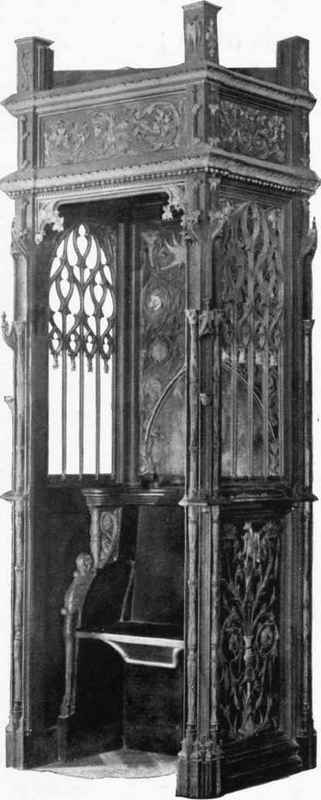
Plate III. STALL. End of XV Century. Paris Exhibition, 1900.
Continue to:


My Books

