


The Fifteenth Century. Part 2
Description
This section is from the book "French Furniture", by Andre Saglio. Also available from Amazon: French Furniture.
The Fifteenth Century. Part 2
Fresh acquisitions were constantly made: dressers and benches for Antony of Burgundy, known as le Grand Batard; a wooden chest with iron clamps for the reception of gifts of visitors to meet the expenses of an expedition against the infidels of Constantinople; endless descriptions of jewels, paintings, manuscripts, and costly garments are, as it were, sprung upon the student of these wonderful archives.
John Duke of Berri at his Court at Bourges vied in splendour with his powerful brother, Philip the Bold; the Dukes of Orleans, waiting their turn to reign, constantly enriched their chateau of Blois; the Kings of France dissipated their resources betimes, for the treasury was often at a terribly low ebb in the century which witnessed the replacing of Charles the Mad by Charles VII, most effeminate and most lax in principle of any of the French princes; the Cabochiens, named after their leader, the butcher, Caboche, were masters of Paris whilst the English were masters of France. Lastly, and above all, all classes of society, were permeated by deep and widespread demoralisation - a demoralisation that did not check luxury, but imbued the people with a distaste for work and for thrift, which are the very foundations of prosperity. The great nobles went forth, to quote the words of a contemporary historian, Bishop Jacques of Vitry, like birds of prey to plunder the churches and to assassinate the plebeians who were guilty of letting their wealth become known.
This contempt of right in high places lent sanction to all manner of popular excesses, and many must have been reminded of the Republic of Florence, for the statutes of the new State, drawn up by the victorious burghers, declared that it owed its greatness pro homicidio, pro furto, pro incesto, and also of their kindred spirits of England, Jack Straw and John Ball, who said to the mob, "Good people, things will never go well in England so long as goods be not in common, and as long as there be villeins and gentlemen."
Meanwhile the people imitated the luxury of their oppressors with an eager zeal - which led to an attempt, unsuccessful of course, to check that zeal by sumptuary laws. Even during those terrible years of excessive mortality when, as a contemporary wrote in his journal, wolves scoured the country and even ventured at night into the streets of Paris to carry off dead bodies, the common people continued to indulge in wearing costly and luxurious clothes - from which it is natural to conclude that they showed no more discretion in the embellishment of their houses. Unfortunately, actual evidence of this is wanting; or, to speak more correctly, it is all but impossible to prove that this or that piece of furniture which has been preserved in some museum or private collection belonged originally to the household of a burgher, a noble, or an ecclesiastic. This doubt assails us, for instance, in examining the charming table in the Bardac collection, consisting of simple planks set on trestles, the only ornament a little purling, a perfect marvel of combined lightness and strength.
Other examples that have come down to us are the set of panels known under the name of the Lit de Justice of the Chateau of Argentelles, which now belong to M. Edmond Foule, and appear to have originally formed part of an alcove of that Norman castle. If this be a true attribution - and the most expert judges think that it is - this Lit de Justice proves how very ornate the interiors of private houses were. The so-called bed consists of a square canopy, on three sides of which is a double frieze of carvings with floral motives and arcades in the flamboyant style, further enriched with campaniles, pendentives, and figures of children balancing themselves in the air, whilst below an angel with folded wings holds a shield bearing a coat of arms. The panels surmounted by the dais are adorned with fleurs-de-lys and Gothic ornaments, and the whole structure rises from two steps. All that is needed to form just such a corner of a room as is represented in the miniatures of many old manuscripts is the actual bed with its velvet or tapestry curtains.
The arm-chairs, or thrones, that we are able to cite as examples of skilful carpentry are all of a princely character, such as those in the Cluny Museum bearing the arms of France, or the combined arms of France and Brittany. The most remarkable dates from quite the end of the Gothic period: the back is finished off at the top by a frieze of open-worked vine foliage, and eagles with drooping wings, in the centre, beneath an arch, stand two angels in long robes holding the royal shield surmounted by what is known as a couronne ouverte, or a crown consisting of a simple fillet. A large number of authentic and uninjured coffers have come down to us. In quite humble collections specimens of a character so simple were to be found as to lend probability to the theory of their plebeian origin. They are nearly all put together in much the same way. The front is divided into a series of little arcades, subdivided in their turn by curves and semi-curves imitated from monumental architecture; the spaces between are often filled in with carved rose-tracery or other floral designs, occasionally with the figures of children.
A fine example is the chest in the Cluny Museum from the Abbey of Val Saint Benoit (Saone et Loire); and another typical specimen is one in the Tours Museum, in which the principal panel is divided into rectangular spaces ornamented with a lozenge moulding, each lozenge containing rose-tracery - a motive often also met with on doors. Lastly, though more rarely than the ornaments just described, a series of Gothic arcades is sometimes met with, in each of which is introduced a kneeling figure. It is also worthy of note that the smaller side-panels of chests are generally decorated with the simple but effective linen-fold design, that is not unlike an open book, or, which is perhaps a better comparison, a parchment rolled up at each end.

Frontispiece. CUPBOARD. XVI Century. School of Du Cerceau. Cluny Museum.
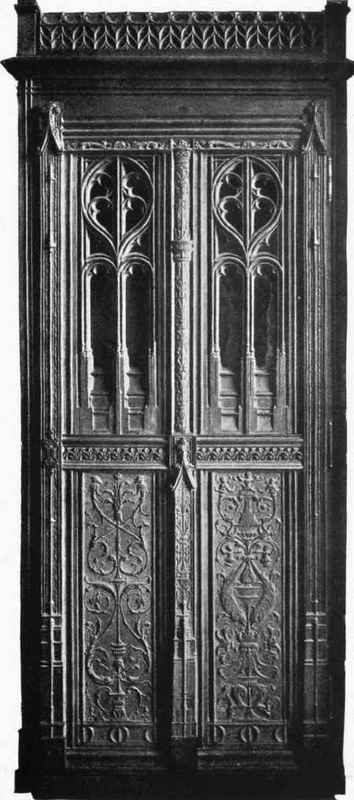
Plate II. CUPBOARD. End of XV Century. Louvre Museum.
Continue to:


My Books

