


The Renaissance
Description
This section is from the book "French Furniture", by Andre Saglio. Also available from Amazon: French Furniture.
The Renaissance

IT is very much the fashion nowadays to deplore the fact that Charles VIII., previously imbued with the Romanesque spirit, should have been so excited by the perusal of the "Rosier des Guerres" as to provoke in 1494 the conflict between the French and the Italians which could but be the death-blow to the highest expression of French genius: Gothic art. This judgment, however, really proves a very superficial knowledge of facts. The Gothic art that gave birth to such splendid buildings as the cathedrals of Chartres, Notre Dame of Paris, Rheims, and Amiens was the result of a fervent faith which could not long be maintained at its original intensity, and had indeed already begun to decline at the end of the thirteenth century. The growing intricacy of the works we have been studying in chronological order, the decline in good taste everywhere noticeable, prove all too surely that at the date to which we have now come Gothic art was dying of natural causes; dying because it no longer had in itself the vital sap which was the essential principle of its life, so that it resembled a fruit-tree that is no longer pruned, the supports of which have given way, and which must eventually succumb beneath the weight of redundant foliage and sterile blossom.
Weary of exercising their skill on lines of architecture that never varied, artists and artisans were ready to accept any innovation, no matter what its source. At the Court of Burgundy, for instance, as we have seen, the Flemings who brought with them nothing novel but certain mannerisms of their own, readily found pupils; whilst in the South, Italian ideas early filtered across the boundary, and King Rene sent from beyond the Alps for such artists as Laurana and Pietro da Milano to enrich his capital of Aix.
To resume:-The Renaissance originated in France at the favourable moment for the rapid adoption of decorative motives founded on antique Latin models, that had already been freely drawn upon for some hundred years by Italian artists: decorative motives only, be it observed, for no new form of domestic furniture was introduced until a long time afterwards, everything of that kind still re-mainingwhat it was whensudden and frequent removals were the rule. ) Moreover, French cabinet-makers never gave up the carving in relief of which they were such thorough masters, for the less familiar processes of painting on panels, nor did they adopt the use of coloured marqueterie, or of paste mouldings, in the style to which the names of tarsia, intarsia pittoric, and certosina were given in Italy.

Plate IV. RENAISSANCE ARMCHAIR. Louvre Museum.
Sudden as was the invasion of France by Italian design, it is doubtful whether the change was really effected all at once. As already stated, some works have been preserved in the purest Gothic style, that date from the first quarter of the sixteenth century, most of them in churches, for which the supple Florentine line did not appear sufficiently dignified to the artists who designed them and who were attached to old traditions. Leaving them aside, we will first study the examples in which the old and new styles jostle each other, and then those in which the pointed arch has completely disappeared, giving place to a purely Italian motive.
What may be called a classic type of the marriage of the two styles - which we must quote as a masterpiece of wood carving, though it leads us somewhat away from our subject - is the door of the church of Saint Sauveur at Aix in Provence, which dates from 1504, and on which, though the whole is evidently the work of one hand, niches with pointed arches in which stand the figures of prophets are separated by pilasters decorated with arabesques and the animals that symbolise the Evangelists. The two styles are naively used side by side, the artist having made no attempt to unite them by any transitional features, and the effect of the whole is charming. The same combination is met with in a pulpit of the church of Beaulieu les Loches, in which panels in the flamboyant Gothic and Italian styles alternate with each other. This little masterpiece was no doubt produced in the brilliant workshops on the Loire, whose talented owners were the first to learn the technical secrets of the craftsmen brought back with him from Italy by the victor of Fornova to his favourite Chateau of Amboise, and to win fresh inspiration from the works of art that formed part of the spoil he amassed in it.
It is probable that the new arrivals themselves at first worked in the princely mansions of France, as was the custom in their own country, side by side with the carpenters of Amboise and Tours, who in 1493 received from the King a commission for a large number of benches, trestle-tables, dressers, wooden bedsteads and wooden chairs, to be covered with red leather. In any case the lessons the foreigners taught were very quickly learnt, for not a single Italian name occurs amongst those of the twenty-one cabinet-makers who a few years later executed by order of the noble Archbishop of Rouen, George of Amboise, and his nephew, the wood-work of the famous Chateau of Gaillon. Not a single piece of furniture that belonged to that residence has been preserved but a few wainscot panels now at Cluny and in the Abbey of St. Denis, the beauty of which would have been quite enough to prove what the grandeur of the whole work must have been, even if the accounts of the payments made for it were not accessible.
Although of exclusively French manufacture, they are good examples of the blending of the Gothic and Italian styles.
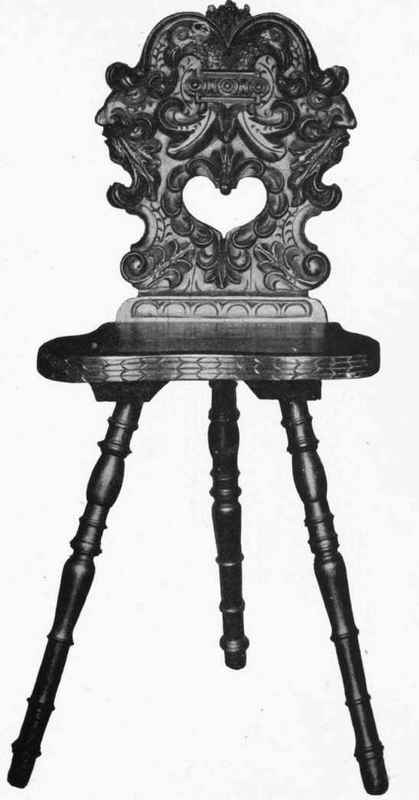
Plate V. RENAISSANCE CHAIR. Palace of Compiegne.

Plate VI. RENAISSANCE CHAIR. Palace of Compiegne.
Continue to:


My Books

