


Chapter VIII. Benches-And Other Things
Description
This section is from the book "It's Fun To Build Things", by W. T. R. Price. Also available from Amazon: It's Fun To Build Things.
Chapter VIII. Benches-And Other Things
For the making of anything in the nature of benches, which need to be strong, it's best to use 1" lumber, or 11/2 ",if you can stand the cost. Heavier lumber not only looks better in furniture, but nails up so that all the joints are stronger. Making benches with legs isn't to be recommended highly to the amateur, because without cabinet-making tools and cabinet-making skills, it is difficult to achieve the necessary strength. Benches which collapse when anyone sits on them seem to constitute an unnecessarily expensive practical joke.
Here is a simple type of bench, shown in a dimensioned drawing, and of such obvious construction as to need little explanation. It's better to use long wood-screws in this sort of thing, because they do not work loose as nails are almost certain to do, particularly in such a place as the ends of the stretcher. At such points there is the greatest strain on your construction.
A very good construction, and one of the strongest for such a point is the ancient medieval tenon- and - dowel. True, it needs a little care to make, but not more than you ought to be willing to admit being capable of.
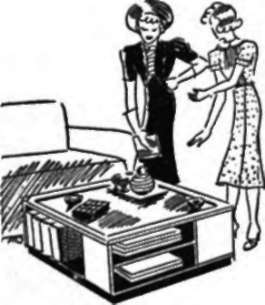
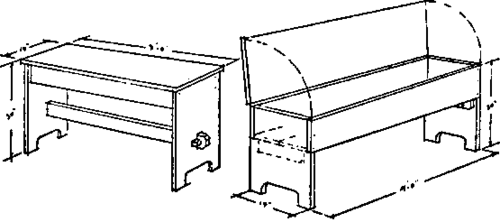
A very simple bench, and one that's also a chest.
Directions: It might be well to first cut the mortice in the upright, doing this either entirely with a chisel and hammer, or with a combination of augur-hole, compass saw and chisel. In any case it needs to be cut true and clean, and in exactly the same position on both uprights. Next mark off the brace, or shelf (whichever you are using in your design), and cut the tenon, or tongue to a dimension which will exactly fit the mortice. The end of the tenon may be left square (sandpapered smooth, of course), or you may cut off the corners. The hole in the tenon needs careful work with the chisel, and should be cut longer than the middle thickness of the peg, as shown at "A." When it has been made, the wedge-shaped pin, or dowel can be dimensioned, so that its thickness at the center will equal the depth of the hole cut in the tenon.
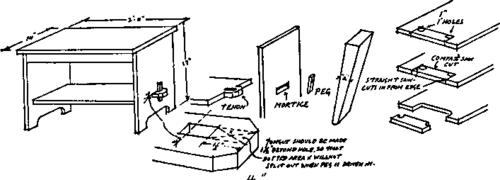
Showing the medieval construction with tenon and dowel.
This tenon-and-dowel construction is as ancient as the Middle Ages, and perhaps even older, but it is just as effective now as it was when the ingenuity of man first figured it out. It was dear to the heart of the designer of Mission furniture, and, as you can see, is eminently practical, even without being tightened up with glue. The mere driving in of the wedge, or dowel-pin, pulls the sides of a bench or table or set of shelves tightly together. Needless to say, if the dowel-pin is driven in violently, you will split the end of the tenon, even though it is held together by the sides of the mortice. A wedge will split almost anything, if you drive it in hard enough.
There are plenty of types of simple benches that can be easily made, such as the long bench shown, with a locker formed by a hinged lid. Or you could build drawers instead of a locker. Or merely a shallow shelf for newspapers and magazines. Benches are handy and useful, not only as extra seating furniture, but also as an extra cocktail or coffee table.
As cocktail or coffee tables do not need to be as strongly built as benches, they offer a wide-open opportunity to anyone who has fallen for the fun of building things. Not that you want either a cocktail or coffee table to fold up in pieces on the floor while you are entertaining (or, for that matter, at any other time).
This well-nigh indispensable piece of furniture may (and often does) also combine the function of a magazine stand, and may be built in styles closely resembling the bench illustrated. But more likely you will want to go modern on the cocktail table, in which case, here are a few designs.
The set-in base is to be recommended, as it does away with the necessity, or at least the desirable technique of mitering the corners. It is simply a frame, nailed together with countersunk finishing nails. In this sort of work, needless to say, all nails should be finishing nails, countersunk, and the holes filled with plastic wood and sandpapered.
The two vertical strips are a simple modern decorative device, offering an opportunity for a contrasting accent of color. They may be cut from 1"x1" surfaced No. 1 grade stock, or, in a larger piece, 11/2"sticks.
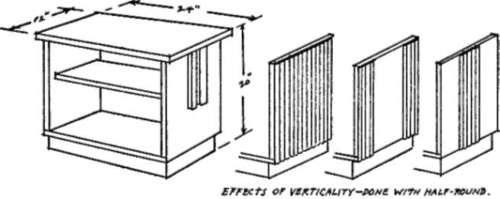
A coffee or cocktail table susceptible to many variations.
Another decorative effect, and a good one where you want to emphasize verticality, or relieve the severity of a surface, is had by cutting up 1/2" or half-round molding and nailing it edge-to-edge, with fine finishing nails. You may use it over an entire surface, or as a vertical strip, or to simulate legs at the corners of a piece.
Now for a trick addition to the cocktail or coffee table-the use of blue, amber or clear plate-glass mirror for the top. You can get this cut to any size, wherever there is a modern glass shop.
The main point is-get it cut and have it on hand before you start to make the table top. Otherwise you are taking a long chance on having it fit, no matter how insistent you may be on having it cut a certain size. Better to fit to it than to hope it will fit your construction-because 1/16" too short, and you have an unsightly crack.
Continue to:


My Books

