


Benches-And Other Things. Part 2
Description
This section is from the book "It's Fun To Build Things", by W. T. R. Price. Also available from Amazon: It's Fun To Build Things.
Benches-And Other Things. Part 2
A mirror top cocktail table, and technique thereof.
Plate mirror, or clear plate glass (under which you could put a fabric or a map or anything else you fancied)-1/8 thick, is surprisingly strong-yet it is wiser to give it some sound support underneath.
You want the surface of the glass and the top surface of its wood frame to be perfectly flush. There is a simple way of doing this. The frame should have mitered corners, as shown, for which a 45° celluloid triangle is used to mark the cuts-and you need to make the cuts with very true vertical edges, or you will get gaping corners, which would be more than distressing. It just wouldn't do.
After carefully nailing the corners of the frame-and here the addition of glue would be a good idea-lay it on the floor, face down. We are assuming that you have made it to exactly fit around your cut piece of mirror or plate glass-and that it does exactly fit. Cut thin strips of felt and press them against the back of the glass by nailing in a narrow quarter-round molding or square stick to form a level all-around rest for the glass. The corners of the quarterround or of the stick should be mitered around the corners if you want a workmanlike job. Or they could be cut off square, just short of the corners, as they will not show.

Now turning the whole thing right-side up, the glass will be found to rest securely on the quarter round rests, cushioned by the felt strips to take up any of the inevitable inequalities.
The glass, to be sure, is not fastened in-but perhaps it is better that it isn't. It will stay in place of itself, and by carefully tilting the table over on its side, you can take the glass out for cleaning, or for replacement, if you might be sufficiently absent-minded or whimsical as to set something very hot on it and crack it.
This technique for making a glass top is simple enough to do, and answers for any such use of mirror or plate glass you may want to make. If a map or fabric is being put under plate glass, support it with a square of masonite cut to fit, using a square of felt over the whole area to press the print or fabric up uniformly under the glass.

A large and ambitious cocktail table.
Here, for instance, is a pretty effective modern piece that has many uses when it is placed before a davenport, with low easy chairs right and left.
After a good look at the drawing you wouldn't need to be insulted by being told how to make this handsome looking number. It explains itself. If you don't care for mirror or plate glass, just a piece of masonite, carefully fitted, makes a good-looking and serviceable top. The whole thing takes on an air definitely Chinese if it is finished in red lacquer, or with a red lacquer base, and top frame, with the middle part done in ivory.

Three Chinese-looking stands for aquaria.
While we are on the "Chinese manner," there are several simple bits of carpentering that will greatly enhance the appearance of one of those oblong, plain glass aquaria. (If you don't like goldfish, or other finny pets, and therefore haven't got an aquarium, you can skip this one.)
The idea is to make such a stand very smoothly, with plenty of sandpapering and several coats of red lacquer to cover the construction, all nail-holes having been neatly filled with plastic wood so that the finished creation will look as though it had been cut from one solid piece of wood.
In many places a small, shallow wall-stand is just the thing you want to fill a wall-space too narrow for most pieces of furniture. Such a piece is simplicity itself to make, and in red lacquer it could give a note of color to some dull spot. The back, of course, should be of masonite or plywood to stiffen the whole thing. (See the design on page 89.)
In a studio you very often feel the need of a piece of furniture that would decently hide from sight the large pieces of illustration board, paper and such, or large portfolios. The front panel could be decorated, or treated with a decorative map, shellacked and varnished.
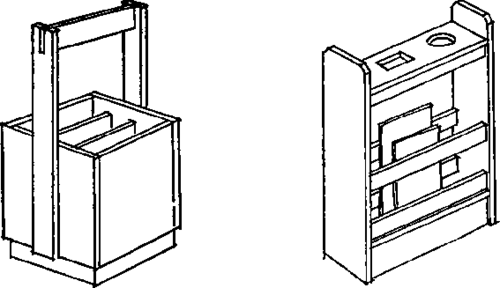
Two magazine racks-one of which also takes care of ash-tray and cigarettes.
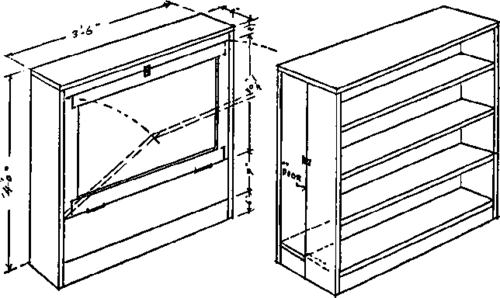
Two pieces designed for the studio, with storage space for large portfolios and drawings.
Such a piece is easily enough made, as also a trick bookcase, with enough depth to allow for a tall, narrow compartment behind the books, closed with a narrow door. This design can be built double, with the other door coming from the right instead of the left, or, rather better, as two uniform units, their only difference being the right and left positions of the doors.
This would hold plenty of books, as well as a lot of otherwise awkward flat stuff, but as it would also be a fairly important piece of furniture, the builder should nerve himself up to the point of spending the necessary money for a wide top board. All the rest of it could be built of 8" or 9" wide No. 1 grade clear lumber-cypress or white pine, according to whether you wanted to stain it or paint or lacquer it.
Returning again to small items-magazine stands and wastebaskets are easily made, though the latter are so inexpensively had ready-made that there seems little point in building one unless it is to be different and distinctive.
Magazine racks are easy enough to build, in many variations of the type sketched, and need to be cleverly colored or decorated to be worth doing at all.
Continue to:


My Books

