


Genoa. Part 7
Description
This section is from the book "Genoa - John L. Stoddard's Lectures", by John L. Stoddard. Also available from Amazon: John L. Stoddard's Lectures 13 Volume Set.
Genoa. Part 7
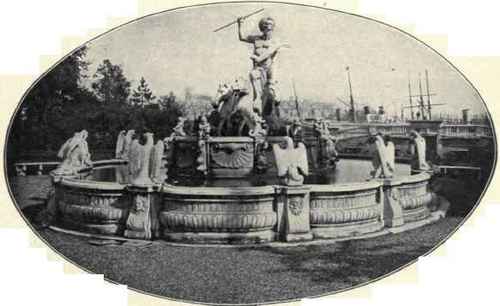
Statue Of Andrea Doria As Neptune, Palazzo Doria.
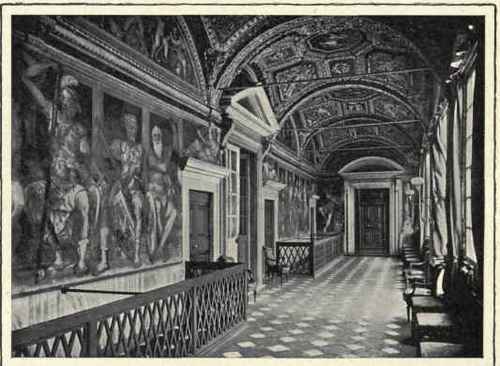
Vestibule Of The Palazzo Dor1a.
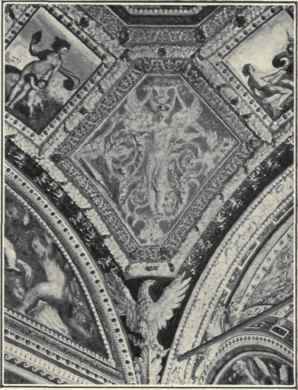
A Ceiling In The Palazzo Doria.
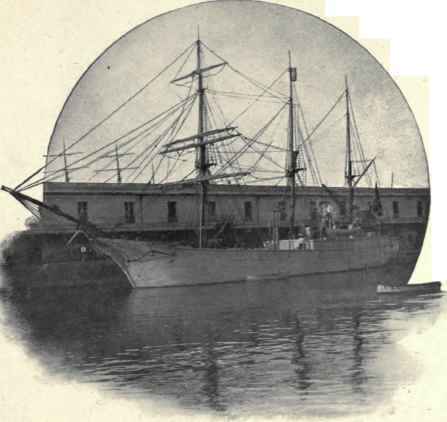
The Darsena, Where Fiesco Was Drowned.
Thenceforth, in fact, his government was undisturbed, and he died finally, loved, honored, and revered, at the age of ninety-two. His tomb is, as it should be, in the crypt of the old church of San Matteo, directly opposite that early home of his, bestowed upon him by his countrymen. Above this in the church itself, and over its high altar - strange ornament for such a place - still hangs the sword presented to him by Pope Paul III. in 1535. What most impressed me here, however, were two ruined statues of heroic size, now lying in the cloisters of the church. They represented once the famous Andrea and his ill-fated nephew, Gianettino; and, till the out break of the French Revolution here, both figures stood on lofty pedestals before the Ducal Palace. But they were then pulled down and broken by the populace, and now the mutilated torsos stand on columns at whose bases lie their heads, hands, feet, and fragments of their legs grotesquely heaped together. So weird and awful are their faces, looking up from this debris, as if protesting at the outrage, that one inevitably asks why no one has attempted to restore these statues. It seemed to me that I was looking at the evidence of a dreadful crime, and had to reassure myself by recollecting that in reality both these Dorias repose in honored graves.
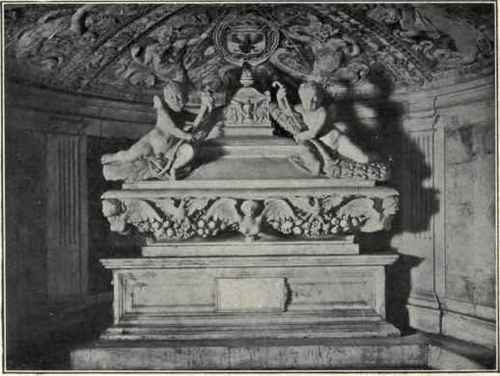
Tomb Of Andrea Doria.
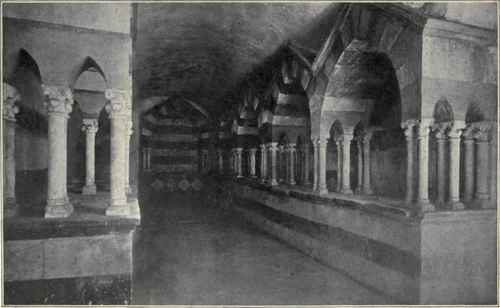
Tombs Of The Dorias, Portofino, Near Genoa.
Genoa's wellknown title, "La Superba," is not wholly due to her palatial residences. It may have been bestowed upon her also from her proudly dominant situation, which no one who has gazed upon it from the sea can possibly forget. No other urban gem in Italy, save Naples, has so glorious a setting. Her splendid semicircle of protecting mountains, crowned by frowning fortresses, is complemented by the ample curve of her majestic bay; and in the intervening space, between the noisy strand and tranquil mountain side, a multitude of stately edifices, terrace upon terrace, lift themselves in grandeur toward a radiant sky. These residential heights are usually reached by an electric railway or by modern streets, which make the ascent in sweeping serpentines. But such a situation necessarily called into existence long ago innumerable "short cuts" of communication. Hence up and down the slopes of Genoa wind steep, contracted flights of stairs, where donkeys are the only quadrupeds, and few adventurous tourists care to stroll. The dwellers on these Genoese hills might justly look upon themselves as well-trained alpinists, since climbing has become for them a second nature. Even their houses are enormous about the bases of the ancient palaces, they seem so cool, so quiet, and so lonely, contrasted with the sunny and uproarious squares, that they remind one vaguely of the small canals of Venice. From many windows of these houses lovers could reach across the yawning gulf dividing them, and test the value of the proverb, "Take hands, and you part with laughter; Touch lips, and you part with tears".
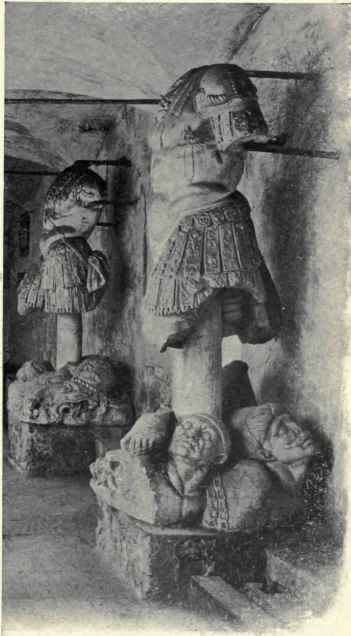
Ruined Statues Of The Dorias, Cloister Of San Matteo.

Genoa, La Superba.

In Genoa's Labyrinth Of Lanes.
Only a vertical sun can gild the pavement of these Genoese canyons, and even that illumination is made rarer by the articles of clothing hung across them,
"Thick as autumnal leaves that strow the brooks In Vallombrosa".
Despite their gloom, however, these alleys are not generally dirty or pestiferous. Nay, on a summer afternoon their twilight and tranquillity are refreshing; and there are many less agreeable occupations in the world than that of strolling at one's leisure through this labyrinth of lanes, pausing to notice here and there a once majestic doorway, or a bit of mediaeval carving, or to reflect upon the time when through these streets the gilded sedan chairs of Genoese nobility, preceded by their torch-bearers, were wont to glide by like terrestrial gondolas. For here are many sombre palaces, which once were the abodes of merchant princes, but now stand half apologetically in the dimness of these shabby passageways, like fallen members of old, aristocratic families, still lingering in the shadow of forgetful patrons, and clinging to the outskirts of gentility. Dilapidated though they are, they still possess a certain dignity and air of better days, which call to mind the saying of the French King Louis XII., that even the houses of the Genoese were more luxurious than his royal palace.
Continue to:


My Books

