


Genoa. Part 5
Description
This section is from the book "Genoa - John L. Stoddard's Lectures", by John L. Stoddard. Also available from Amazon: John L. Stoddard's Lectures 13 Volume Set.
Genoa. Part 5

Mosaic Portrait Of Marco Polo, Municipal Palace.
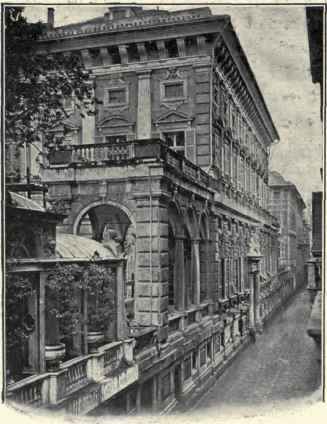
Exterior Of The Municipal Palace.
For him that precious frame possessed a personality and character, if not an actual intelligence, and he was sufficiently loyal to the loved companion of his triumphs to make special mention of it to the world. As a performer, Paganini probably never has been equaled. Rossini said of him, "I have wept only thrice in my life; the first time when my earliest opera failed completely; . . .; the third when I first listened to Paganini;" and Meyerbeer expressed himself as follows, "Imagine the most astonishing effects that it is possible to produce on the violin, and Paganini even then will go beyond your highest expectations." Indeed, so superhuman seemed his execution, especially when using the fourth string alone, that he was thought by many to be the offspring of the devil. Some went so far as to detect a fancied similarity in his countenance to that of Satan, and after one performance, a Viennese amateur declared that he had seen the devil standing at his side and aiding him! Accordingly, in many of the cities which he visited, he hardly dared to show himself in the streets, since his appearance always gathered round him curious and excited crowds. Among the less supernatural stories current in regard to him was one to the effect that he had been a political prisoner for twenty years, during which time he had played continually on an old, discarded violin with but one string, thereby acquiring his marvelous dexterity. There was no truth in this romantic legend, for Paganini, born in Genoa, in 1784, of musical parents, had played the violin remarkably from childhood, and as a youth was wont to practice intricate passages for ten consecutive hours. He also was the author of music for the violin so difficult that no one but himself could play it. And yet behind his wonderful technique, and even his instrument, however admirably made, was Paganini's personality. This must have been surcharged with magnetism. For the first drawing of his bow across the strings is said to have sent a strange thrill through his auditors, which held them spellbound to the end. Here, then, is actually the fragile form from which he drew that pathos, tenderness, and passion, which made both men and women weep, at hearing music that seemed supernatural! What scenes of public triumph and of private sorrow in the master's life could not this violin describe, had it but voice and language! How often has his cheek pressed lovingly against its throbbing breast! How often have his fingers run with almost inconceivable celerity along its slender threads of tone! But now a silence, as of death, pervades it. Under another's touch would it, and could it, throb and pulsate as of yore ? The skillful hand of the magician has been turned to dust, and his strange, restless spirit has departed from its earthly incarnation. May we not hope that also from his treasured violin, confined thus in its crystal sepulchre, the spirit he evoked from it has passed into another form, to gladden other lives?
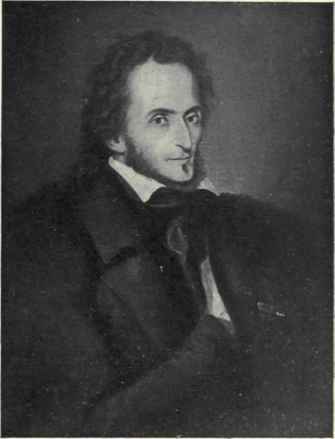
Portrait Of Paganini, Genoa.
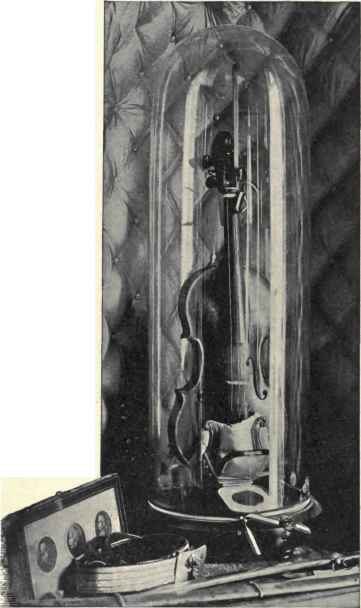
Paganini's violin, municipal palace.
Perhaps the most interesting spot in Genoa is the small Piazza of San Matteo. I do not know in any city a square that speaks so eloquently of a single family. It is almost entirely surrounded by the former palaces of the Dorias, who were to Genoa what the Scipios were to ancient Rome, and whose astonishing history is largely that of Genoa itself. Among these residences also stands the little church of San Matteo, founded by members of the Dorian family in 1125, and subsequently rebuilt and adorned by their successors. On its façade one sees a number of inscriptions proudly placed there many centuries ago, to testify to the devotion of the Dorias to their native land. All who were honored thus were famous naval captains, who were not satisfied to shine at home in showy uniforms, but took an active part in hand-to-hand combats with redoubtable enemies, and came off victorious. Thus, in 1284, it was Oberto Doria who gained the celebrated victory over Pisa, in which he sank seven Pisan galleys, captured thirty-three, and brought home more than seven thousand prisoners. In 1290 Conrad Doria, commander of a second Genoese fleet, inflicted another crushing blow to the same enemy by breaking through the chain with which the Pisans closed the mouth of the Arno, and utterly destroying Pisa's port and fortifications. A few years later, Lamba Doria, with a fleet of seventy-two, completely routed in the Adriatic eighty-four Venetian galleys, of which he burned no less than sixty-six, and brought back eighteen to his native city. Among the prisoners taken by him in this battle was the traveler, Marco Polo. But this does not exhaust the list. Pagano Doria in 1353, and Lucian Doria in 1379, both gained remarkable triumphs over the Venetians, fully as advantageous and creditable to the Genoese as any of their predecessors; while even more renowned and capable than all the other members of this famous house was Andrea Doria, whose brilliant victories over the dreaded Turks and Barbary pirates gave him the rank and reputation of the greatest admiral of his time. Moreover, for having driven out of Genoa, in 1528, the hated French, his grateful countrymen presented him with a handsome palace in this same piazza, opposite the historic sanctuary of his ancestors. Of all the Genoese palaces, therefore, none so appealed to me as this. Above the door of the once noble structure we still can read the inscription stating that the Senate of the Republic gave this edifice to Andrea Doria, as the "Liberator of his Country," - a title which has ever since adhered to him, so that his name retains in Genoese history about the same distinguished rank as that of Washington in ours. Endowed with this prestige and as commander of the navy, he could have easily made himself the sovereign of the State. But, far from doing so, he summoned an assembly of the people in this Piazza, disclaimed all right to such supremacy, and urged them to decide among themselves what form of government they preferred, and to elect impartially the man they wished to rule them.
Continue to:


My Books

