


Genoa. Part 4
Description
This section is from the book "Genoa - John L. Stoddard's Lectures", by John L. Stoddard. Also available from Amazon: John L. Stoddard's Lectures 13 Volume Set.
Genoa. Part 4
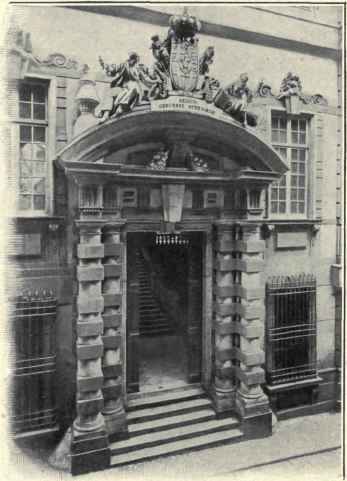
Palace Of The University, Via Balbi.
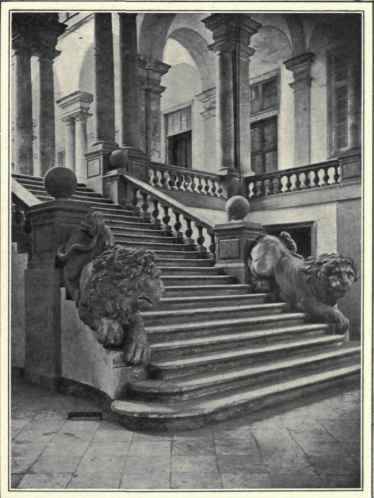
Staircase In The Palace Of The University.

Courtyard Of The Municipal Palace.

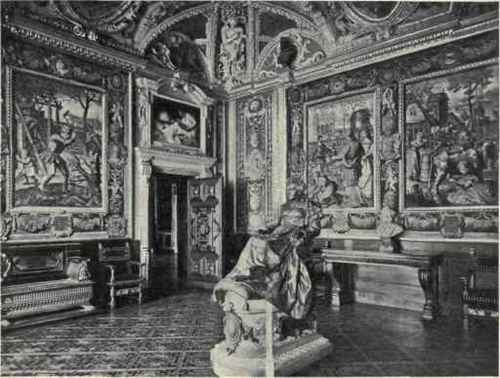
A Room In The Palazzo Rosso.
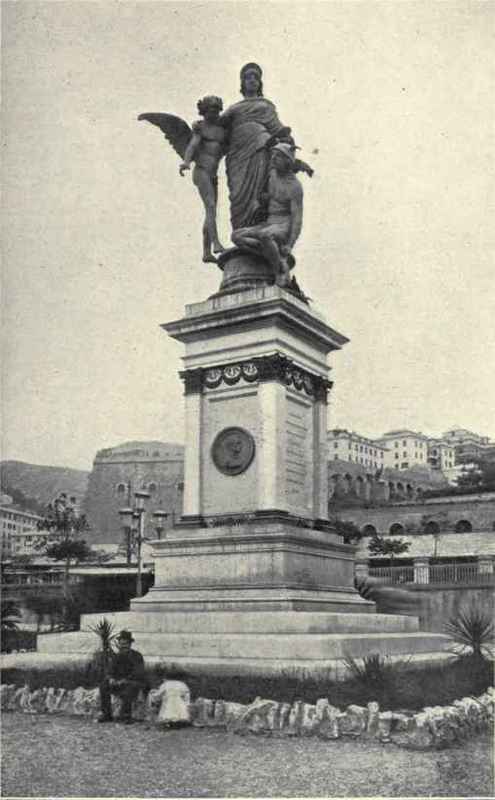
Monument To The Duke Of Galliera, Genoa.
Meanwhile, the Duke of Galliera, equally generous, presented Genoa with four million dollars for the improvement and enlargement of its harbor, on the condition that the city should contribute for that purpose an equal sum. The result is seen in that remarkable series of dockyards, piers, and basins, equipped with the most modern appliances, which are the pride of Italy, and enable ocean steamers of the largest type to come directly to the land. Beyond them also massive breakwaters have been constructed, whose granite arms beat back the billows of the wildest storms, and make their fury powerless against the vessels gathered in their fold; while, towering over all, a monster lighthouse rises to a height of three hundred and eighty feet above the sea, and flashes its resplendent signal out upon the waters through a space of twenty miles.
Statue Of The Duchess Of Galliera, Municipal Palace.
In respect to treasures of historic interest, none of the Genoese palaces equals that of the municipality. Among its contents is a well-preserved bronze tablet, whose legible inscription still records a boundary decision in the neighborhood, rendered by arbiters appointed by the Roman Senate more than a hundred years before the birth of Christ. This valuable relic was discovered several centuries ago by a peasant, plowing in a field near Genoa, who brought it to the city to dispose of it as a piece of metal! In the same room one sees facsimiles of letters written by Columbus, the originals being kept in the pedestal of his bust, which stands in the anteroom of the Council Hall. In still another apartment hang two colossal portraits in mosaic. One represents Columbus, and was a gift to Genoa from Venice, when the former rivals became sister cities in the family of United Italy. The other is a likeness of his famous predecessor by two centuries, Marco Polo. The latter, as we know, was born in Venice, but on returning from his then unparalleled travels in Mongolia, India, and China, he was taken prisoner by the Genoese in one of the wars which raged so frequently between their city and the "Queen of the Adriatic".

Bird's-Eye View Of The Harbor Of Genoa.
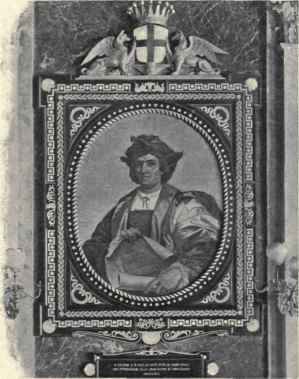
Mosaic Portrait Of Columbus, Municipal Palace.
He, therefore, languished for a year or more in Genoa as a captive; and it was while thus helplessly imprisoned here that Polo dictated to a friend the precious record of his voyages and adventures, which no doubt had its influence on the active mind of the discoverer of America. Here is another proof of the tardy recognition of great genius on the part of Genoa. But now the city which ignored the one, and kept the other in a dungeon, treasures their portraits on a ground of gold! Time, after all, deals kindly with the memory of most great men. The chains they wear in life become the gilded links that bind them to posterity. Their prisons are transformed to expiatory chapels. Their fagots burn as beacon lights of history. Their Calvaries are holy ground. Their tombs are altars. The Cross becomes a symbol of Divinity. In some respects a still more interesting relic in this palace is the violin of Paganini. Who can behold unmoved the instrument from which the wizard's hand evoked such subtle harmonies, but which a glass case now encloses, like a coffin? It is a "Stradivarius," and was no doubt the finest specimen that Paganini could procure of that rare, seventeenth-century workmanship, which still remains the model for all time. How much he must have loved it! It was his one, inseparable comrade. It lay beside his chair by day and near his bed at night. He caused, moreover, to be printed on his concert bills, not "Paganini will appear" or "Paganini will play," on such an evening; but "Paganini will cause his violin to be heard!" Indeed, by making a literal translation of the word which he employed, sentire, this might be rendered "Paganini will cause his violin to be felt." Could anything be more delicate and beautiful than this tribute of the master to his instrument?
Continue to:


My Books

