


India. Part 17
Description
This section is from the book "India - John L. Stoddard's Lectures", by John L. Stoddard. Also available from Amazon: John L. Stoddard's Lectures 13 Volume Set.
India. Part 17

The Himalayas From Darjeeling.
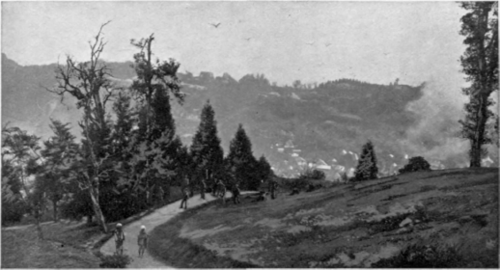
Up In The Clouds.
Only a few miles from Benares stands a ruined tower, which marks the spot where twenty-five hundred years ago Gautama Buddha led a revolt against this tyranny of the Brahmins. He welcomed his disciples from all classes, exclaiming: "As the four rivers which flow into the Ganges lose their names so soon as they have mingled with that holy stream, so all who believe in Buddhism cease to be Brahmins, Pariahs, or Sudras, and become brothers." He made religion to consist of love and kindness to all living beings. All tests of rank were merged by him into the one test of character. Here, then, upon these plains of India, was fought out the great conflict between selfishness and love. Alas! the old, deep-rooted despotism proved the stronger, and Buddha's Christlike doctrine of the brotherhood of man was driven into other lands.
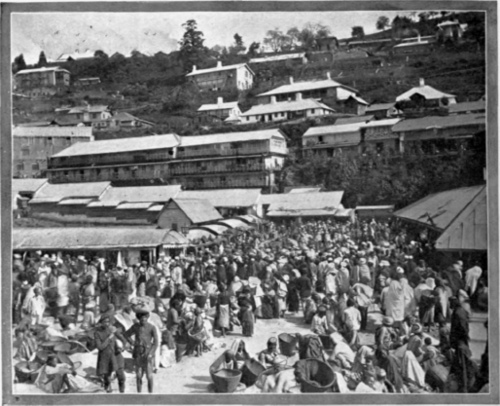
Market-Place, Darjeei.Ing.
But interesting as all Indian cities are historically and religiously, there came to us a time when we were glad to say farewell to their tumultuous life and picturesque pageant of idolatry; for we were eager to behold something as far removed from all such scenes as heaven is high above the earth. In fact, to go from the polluted Ganges at Benares up to its crystal source in the Himalayan glaciers is to turn from pestilence to purity, from degradation to sublimity, from man to God.
The Himalayas, as all know, are the loftiest range of mountains on our globe, their name being derived from the two Sanskrit words, hima, snow, and alaya, a house. Hence the appropriate translation of their title is "The Halls of Snow." On one of their foot-hills, three hundred and fifty miles from Calcutta, and more than seven thousand feet above the sea, is a grand point of observation, called Darjeel-ing, which signifies "Up in the clouds." This is a pretty little mountain sanitarium, with many charming villas and a good hotel. It is never entirely "out of season," for travelers come to it in winter, as residents of Calcutta do in summer - the former to enjoy the wonderful view of the Himalayas, the latter to escape the fearful heat upon the Indian plains; for here the temperature never rises above 78°, and sometimes falls as low as 300. The proximity to Thibet, which in an air-line is only one hundred and fifty miles away, is shown by the Mongolian types of faces seen in the streets and market-place. We noticed several Buddhist lamas from Thibet, turning a kind of hand-bell, within which is a roll of printed prayers. The revolution of the machine reels off the prayers, without interfering in the least with the holder's thoughts. Even this is deemed too laborious by some Buddhists, and enormous cylinders, containing prayers enough for a whole community, have been ingeniously constructed, so as to revolve by means of water-wheels or wind-mills. One of these automatic prayer-barrels may be seen at Darjeeling, and a bell marks each revolution, as it turns upon its axis.
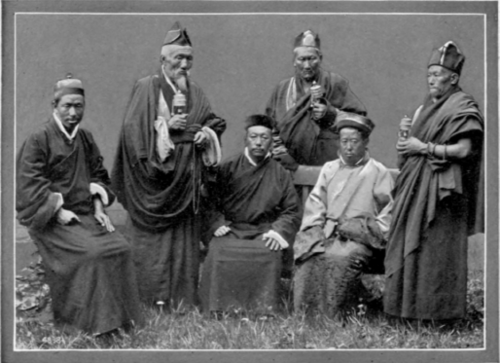
Buddhist Priests With Prayer-Bells.

Going To Darjeeling.

A Peak Of The Himalayas.
The means of reaching Darjeeling is a tiny railroad, so small as to be almost ludicrous. It is, in fact, but two feet wide. Yet, narrow though it be, its length is more than fifty miles and it winds up the mountain side in such a multitude of twists and turns that the engineer in the locomotive can sometimes hold a conversation with passengers in the rear car, as across a narrow street. In one place, it describes the figure eight within a length of about five hundred feet; and several times, where loops are quite impossible, the engine has to draw the train up one incline and then push it backward up another, thus working up the cliff in zigzags.
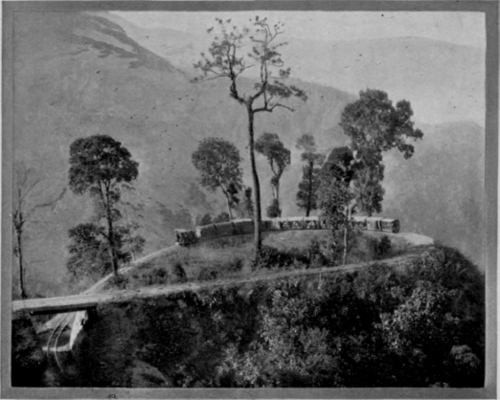
The Loop.
Continue to:


My Books

