


Vienna. Part 3
Description
This section is from the book "Vienna - John L. Stoddard's Lectures", by John L. Stoddard. Also available from Amazon: John L. Stoddard's Lectures 13 Volume Set.
Vienna. Part 3

A Corner Of The Ringstrasse.
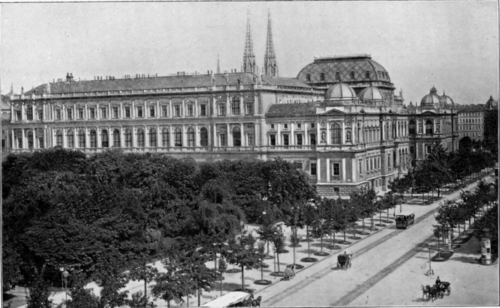
The University.

The Royal Theatre.
On leaving this church, I exclaimed to my companions, "Surely there can be nothing else upon this promenade approaching in magnificence of architecture what we have already seen." Yet, at a little distance, another modern building greeted us, which we confessed was entitled to an equal rank with any of its rivals. This was the City Hall, the cost of which was more than seven million dollars. Even at the risk of being tedious, I must enumerate a few of the remarkable features of this edifice. Its massive tower, adorned with fine reliefs, reaches the height of three hundred and twenty feet, and holds aloft the gilded statue of a standard-bearer. Within its enclosure are no less than seven courtyards, some of them surrounded by arcades, resembling cloisters. Two stairways of white marble, lined with gilded balustrades, lead to a series of municipal apartments which I believe to be unequaled in any similar structure in the world. One of these, the Historical Museum of Vienna, will repay careful scrutiny. Here are gathered almost all imaginable relics of the city from the days of the Romans to the present time, including ancient tombs and statues, souvenirs of Maria Theresa, former costumes of the nobility, old instruments of torture, portraits of famous poets and musicians, the pianos of Mozart and Schubert, and the death-masks of Beethoven and Haydn; together with nearly fifteen hundred specimens of ancient weapons and armor, and relics of the wars between the Austrians and Turks.
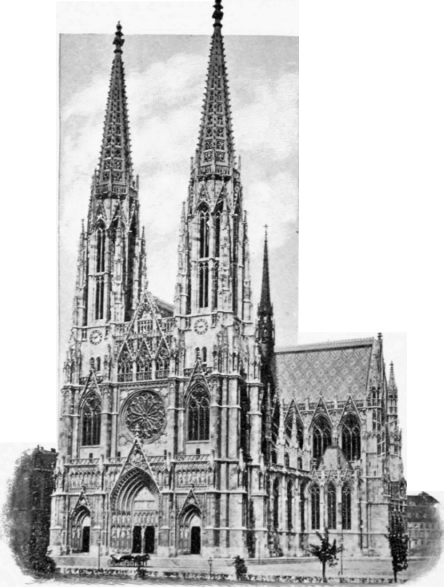
The Votive Church.
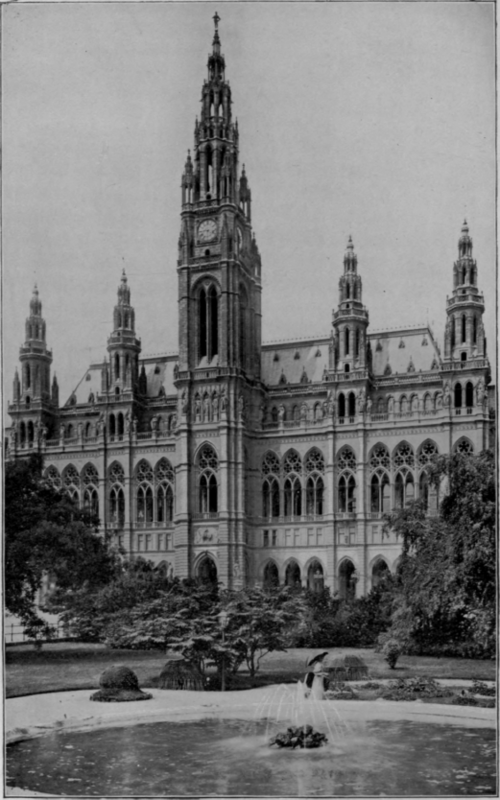
The City Hall.
There is, in Vienna, as there should be in all large cities, a censorship of architecture. People are not allowed to build precisely as they like, without the least regard to the property of their neighbors or the aesthetic appearance of the city. The good of the community is not sacrificed to an excess of individual liberty. Moreover, here, as in Paris, attention is invariably paid to perspective, and every public building, statue, or fountain is placed so that it can be seen to advantage. With the exception of Washington, this rule has been too seldom observed in American cities; but in Vienna the eye is always pleased with long perspectives of tastefully decorated buildings, which usually form an avenue of approach to some grand object at the terminus. In fact, to such an extent is the idea of municipal embellishment carried, that prizes have been offered to those who should erect the handsomest edifices on certain streets or squares. By one who did not understand this sentiment of civic pride, the principal railway station of Vienna might be, at first, mistaken for a Government building, so palatial are its dimensions and so imposingly designed are its huge, crenelated walls and towers. It follows, as a matter of course, that the " skyscrapers" which mar the beauty of many of our cities, not so much from their materials or design, as from the hideous irregularity in the sky-line which they cause, are never seen in Vienna, since the Government regulates there the height of the buildings in proportion to the breadth of the streets. We are accustomed to regard New York as a handsome city, architecturally, and so it is in spots; but even on Fifth Avenue, within a block of some of the best residences, one sees occasionally miserable wooden structures side by side with beautiful stone houses. This in Vienna would be impossible.

A Portal Of The Votive Church.
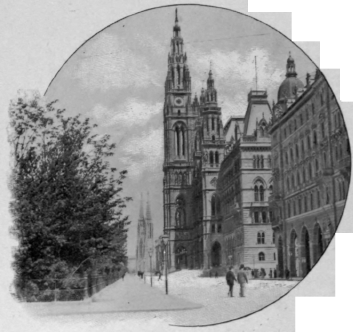
The City Hall Front.

The Reception-Room In The City Hall.
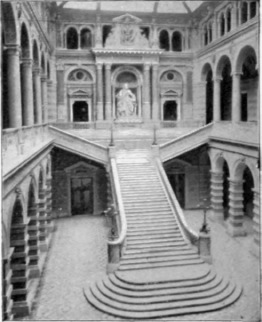
The Staircase In The Palace Of Justice.
Continue to:


My Books

