


Vienna. Part 2
Description
This section is from the book "Vienna - John L. Stoddard's Lectures", by John L. Stoddard. Also available from Amazon: John L. Stoddard's Lectures 13 Volume Set.
Vienna. Part 2

On The Old Bastions.
It would perhaps be injudicious to make a minute comparison between this and the Parisian boulevards. The latter are more animated, and, in the neighborhood of the Avenue de l'Opera, are unrivaled ; but certain portions of the Viennese thoroughfare undoubtedly surpass some sections of the boulevards of Paris, and, as a rule, the buildings on the Ringstrasse are far superior to those between the Church of the Madeleine and the Place de la Bastille. Moreover, the circular form of the Austrian promenade imparts to it a charm that no straight avenue can possibly possess. Imagine, then, the Ringstrasse to be a splendid girdle, dividing, yet uniting, old and new Vienna, lined with imposing modern structures, bordered by handsome parks and squares, and containing a bridle-path, two driveways, spacious sidewalks, and well-shaded promenades. One should, at first, drive around the entire circuit to gain a general impression of its beauty and extent, and then retrace the curving route by sections, observing carefully the architectural gems with which it is adorned.

The Hotel Metropole.

On The Ringstrasse.
These buildings, having been constructed recently, present a fresh and elegant appearance, and are remarkable for their fine proportions and their immense amount of sculptured ornamentation. One after another, they excite our admiration, and when we have surveyed them all, we find it difficult to award to any one of them the honor of supremacy. The House of Parliament, for example, is a triumph of modern architecture, being a reproduction of old Grecian styles adapted to modern requirements, and a magnificent edifice of white marble, its walls enriched by columns, statues, and reliefs, and with colossal groups in bronze upon the roof. Not far away stands the imposing University, with nine courts, elegant reception halls, marble staircases, an extensive library, great lecture-rooms their walls embellished with wood-carving and historic paintings, and a reading-room with seats for three hundred persons. This noble institution has about six thousand students, and a faculty of about four hundred professors, some of whom enjoy a world-wide reputation.
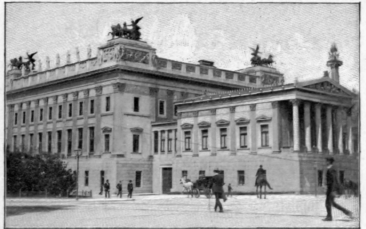
A Corner Of The House Of Parliament.

Approach To The Parliament House.
Rivaling the University in interest is the. Court Theatre, one of the most imposing structures on the Ringstrasse, and one of the finest temples of dramatic art that man has yet produced. Too much detailed description of these edifices would be monotonous, yet it should be remembered that this admirably proportioned building is of white marble, and abounds in statues and reliefs, which tell in sculptured lines the progress of the drama from the earliest times. The grand relief on the facade, portraying the " Triumph of Bacchus," is one of the finest productions of the century. Everything is admirably managed in this theatre for the comfort of its patrons. Before and after the performance, polite, uniformed officials stand on the steps to assist those who arrive in carriages to alight; and, once past the marble corridor, one finds a number of ticket offices to obviate crowding. The cloak-rooms, too, are large, with numerous attendants to prevent delay; while courteous ushers are at hand to lead the way into the richly decorated auditorium. This theatre is, of course, subsidized by the Government; and dramas of the highest order are given here in a style worthy of the magnificent edifice in which they are produced. Another remarkable feature of the circular boulevard is the Votive Church, whose delicately sculptured and openwork towers - three hundred and twenty-five feet in height - remind one of the cathedral of Burgos in Spain. Designed in florid Gothic style, and exquisitely proportioned, it is the most beautiful ecclesiastical structure in Vienna, and is deservedly dear to the Viennese as commemorating the escape of the present Emperor, Franz Joseph, from assassination in 1853. For, popular and beloved though the Austrian Kaiser is, there was then found a wretch who wished to murder him, and would probably have succeeded in his attempt, had not the gold lace on the collar of the Emperor's military coat turned the point of the knife, as the assassin thrust it at his throat.
Continue to:


My Books

