


Troubles With Plumbing, And Their Remedy. Part 6
Description
This section is from the book "The Care Of A House", by T. M. Clark. Also available from Amazon: The Care Of A House.
Troubles With Plumbing, And Their Remedy. Part 6
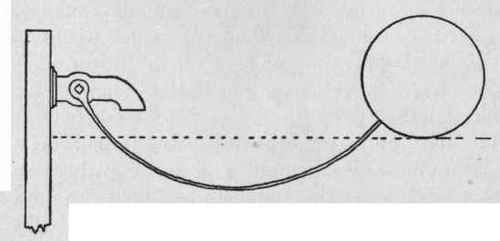
Fig. 29.
If the rod connecting the float with the ball-cock is found to be straight, but the cistern overflows, this is probably due either to the wearing out of the washer, or to the presence of some foreign substance between the washer and its seat. The latter is very apt to occur in a new house, as the particles of lead cut or rasped from the pipes are often carried along by the water, and are caught under the washers. In either case the trouble is easily remedied by shutting off the water, taking off the rod, which is usually held in place on the spindle of the ball-cock by a cap screwed over it, and removing the spindle which carries the washer, cleaning or replacing this as may be necessary.
If, on inspecting the cistern, the float is found submerged, the cock running a full stream meanwhile, the ball itself probably leaks, so that it floats no longer, and the hole, after draining out the water, should be found and stopped with a drop of solder. Nearly all floats are made of copper, which is easily repaired in this way.
Temporarily, in this case, as in that of the bending of the rod, the overflow can be stopped by tying up the ball to something overhead. It is usual to provide all ball-cocks with a chain anchored to some fixed point, which will prevent the ball from falling to a position in which the rod hangs vertically down. If this precaution is neglected, it may happen, when a cistern or tank is emptied, and then refilled, that, in refilling, the upward pressure on the float will be exerted directly in the axis of the rod, pushing this upward, but not turning it to its proper position, so that the cock remains open to its fullest extent, wasting a large amount of water. A touch with the hand will bring the float up to its place in such cases, but it should be provided with some means of preventing it from assuming such a position again.
Housekeepers are often alarmed in summer by a dripping of water from pipes, due solely to the condensation of moisture from the atmosphere upon them when they are chilled by the passage of cold water through them. In kitchens and cellars, particularly where the atmosphere is moist, the course of the cold-water supply-pipes may often be traced by the water which drips from them on the floor. A little observation will show the difference between the dripping of condensed water, which forms in drops all over the surface of a cold pipe, and the tiny stream which issues from a cracked pipe or imperfect joint; and, if the condensation is annoying, it can easily be checked by wrapping the offending pipe with asbestos paper or felt.
Condensation.
Plumbing fixtures are not very liable to defects not connected with their waste-pipes and traps, or their supply-system, but the defects which sometimes occur in them are not easily curable. All manufactures of white earthenware, including kitchen sinks, pantry sinks, laundry wash-trays, bath-tubs, water-closets, and wash-basins are liable to "craze," the glaze cracking, so as to injure the appearance of the fixture, and sometimes coming off in chips, or flakes, leaving the body of the earthenware exposed. As this is somewhat porous, it soon becomes discolored and looks badly, although the use of the fixture is not seriously interfered with. "Crazing" is much less common now than it was before the American potteries brought the art of manufacturing plumbers' earthenware to its present perfection, but it still occurs to some extent. For wash-basins and water-closets it can be entirely avoided by using, instead of ordinary glazed earthenware, the "vitreous china," also an American invention, which differs from glazed earthenware just as French china or porcelain differs from ordinary stoneware, being far stronger and handsomer, while its glossy surface is unaffected by anything which does not destroy the article itself. Unfortunately, sinks, bath-tubs, and wash-trays are too large to be made of vitreous china; and, although they sometimes profess to be of "porcelain," or of "vitrified" ware, they are, unless in very exceptional cases, simply of earthenware.
Defects in fixtures.
Vitreous china.
Another reason for preferring vitreous china to ordinary earthenware, particularly for water-closets, is that the latter, being of somewhat complicated form, are always moulded in several pieces, which are stuck together, when the clay is soft, and then hardened by burning, the glaze being subsequently applied, and fixed by a second burning. As the burning is effected at a far lower temperature than that required for making vitreous china, the different portions of the earthenware fixture do not always unite perfectly; and there are few accidents more annoying than the sudden separation of a water-closet bowl into its component parts while in daily use.
For kitchen sinks a dark-colored ware is sometimes used, made of a clay similar to that employed for manufacturing drain-pipes, and glazed in the same way, by throwing salt into the fire in which it is burned. These sinks are cheap, and are said to be strong and durable, but they are not attractive in appearance. A yellow ware, like that used for the pie plates and pudding bowls which have ornamented American pantries for a century, is also occasionally used for sinks, but with no conspicuous advantage.
All fixtures of "porcelain," glazed earthenware, and vitreous china are divided by the manufacturers, before they are sent out, into three grades, known as "A," "B," and "C," those of the "A " grade being supposed to be as perfect as the process of manufacture will admit; those of the "B" grade being slightly warped, or having imperfections in the glaze; while those of the "C" grade are more warped, or have greater imperfections in the glaze. All the grades, however, are suitable for use, the differences being only in appearance.
Continue to:


My Books

