


Troubles With Plumbing, And Their Remedy. Part 5
Description
This section is from the book "The Care Of A House", by T. M. Clark. Also available from Amazon: The Care Of A House.
Troubles With Plumbing, And Their Remedy. Part 5
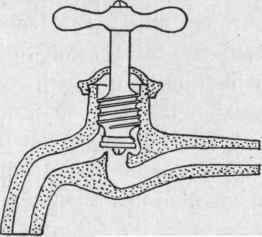
Fig. 28.
Putting on new washers.
Occasionally, where the tank is placed above the ceiling, or overhead in a bath-room, the valve in the cistern is suspended from a lever, from the other end of which a wire is carried down to some accessible point on the wall of the room, and attached to a hook, generally sliding on a brass plate, with a catch at the bottom. When the hook is drawn down until it catches, the valve is opened; and, to shut the water off, it is only necessary to disengage it and leave it free.
Still more rarely, the tank is either raised above the floor, or supported near or above the ceiling, with either an ordinary stop-cock or a steam-valve on the descending pipe under the tank, which can be opened or closed in the same manner.
Shutting off the hot water.
However the pipe descending from the tank may be closed, the water in the hot-water system will be held temporarily suspended, by atmospheric pressure, until it is opened again. If there is an expansion-pipe to the system, the suspension will not be complete unless this pipe, which is usually bent down over the overflow of the tank, is plugged with a cork, or a bit of paper; but the operation of putting in a new washer is not interfered with by a little leakage of water.
When a cold-water faucet needs a new washer it is necessary to shut off the cold-water supply, either just inside the cellar wall, where a main stop-cock is always provided, or, if a special shut-off is arranged for the fixture requiring attention, this may be closed. In either case, there will probably be a temporary spouting of water from the waste-tube of the shut-off cock, which may need to be attended to.
When the water has been shut off, the first step in the operation of replacing the washer is, with most compression-cocks, to unscrew the octagonal cap through which the stem of the spindle passes, and which is furnished with packing, to prevent leakage around the stem. A wrench is likely to be needed for unscrewing this cap for the first time, but it is not necessary to screw it down tight in replacing it. After the cap has been loosened, the spindle is easily unscrewed and taken out, bringing the cap with it. The washer, or its remains, will then be seen, held to the bottom of the spindle by a round-headed brass screw. Supposing the careful householder to have provided himself with a few half-inch washers for basin-cocks, and five-eighths inch for sink, bath, and wash-tray cocks, which can be had of any dealer in plumbing materials, there is nothing more to be done but to take out the round-headed screw, remove the old washer, put on the new one, replace everything as before, and turn on the water again.
Putting on new washers.
The whole operation, including turning the water off and on, can easily be performed in five minutes, in most houses; and, as a plumber and his helper often consume half a day in coming from the shop to see what is wanted, going back to the shop for the necessary tools, returning to the house, making an elaborate search for the shut-offs, applying the new washer, refreshing themselves with a pipe after their exertions, and getting back to the shop again, there is a material economy in employing home talent in an operation which is required several times in the course of a year, even in a small house. Plumbers generally use washers of thick leather for cold-water faucets, and special washers of various materials, including pasteboard and hard rubber, for hot water, which soon softens and disintegrates leather; but. if the householder can apply washers for himself, leather will answer for all purposes, and is less likely to crush and injure the thin, brass edge on which the washer presses than the harder materials. In any case, this thin edge, under the action of hot water, slowly crystallizes and crumbles away, until it becomes so uneven that even a leather washer will not keep the water back. When this happens, the faucet is practically worthless, and a new one should be put in its place.
Ball-cocks are only used to supply tanks or cisterns of some kind; the ball, or float, rising as the cistern fills, so as to shut off the water when the cistern is full. As not only the main tank, but all the water-closet cisterns, and often the furnace-supply, are provided with ball-cocks, the number of them in a house may be considerable, and they are quite likely to give trouble. In substance, they are usually simple compression-cocks, turned over on their side; the float, with the brass rod which connects it with the spindle of the cock, taking the place of a handle. As the float is almost constantly in motion upward or downward, as the cistern is discharged and refilled, the washer wears out slowly, allowing the ball-cock to leak; and leaks also occur from other causes. As all tanks and cisterns supplied through ball-cocks are provided with some sort of overflow, the water which leaks through the ball-cock runs off, almost unnoticed, through the overflow, which generally discharges, either directly or indirectly, into a water-closet basin, escaping through the trap, without doing any visible harm; but, as a great deal of water may be wasted in this way, to the unpleasant surprise of householders who take water through a meter, such leaks should be promptly stopped.
M
Ball-cocks.
A very common source of waste of water in this way is not strictly leakage of the ball-cock, but the bending of the rod which carries the float. This rod is often made of light tubing, instead of solid wire, and is rarely stiff enough to resist firmly the powerful upward pressure of the water on the float; so that it by slow degrees acquires an upward curve (Fig. 29). It is obvious that if a ball-cock with a straight rod is arranged so as to shut off the water when the float reaches a certain height, the consequence of the upward bending of the rod will be that the float must be lifted higher to produce the same effect in shutting off the water; and, as the bending increases, the water ultimately reaches the level of the overflow before it is shut off. Inspection of the ball-cock and cistern will generally show whether such curvature of the rod has taken place, and, if so, it can, with care, be bent back again to its proper position, in which it will stay for a longer or shorter time, according to circumstances.
Continue to:


My Books

