


William And Mary. 1688-1702. Part 2
Description
This section is from the book "The Practical Book Of Period Furniture", by Harold Donaldson Eberlein And Abbot McClure. Also available from Amazon: The Practical Book Of Period Furniture.
William And Mary. 1688-1702. Part 2
Articles
The articles of furniture most commonly in use during this period were chairs, stools of several sorts, forms and settles, settees or sofas, day-beds, bedsteads, various kinds of tables, chests and chests of drawers, highboys and lowboys, cabinets, secretaries, desks or bureaux, cupboards, buffets, dressers, mirrors and clocks. Other forms of furniture there were, of course, but their use was not general enough to warrant placing them in the foregoing list of pieces of daily necessity in the household economy of the time.
Contour
As mentioned, the contour of William and Mary furniture is strongly individual and not to be confounded with anything that went before. It is at this date that the curvilinear element comes into play and is everywhere conspicuous. A few minutes' careful study of the William and Mary page of the Chronological Key and the illustrations in this chapter will fix in the mind the characteristic features to look for in this period - legs with inverted-cup or spindle turnings (Key III, 1, 2 and 3), shaped stretchers between these legs (Key III, 1, 2, 3 and 4), arches ogival (Key III, 3, apron) or flat (Key III, 1, apron), and rounded hoods to cabinets (Key III, 2), backs of chairs and settees (Key III, 4), occurring singly, double or treble or, sometimes, in the shape of a broken pediment formed from the single hood. Spirally turned, and scrolled legs or legs with Spanish feet (Key III, 4) persisted from the previous age, but are here united with other William and Mary features. So also with the cabriole leg, which originated in this period. These and other forms of legs are shown in Figs. 1 and 4. The carcases (bodies) of cabinet work remained rectangular.
Full details will be found in the descriptions of the various pieces which here follow.
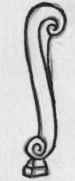
A
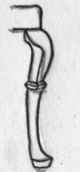
B
Fig. 1. A, Flemish Scroll Leg. B, Early "Ringed" or Collared Cabriole Leg.
Chairs
In the very first part of the period, stretchers between chair legs were either turned, sometimes with bulb turning, or scroll carved. The hooped and scrolled Spanish stretcher was often recessed slightly from the front legs as were also occasionally the turned stretchers. Turned and carved straight stretchers early gave place to shaped and serpentine stretchers of Italian origin. These shaped and serpentine stretchers were almost invariably arranged saltire-wise or in X-fashion between the chair legs and were often surmounted by a ball or finial at the point of intersection (Figs. 2 and 3). Stretchers of this sort were either plain or moulded and were generally flat. They were, however, sometimes rising toward the point of intersection beneath the centre of the chair, settee or stool (Fig. 4, H).
Legs were Flemish scrolled, carved and moulded (Fig. 1, A); straight quadrangular (Plate VII, p. 90; Fig. 4, C and D), or octagonal (Fig. 4, H and Fig. 5), or round tapered and carved (Fig. 2), turned or moulded, with gadroons at top, and bun feet (Fig. 4, D); straight, with some form of turning, inverted cup, spinning top, spindle or baluster, with bun feet (Key III, 1, 2 and 3, and Fig. 4, N, 0, and P); straight with Spanish scrolled foot (Fig. 3 and Fig. 4, G), or, at the end of the period, cabriole with hoofs, cloven goat's feet (Fig. 4, 7), or club feet (Fig. 1, B). Many early cabriole legs had either an angle in the curve or were "ringed" or "collared" with a moulding below the knee and sometimes both "ring" and angle occur (Fig. 1, B, and Fig. 4, E).

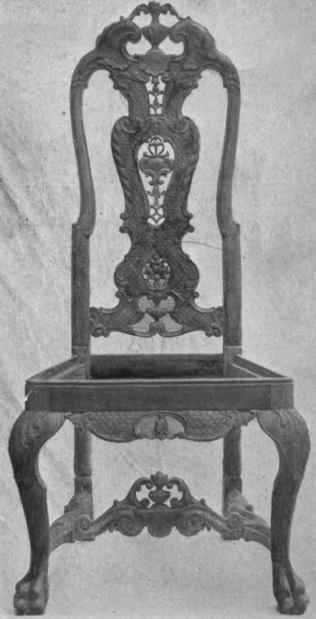
PLATE IV. WILLIAM AND MARY CARVED WALNUT CHAIRS.
By Courtesy of Messrs. Gill & Reigate, Oxford Street, and Messrs. Robson & Sons, Knight abridge, London.
Seats were approximately square with a slight narrowing towards the back (Fig. 2) and the framing was either visible or upholstered. The front legs of side chairs were dowelled into the seat rails. At the extreme end of the period the front corners of seat framing were sometimes rounded.
Backs for the most part were high and were caned, carved, upholstered or balustered. Often there was a combination of carving and upholstery or caning and carving. Nearly all of the caned and upholstered backs, especially, were high (Fig. 2), and the upholstered backs usually had more rake than the caned backs. "Banister back" chairs had the same general characteristics as the cane-backed chairs, except that four or more split balusters were used in the back instead of caning. The tops of the upholstered backs were straight across (Fig. 2) or else shaped in Spanish wise with cyma curves and semi-circle, resembling in general outline the hooded cabinet work (Fig. 3). Uprights of carved or caned chairs were ordinarily baluster turned. The carved wooden backs usually finished in elaborate cresting (Plate IV, p. 76), the central portion, containing most of the carving,being separated from the uprights and supported by the cresting and a cross-rail just above the seat line. This cross-rail had scroll work or carving below to carry out a correspondence with the ornate cresting. Caned backs finished with carved cresting or plain moulded shaping.
Among both caned and carved backs we find the cresting either carried over and dowelled to the uprights or fastened between the uprights which terminate in finials. In the caned backs with a moulded cresting the cane is stretched from uprights and crest, while with the other sorts of cresting the cane is stretched from a frame between the uprights.
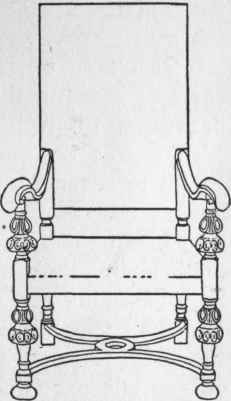
Fig. 2. Upholstered Square-back Arm-chair with Straight Carved and Turned Legs. By Courtesy of Chapman Decorative Co., Philadelphia.
Towards the end of the period the central splat began to assume a strongly individual form and the spaces between the splat and the uprights were often caned. In some instances the back approximated the fiddle shape, though it was not so clearly defined as in the succeeding period. When cabriole legs appear we find the back slightly "spooned" to fit the contour of the body. Arms were either of wood, shaped with an outward flare, or upholstered and rolled.
Continue to:


My Books

