


Coffers And Chests From The Norman Times To The Renaissance. Part 5
Description
This section is from the book "Old Oak Furniture", by Fred Roe. Also available from Amazon: Old Oak Furniture.
Coffers And Chests From The Norman Times To The Renaissance. Part 5
Though this work does not pretend to treat at all fully on foreign methods or styles and their intermediate variations, it is expedient to notice here some peculiarities connected with certain articles of Continental make. The first instance is the intersection of stile-mouldings - i.e., the crossing of the raised members at the corners of panel-framings, something after the manner of what is now known as an Oxford frame. It is certain that this style was never employed on English-made furniture, though it was extensively used on the productions of France, Flanders, and parts of Germany. Now, international differences in linen panelling are often so vague that if the mouldings on the pieces are only of ordinary design, it is difficult - nay, almost impossible - to determine their source. Chests or cupboards need not necessarily be of foreign make, even if they are furnished with German iron fittings, for these accessories were extensively sent over by the Hanseatic League. Directly, however, that a piece exhibits the intersected mouldings which we have just referred to - no matter how bluff and simple its lines may be - it may safely and without a doubt be assigned to a Continental source - that is, if the piece be true; and the detection of this detail may occasionally prove of the greatest value in coming to a decision as to the nationality of debatable linen-panelled productions.
Another peculiarity attaches to certain German and Flemish chests, and has led to the ignorant mutilation of many of their kind. A complete and typical specimen, though not the finest of its class, may be seen in the Victoria and Albert Museum, No. 1,750-1,869. Chests of this type are large in size, and supported on rather longer legs than the generality of their brethren. The panels in the front are generally ornamented with parchemin decoration, and those in the sides with the linen fold, but the curious feature which has been alluded to is a sort of skirting, veiling the space beneath the chest, and formed by a repetition of the upper panels and their dividing stiles. This skirting, however, was only formed of half-panels, descending direct on to the floor, without any base rail whatever, thus giving the piece an appearance of having been cut down and shorn of several inches of its original height. The construction of this detail at the base is faulty in the extreme, for when the trenails, or pegs, which held these depending stiles in their place became loose, the skirting gave way for want of proper support, and dropped out.
It has, however frequently happened that the complete piece has come into the hands of some third-rate dealer or inexperienced amateur, who, ignorant of the peculiar characteristic of the object, has become possessed of the insane idea that, from the lack of the lower half of the bottom panels, as well as the absence of a transom rail at the base, the chest must necessarily have been sawn down. In order, therefore, to hide what the temporary owner, regarded as a mutilation, the piece was cunningly deprived of these tell-tale demi-panels at the base and reduced to the condition of an ordinary chest elevated on rather high legs. This has been done in dozens of cases, but once the trick is known the evidence of the mutilation is not difficult to detect - viz., the holes in the front transom bar for the trenails on which the dwarf stiles of the skirting hung; and the only explanation of them and the accompanying grooves for the missing panels is obviously that which I have indicated. The purpose of this skirting may be conjectured. It does not exist at the sides, but solely in the front, and therefore can only have been intended to screen any articles, such as shoes, which might be thrust beneath the chest from either side.
There can scarcely be any other interpretation of so strange a feature. Many of these chests exist in a complete state, but by far the greater number have, either by design or accident, lost their characteristic trait. The feature of a front skirting is not unknown in France, but the chests which we find bearing it are nearly all German or Flemish. To recapitulate: If any reader has a large parchemin panelled chest in his possession which exhibits mortise holes in the bottom of the lower transom rail corresponding to those above, it is more than probable that the piece - if genuine - once possessed such a skirting at its base, and, in this event, it was certainly not made in England.
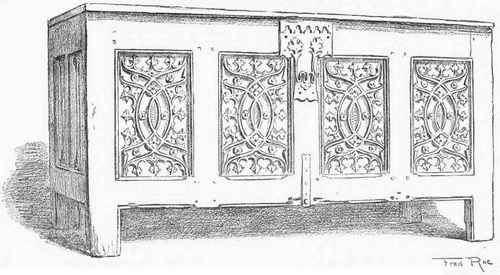
LATE FIFTEENTH-CENTURY CHEST, WITH PANELS OF GERMAN DESIGN.
It does not very often happen that the linen panels are inserted longitudinally, and it is really rare to find pieces of antique furniture in which the linen fold occupies that position exclusively. A curious piece was recently sold at Christie's, however, which had this peculiarity. It had three small drawers at its base, with a box above, the whole front, as well as one of the ends, being panelled in this peculiar manner. From the circumstance of one end being without decoration, it is evident that the piece of furniture was intended to occupy a corner position, while from the manifest signs of wear on the lid it must have been used as a seat, and most probably was originally intended to occupy the place of an ingle nook, where it could be used as a receptacle and as a rest. The linen fold is extremely simple in character, and might have belonged to any country, but a close observer could see the interlacing mouldings, to which we have just been referring, at the corners of the panels, and this at once stamped it as a foreign production.
Chests during medieval times were often provided with wooden bars or clamps underneath, in order to give increased support to the structure, and prevent bulging under excessive weight. We find this feature more often on Continental productions, but I am unable to say it was altogether a foreign one. For instance, in the Church of St. Sepulchre, at Northampton, there is a dome-topped coffer of sixteenth-century type, with three locks, which still retains its clamps. It is probable that in the greater number of cases the clamps, being detachable, have been lost, and it is not unreasonable to conjecture that most chests constructed with framework once possessed them.
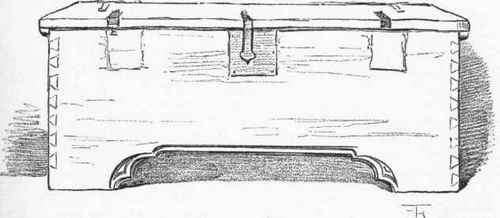
COFFER IN ST. LAWRENCE'S CHURCH, EVESHAM, SHOWING DOVETAILING AT CORNERS, COMMENCEMENT OF SIXTEENTH CENTURY.
The construction of coffers of the earlier Gothic type has already been touched upon. With regard to the later examples, it is perhaps sufficient to observe that they were always fastened together with wooden pegs or trenails, iron only being used for hinges, clamps, and locks. Dove-tailing, which was practised in the thirteenth and fourteenth centuries in a secret form, so as to give strength to the coffer without being visible from the outside, in late Gothic times was carried out in quite an open manner. A series of small fantailed mortises interlocking with each other at the corners may be sometimes seen on late Gothic coffers, such as that in the church at Evesham. It may be doubted, however, whether this form was practised - at any rate in England - before the beginning of the sixteenth century.

MEDALLION HEAD ON PANELLING, TEMP. HENRY VIII.
SHOWING CLASSIC FORM OF HELMET ADOPTED BY CARVER OF THE PERIOD.
Continue to:


My Books

