


Coffers And Chests From The Norman Times To The Renaissance. Part 4
Description
This section is from the book "Old Oak Furniture", by Fred Roe. Also available from Amazon: Old Oak Furniture.
Coffers And Chests From The Norman Times To The Renaissance. Part 4
Two shields appear on each side of these figures, the charges being those of England and France quarterly, and the arms of the d'Aungerville family, one of whom, Richard de Bury, was Bishop of Durham, 1333-1345. It is probable that this coffer is one of two which are mentioned in contemporary accounts of the Bishop's funeral, and which the sacrist claimed as his right, with other effects.
The Rockingham Castle chest, well known from Parker's well-executed wood-cut of it, also comes under this category. It has been attributed to both the time of Henry V. and that of Edward IV., the latter date doubtless having been conjectured because of the chest displaying not only the arms of England, but also those of William, Lord Hastings, who was in the reign of Edward IV. appointed Constable of Rockingham Castle for his lifetime. In spite of this armorial evidence, the chest would seem, from certain indications, to be somewhat later in date than the reign of Edward IV.
The iron furniture or fittings of medieval coffers is a study in itself. Even when the pivot hinge was used in the thirteenth century, the lids of coffers were occasionally crossed with bands of iron, perhaps lightly decorated with a cross-hatched pattern, as in the very early Graveney example. Later on these bands were merely extensions of the hinges, and they were sometimes carried round the structure so as completely to envelope it. A coffer in Debenham Church, Suffolk, has a series of iron bands, nine in number, on its lid, the ends of which are fashioned in the form of scrollwork and conventional leafwork. In the chapel of Haddon Hall is also a coffer of immense length composed of oak slabs at least 2 1/2 inches thick, the lid of which is further strengthened with bands of iron decorated with the fleur-de-lis. This coffer, which seems but little known, should be examined by all interested in medieval furniture. Many works have been written and illustrated on the subject of Haddon Hall and its woodwork, but this coffer, which was actually one of the ancient possessions of the Vernons, has, curiously enough, despite its intense interest, remained unnoticed.
Besides bearing the decorative metal strapwork on its lid and corners, the front is carved with the arms of the Vernon family, enclosed in sunk circles bordered with a trefoil ornament. The corners are dove-tailed together in a rather obvious manner, which suggests a date about the junction of the fifteenth and sixteenth centuries, but the shape of the shields points to an earlier date, rendering it somewhat difficult to ' place' the piece with accuracy.
Very few of the original locks and lock-plates remain on coffers or chests constructed previous to the latter half of the sixteenth century. Mention may be made, however, of a few notable and splendid examples. The painted coffer at Newport retains its original lock and lock-plate, fastened on with large square-headed bolts, and is perhaps the earliest complete example of its kind now remaining. Original locks of artistic design and fine construction also remain on the tilting-coffer in York Minster, and the elaborate Renaissance chest in East Dereham Church, Norfolk, though the former appears to be, and the latter most certainly is, of foreign workmanship. The hasp of the York coffer is fashioned in the shape of a dragon, a favourite form of decoration on the Continent, whilst the Dereham lock-plate is a typical specimen of pierced Flemish (or French) flamboyant work.
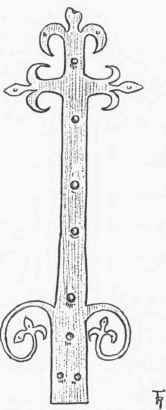
STRAP HINGES ON LID OF COFFER IN THE CHAPEL AT HADDON HALL.
On lock-plates of the fourteenth and fifteenth centuries we frequently find a V-shaped piece of metal, raised above the surface of the plate and surrounding the keyhole. This V piece sometimes splays out into a leaf ornament or other decorative form, as in the York coffer. I do not know if any conjectures have been hazarded by antiquaries as to its use or intention, but, regarding it in a practical light, there only seems, to me at least, one reasonable explanation. Artificial light was in its infancy in these dark ages, and the feeble oil-lamps which made some apology for illuminating the halls and dwellings of our ancestors were so palpably inefficient that the ridge of metal gave some assistance to the sense of touch when it became necessary to open the coffer or chest at night-time.
Anyone who has tried the experiment of fitting a key into one of these medieval locks by the dim light of a winter's dusk will realize at once the great practical assistance which these V-Aanges afford. This simple contrivance was fitted to the locks of doors as well, and the feature might advantageously be revived in these modern times in the interests of those who for any reason experience a difficulty in inducing their latch-key to perform its office.
Of plain, iron-sheathed or banded coffers there are plenty remaining, but the probability is that the greater number of them belong to a period not earlier than the sixteenth century. With the cessation of decorative forms in their ironwork, interest in these productions becomes considerably curtailed.
At the end of the fifteenth century the linen and parchemin panels began to come into vogue in England, where they rapidly supplanted tracery decoration.
Linen-panelled chests are still fairly easy to discover, but they mainly belong to the sixteenth century. The earlier specimens may usually be detected by their more weighty method of construction. Linen and parchemin panels on chests are always enclosed with framing. I have never yet met with a box of the coffer construction carved with either of these decorations, nor have I heard of one from other antiquaries. Chests with linen panel fronts are to be met with fairly frequently in old mansions and private collections, or even in the London sale-rooms, but they are not often to be seen in churches.
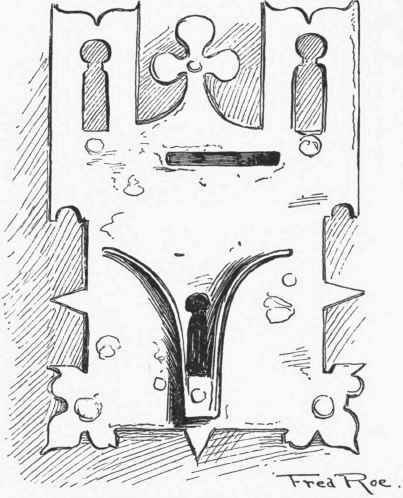
CHEST LOCK-PLATE, FIFTEENTH CENTURY.
Continue to:


My Books

