


XIX. European Hand-Blocked Papers
Description
This section is from the book "Home Furnishing", by George Leland Hunter. Also available from Amazon: Home Furnishing.
XIX. European Hand-Blocked Papers
THE paper hangings illustrated in connection with this chapter represent the best that has been accomplished in patterned wall papers. They range in price from $ 1 to $ 12 a roll, the English rolls being 12 yards long and 21 inches wide exclusive of the plain edges, the French and German ones 9 yards long and 18 1/2 inches wide, as compared with our American roll length of 8 yards and width of 18 inches. All of the papers illustrated were printed by hand from wooden blocks in France or England or Germany (Alsace), and are sold in one or more shops in every large American city.
In bringing these papers to the attention of my readers in different parts of the country, I do not wish to emphasize the hand-blocked part or the European part unduly. Both in America and in Europe excellent papers are printed by machine, and America as well as Europe produces hand-blocked papers of good design and high quality. But as a general principle it may be stated that hand-blocking, after the manner invented in 1688 by Jean Papillon in France, is superior to machine work, and that the finest papers, patterned as well as scenic, are made in Europe, although one American wall paper manufacturer has had the audacity to carry coals to Newcastle by opening a shop in London. I understand that the shop has been very successful, which is perhaps the best testimonial to the merit of his wares.
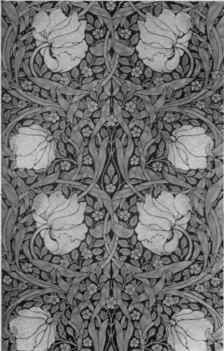
I. Morris, the Pimpernel.
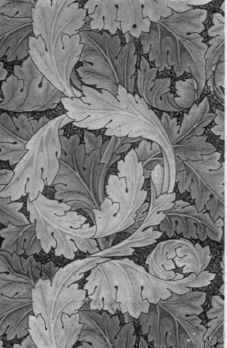
2. Morris, the Acanthus Scroll.
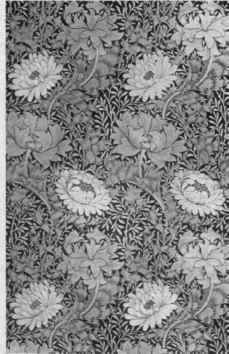
3. Morris, Chrysanthemum.

4. Walter Crane, the Golden Age.
The principal points of inferiority of machine to hand-blocked papers are:
The stock of the cheaper machine papers is so rough and full of impurities that it could not receive a clean impression even from hand blocks. It also tears easily and fades quickly.
The colors used in machine printing are necessarily thin, and all are printed at one operation, one on top of another while still wet. In hand blocking, rich colors are available and each color is allowed to dry before the next is applied. Large, flat flowers and leaves and broad stripes cannot be successfully printed on the machine.
The wooden blocks of the hand printer, with only dots and thin lines in brass, produce a much softer and more interesting impression than the brass and felt machine rollers.
Aside from the difference in artistic merit, it is easy to tell hand-blocked from machine papers by the narrow blank border at each end of the roll, and by the guide marks in the margin that show the printer where to place his blocks.
The effect of machine papers is apt to be monotonous, even when variety is secured by combining different rolls that have been planned to go together as frieze and border and filling. This is due to the smallness of the unit of design and the necessary frequency of the repeat. Elaborate and scenic designs are not only better, but also cheaper when printed by hand. Such papers as those ancient scenic ones illustrated in Country Life in America for November 15, 1911, it would not be possible to print by machine. Even by hand they present enormous difficulties. The famous Cupid and Psyche series designed by Lafette and printed by Dufour in 1814, has twenty-six different widths that together form the complete story, and no less than 1,500 separate blocks. It is interesting to note that this paper is still on the market, having been reprinted from the original blocks, and has been used with splendid effect in American residences.
The Stag Hunt that appeared as a frontispiece in the number of Country Life in America mentioned above, and that was from a photograph taken by Mr. Cousins of one side of a room in the old Andrew Safford house, in Washington Square, Salem, Mass., has been identified by Mr. Harry Wearne as one originated by Reveillon, the famous and most important French late eighteenth century manufacturer of wall paper, whose business was ruined by the French Revolution that in 1789 broke out in his factory in the Faubourg Saint-Antoine, the establishment being raided, set on fire, and destroyed by the mob. The Stag Hunt took thirty-one widths of paper to form one complete set or collection.

5. Walter Crane, the Peacock.

6. Walter Crane, the Macaw.

7. Muller, Roses.
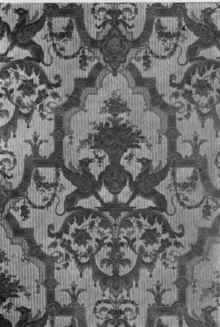
8. Regence pattern.
And now for the papers shown with this chapter. Nos. 1, 2, and 3 are English papers designed by William Morris, who did more than any other man of the nineteenth century to raise the standards of industrial art, and not only designed but - what was of far greater importance and significance - actually made and superintended the making of wall papers, printed draperies, real tapestries of the old Gothic type, and furniture. He knew what so many forget or never learn, that in the creation of masterpieces of art the hand is more important than the head, and the execution than the design. Pattern No. 1 is called the Pimpernel (the pimpernel being not the large but the small flower), No. 2 the Acanthus Scroll, No. 3 the Chrysanthemum.
Pattern No. 7 is the best "roses" paper in the world. The bold simplicity of the lines, combined with the exquisitely soft delicacy of the colorings, appeal to him who sees it, quite in the same way as a wonderful painting, a marvelous tapestry, or a perfect statue in marble. This paper was designed by Muller about 1850 and is made in Paris. It takes 185 blocks to print from and the widths are twenty-six instead of the regular eighteen and one half inches wide.
Patterns Nos. 4, 5, and 6, shown two widths together, were designed by Walter Crane and printed by the firm who did and still do all the Morris papers. No. 4 is called the Golden Age, No. 5 the Peacock, No. 6 the Macaw. I regard the Golden Age as a masterpiece. It comes in self tones and also in many colorings, as do most of the papers here illustrated. Some of these patterns can also be had on cretonne.
Nos. 8, 9, 10, 11, and 12 come from Alsace from a factory that has been established for more than a century, and consequently in character class properly with French rather than with German papers. No. 8 is a Regence pattern originated in the early part of the nineteenth century. No. 9, the Golden Pheasant, was originated only three years ago. However, the form in which it now appears is not the original one that was rejected after the blocks had been cut and samples printed. I saw the original cartoon. It was evident to me, after I had been told, that when assembled on the wall the tails of the birds would mark too strongly. This and other defects caused the maker to destroy the paper that had been printed and the blocks that had been made, and after an interval of twelve months, to bring out an entirely new and much modified set of blocks from which was printed the paper before us. The result is worthy of the effort.
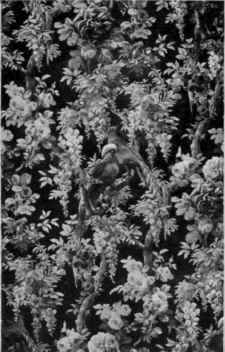
9. The Golden Pheasant, a modern Zuber paper.
II. Reproduced from an old toile de Jouy.
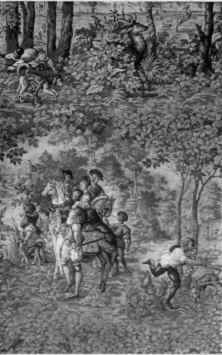
10. Modeled on a Renaissance tapestry after Van Orley.


12. The Dutch Garden, a modern paper.
No. 10 is a paper taken from one of the famous tapestries designed in the sixteenth century by Van Orley, the Belles Chasses de Guise, also called the Hunts of Maximilian. No. 11 was reproduced from a Louis XVI toile de Jouy, Jouy being a little town near Paris where were made the most famous linen drapery prints of the eighteenth century. The ground of No. 11 is faintly but charmingly damasse.
No. 12 is a modern paper, the Dutch Garden, designed by the famous Frenchman, Arthur Martin, whose collection of tapestries, furniture, wall paper, etc., is worth crossing the Atlantic to see, and whose services to French makers of damask, brocades, and other woven stuffs are noteworthy. This Dutch Garden appeals to me most when printed in gray.
Continue to:


My Books

