


XXII. Real Tapestries
Description
This section is from the book "Home Furnishing", by George Leland Hunter. Also available from Amazon: Home Furnishing.
XXII. Real Tapestries
TAPESTRY is a broad word. It ranges all the way from ten cents a roll for verdure papers to ten thousand dollars a yard for the marvelous pictures woven on the highwarp looms of the Fifteenth and Sixteenth Centuries. In between the wall papers and the arras come numerous printed, painted, and loom-figured textiles that, on account of their resemblance to real tapestry - often remote - have acquired the same name. Consequently it is not strange that confusion exists in the minds of many as to what real tapestry actually is, especially as dictionaries and encyclopedias almost without exception define the word incorrectly or incompletely, while its trade meaning varies according to the shop in which it is found.
Several years ago the writer was invited by an intending purchaser to visit an antique shop to pass on the genuineness of what purported to be a Seventeenth Century Gobelin tapestry, declared to be worth $ 10,000. While the dealer disclaimed all expert knowledge of tapestries and was not ready to guarantee the attribution, the eagerness with which he pointed to the woven signature, Ch. Le Brun Pinxit, and the willingness with which he introduced references to persons and books likely to spur on the hesitating purchaser, showed that he was either extraordinarily ingenuous - which antique dealers seldom are - or was trying to perpetrate a gross fraud without technically violating the law. The dealer was indignant and threatened violence when the writer stated that the tapestry was machine-made and worth about twenty-five dollars. The purchaser covered our retreat, incidentally expressing his opinion of the dealer. Recently I related the anecdote to the manager of a house that imports many of these Jacquard tapestry panels, expecting him to be as surprised at the customer's ignorance and the dealer's dishonesty as myself. Imagine my amazement when he retorted: "Wha'd yer wan'der butt in on der man's business fur? He had a ridt to get what he could. Lodts of the tealers magke good money on dese dapestries." He then went on to express an unflattering opinion of writers who give illustrations and prices that tend to make the public less gullible. Indignant at his attitude, and enlightened by it, I have since made it a point to investigate the methods of distribution of these tapestry panels, and have discovered that a large proportion of them are sold to persons who do not understand what they are buying, at prices that are extortionate. They are an important source of revenue to the cheap and tawdry auctioneers of bric-a-brac and what are called "art" objects for the home. And, as instanced above, they are a treasure trove to the dealer in bogus "antiques" and second-hand furniture.
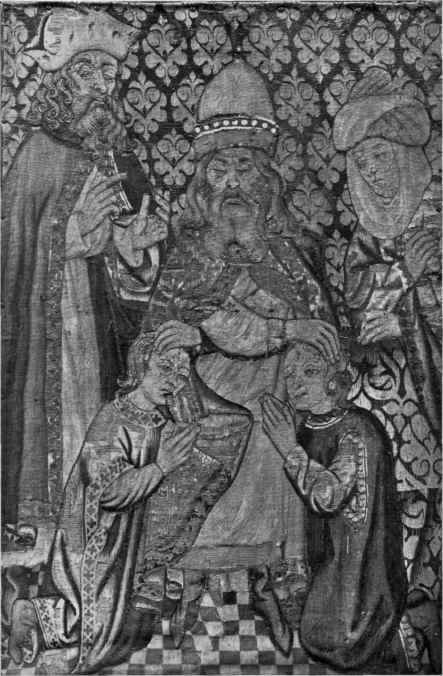
Jacob blessing two children. Part of the Gothic Seven Sacraments tapestry at the Metropolitan Museum, New York.
Only in a few of the large establishments is it possible to purchase these Jacquard tapestry panels at a fair price, from a stock that is large enough to give reasonable choice of designs and sizes. Even there, few or none of the salesmen have ever seen a real Gobelin or learned to understand the difference between real tapestry and imitation. So the writer is confident that those behind the counters, as well as those in front of them, will appreciate the attempt here made to present the points of difference, with illustrations that effectively supplement the printed story.
First, as to what constitutes real tapestry. There have been many poetic descriptions glorifying it with the iridescent beauties of the rainbow, and the rich tones of sunrise and sunset; but such descriptions are of little help in deciding whether a particular textile is or is not a real tapestry. Only a definition based on weave can do that. It is the weave that makes the difference.
A real tapestry is a fabric in plain weave with warp entirely concealed by the weft, which is of uniform thickness, and is exactly alike on both sides, except for the loose threads on the back that mark the passage of bobbins from block to block of the same color. With some exceptions, it is also a rep fabric - that is to say, it has a ribbed surface - and in weaving open slits are left where two colors meet parallel with the warp.
This sounds harder than it really is. If the fabric is ribbed with from seven to twenty-four ribs to the inch, is of uniform thickness and exactly alike on both sides, with the characteristic open slits, then it is a real tapestry. If the threads that float loose on the back are parallel instead of zigzag, then the fabric is not a real tapestry, but a broche tapestry, with body that is thicker where figured. The loose threads on the back are not a necessary criterion, for they can easily be clipped close, leaving the back exactly as if it were the face showing through. This is sometimes done to ancient tapestries, which are then mounted back side out, like two of the famous pieces of the "Seven Sacraments" series of the Fifteenth Century tapestries in the Metropolitan Museum, New York, in order to show the colors, that have faded less on the protected back than on the long-exposed face side.
Between furniture tapestries and wall tapestries there are a number of usual but not vital distinctions. The latter are comparatively large, with coarse horizontal ribs, and tell a story. The former are comparatively small, with fine ribs, either vertical or horizontal, and with designs that are primarily decorative. Of wall-tapestries, wool is the basic material, with gold and silver to add richness and silk to increase high lights. Of French furniture-tapestries silk is the favorite material, with wool to serve as background and to supply the low tones.
The first step in learning how to buy real tapestries is to learn where to buy them. It is foolish to seek fine china in a five-cent store, and it is equally foolish to look for important tapestries in ordinary shops. Tapestries are in a class by themselves, and even the furniture coverings are above the heads of general dealers, few of whom are able to tell the genuine from the imitation. Most of the business in real tapestries - furniture coverings, as well as the vastly more important wall hangings - is done through auction-rooms and decorative shops - not the average auction-room, and not the average decorative shop - just a few that, on account of their high reputation for straightforwardness and quality, have as regular clients persons who can appreciate good things of the sort. Among important tapestries sold at auction in New York City during the last few years were those belonging to Henry G. Marquand, Stanford White, Charles T. Yerkes, James A. Garland, and Henry W. Poor. One of these, sold at the Yerkes sale, a Gobelin on the subject of "Vulcan and Venus," designed by Boucher and woven by Audran, brought $ 17,700. For three or four days before such sales begin opportunity is given to examine the tapestries at one's leisure, and the catalogues supplied are not intentionally inaccurate. But they are seldom as complete as they should be. Perhaps that is why the tendency is for imperfect and damaged and artistically inferior tapestries to sell for more than they are worth, while the superior examples sometimes sell for less than they are worth. Out of twenty large tapestries the writer recently examined in an auction-room, seventeen had never been especially good, while the other three were so badly repaired as hardly to merit house room.
Continue to:


My Books

