


Sec. 4. - Furniture Incrusted With Stones
Description
This section is from the book "A History Of Furniture", by Albert Jacquemart. Also available from Amazon: A History Of Furniture.
This section is from the "" book, by .
Sec. 4. - Furniture Incrusted With Stones
The Renaissance did not limit its aim to mere elegance of form, and the scientific construction of furniture; as soon as its cabinet makers had ornamented their console tables and cabinets of architectural structure with masterly sculptures, it aspired to additional splendour, and enriched the entablatures and pedestals of columns, with panelling of marbles of various forms and colours.
Italy went further, and by an excess of luxury, perhaps because original genius had become exhausted, substituted rare and precious materials for the masterpieces of art, and transformed the "stipi," the armoires, the timepieces, and even the tables into regular mosaics of hard stones (pietra dura). Was it at Florence that this new fashion first appeared? We may believe so, as the work of application of stones took the name of Florentine mosaic, and has retained it ever since.
We will endeavour to follow the different phases of this transformation, the progress of which must have been gradual. First the ebony cabinets received lapis lazuli or jasper columns, with pedestals and capitals of gilt bronze, the compartments of the drawers or the panelled spaces between the columns were ornamented with oval or polygonal medallions of agate, carnelian, jasper, and lapis lazuli. Gilded mouldings soon followed as frames to these rich compositions. One step further remained to be taken, and was soon accomplished; wood was no longer used except as a simple framework, into which the real mosaic works were set, a mosaic certainly very different from the painting in close set cubes invented by the ancients, and which had flourished so greatly in Italy since the middle ages.
The mosaic work of Florence consists in an assemblage of cut pieces, chosen from gems, resembling as nearly as possible the colour of the object intended to be represented; if a bird, the undulations or speckles of the feathers of the breast are imitated by means of one of those finely veined marbles of a tint varying from chamois to brown; the neck or the wings borrow their red stains from carnelian or jasper; if fruits are to be copied - cherries for instance - it is still carnelian that is used, being chosen in its transition state from bright red to white to represent its roundness; and again the effect, if needful, can be heightened by the use of a red hot iron. It has been ascertained that certain stones change their tints when exposed to a high temperature, some assuming a deeper colour, others becoming paler. By skilfully making use of this knowledge, works may be enriched and brought nearer to nature.
A large cabinet in the Musee de Cluny, unfortunately disfigured by successive additions, exhibits the Florentine pietra dura work in its full development. Here we sec landscapes with buildings, in another part birds and fruits, especially cherries, the luminous point in which is obtained by the discoloration of the carnelian by means of heated iron. Most of these subjects are framed in lapis, and the cabinet itself is overlaid with tortoise shell.
It is easy to fix a date, at least approximatively, to the principal modifications we have just pointed out. The stipi, or cabinets simply relieved by columns and medallions of pietra dura which we might designate as gemmed furniture, belong to the last days of the Renaissance. In the reign of Louis XIII. is to be classed the gilded furniture with real mosaics, still retaining that architectural disposition which we pointed out in the carved ebony. A new phase appears under Louis XIV; the small pieces of furniture have disappeared, the "Sun" king requires a far different grandeur from that of these diminutive monuments; the pietra dura work of Florence is not discarded, on the contrary it is destined to cover those enormous tables with gilded feet, on which bronze groups and porphyry vases are set out. But more than that, without seeking it from Italy, it is in Paris itself that it will be executed, in the workshops of the Gobelins, founded by the king, and directed by Lebrun. Magnificent specimens of this work may be seen in the Galerie d'Apollon of the Louvre; it is easy to recognise it by the style of its arabesques, the palmette, shells, and wreaths which surround the royal escutcheons. On comparing them with the mosaics of Italian origin, we find equal perfection and equal intelligence in the patient choice of the elements of the work. While we are speaking of patience, we refer the connoisseur to that table on which a personage belonging to the king's household has represented the map of France divided into provinces, with all the inscriptions minutely incrusted.
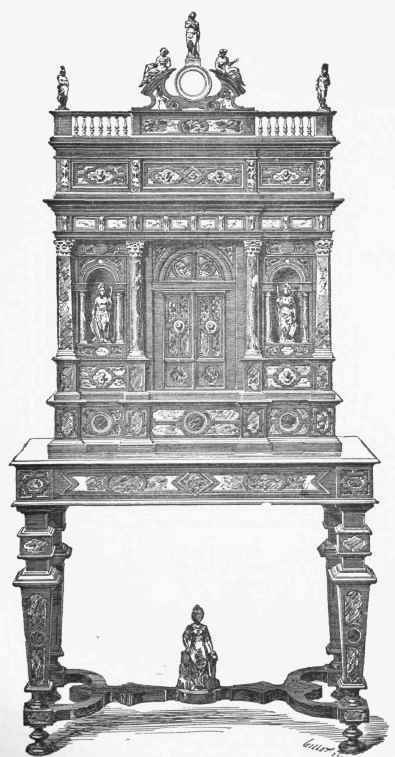
Ebony cabinet with stone mosaics. Italian work of the Seventeenth Century (Florence).
The vast conception of Louis XIV. did not prevent the Florentine mosaic work from being applied to smaller objects : we have mentioned clocks, and we now return to them. Every amateur will have remarked at the Exhibition of the Corps Legislatif, a clock belonging to M. Gustave de Rothschild, the richness of which was unrivalled. Its carved base of variegated jasper had for its central design a bronze gilt palm, whence a bunch of flowers hung suspended. The body, with circular pediment and angular sides, was framed in bronze gilt, with masks crowned by a palmette whence depended two cornucopiae filled with flowers in stones. On a lapis lazuli ground, the dial stood in relief surrounded by a wreath of fruits and flowers in stones enriched by rubies and emeralds; this wreath hung down on both sides. Underneath, surrounded by similar wreaths, was a female bust, executed in stones and framed in bronze. At the angles, bronze gilt caryatides representing the arts and sciences supported the entablature surmounted by an ebony dome, incrusted with gilt bronze, and enclosed by an openwork gallery; the cupola was crowned by a basket filled with fruits in coloured stones.
If we have dwelt so long on the description of this piece, it is because it is of well-known interest; it is not a mere mosaic of stones, it is a sculpture in bas-relief in some parts, and in high relief in others. The form itself of this work of art is remarkable; it is the so-called " pendule religieuse" of the period of Louis XIV., and the beauty of the materials employed, and the perfection of its workmanship, rank it amongst masterpieces of the highest class. The establishment of a workshop for mosaic work at the Gobelins proves the great value attached to this costly work, so thoroughly in accordance with the luxury of Versailles. Indeed it is among the Boule incrustations, and when placed in contact with goldsmiths' work, and vases of hard material, that these mosaics appear to the greatest advantage; they would eclipse by their splendour carved and incrusted ebony, and make the finest patina of the bronzes appear cold.
Continue to:


My Books

