


Incrusted Furniture of The East
Description
This section is from the book "A History Of Furniture", by Albert Jacquemart. Also available from Amazon: A History Of Furniture.
This section is from the "" book, by .
Incrusted Furniture of The East
The Orientals, like ourselves, have had their incrusted furniture, but their system has nothing in common with the mosaics of Florence. Almost always applied upon excessively hard wood, the stones form a relief upon it; to speak rightly, they are sculptures applied upon wood to form pictures. In order to realise a more faithful representation of nature, the artist does not hesitate to employ hard materials, and occasionally even precious stones, with various woods and stained ivory. The latter, in different shades of green, furnishes the stalks and leaves of the bouquets, the flowers of which are of rose-coloured quartz, jade, and topaz; vases will be cut in lapis lazuli, green jade, or rock crystal, and placed on etageres of delicately open carved wood, while graceful fong-hoangs with variegated plumage alight upon rugged rocks surrounded by bamboos and pines. In China most of these bas-reliefs are arranged as pictures to ornament rooms, or are applied to hand-screens, or to folding-screens of many leaves. They are rarely laid to the plain wood; the ground is almost always covered with a coating of blue or rose-coloured lacquer. The real furniture, that is, the etageres, the caskets of greater or less dimensions, show, on the contrary, the wood ground, and frequently, as in the screens, bear inscriptions cut out in jade, or in mother of pearl, in the most prominent part of the piece; this is accounted for, as these inscriptions beginning with the formula, " By order of the Emperor," generally set forth, that the piece is a recompense granted to some high functionary for services rendered to the State. The pictures are sometimes ex-votos placed in the temples, in which case they contain all the emblems of worship, incense-burners, vases for the altar, and honorary insignia.
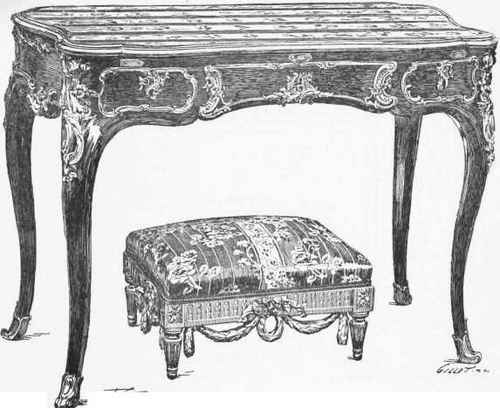
Small rosewood table, mounted in gilt bronze, formerly belonging to the daughter of Louie XV. Footstool in wood, carved and gilded, period of Louis XVI. (Collection of M. Leopold Double).
The Japanese, as it is natural to believe, equal, if they do not surpass, the Chinese in the work of incrusting and carving stones; their large pieces of furniture are almost always lacquered, and the sculptures applied to them are of a perfection and style shewing the hand of true artists; this may be judged from the etagere in Jules Jacquemart's collection, in which an imperial bird is seen, true to life, and of inimitable stateliness.
They have besides brought the work of incrustation down to infinitely small objects, passing from caskets and medicine boxes to breloques and jewellery.
In some of these articles the minuteness of the details takes nothing from their character; there are certain microscopic caricatures in which we can trace the spirited touch and wonderful expression of which we shall have to speak in discussing the works in bronze, ivory, and wood.
We do not now mention the works of India and Persia; not that they have failed to employ stones in natural representations analogous to those of the Chinese, but as the ground of these valuable mosaics is itself chosen from among gems, we shall study the marvellous art of the Indians and Persians when we take these into consideration.
Continue to:


My Books

