


Gems of The East
Description
This section is from the book "A History Of Furniture", by Albert Jacquemart. Also available from Amazon: A History Of Furniture.
This section is from the "" book, by .
Gems of The East
We all know to what an extremely remote age is traced back the art of gem engraving among the Eastern nations. Side by side with the remarkable works of the Egyptians may be placed the cylinders and cones, mysterious witnesses of a long extinct civilisation, the one characterised by the scarabaei, forms inspired by the manners of Egypt, the other by the "pyree," emblem of the religion of Zoroaster, and by the struggle between the lion and the bull, another symbol of the belief in the ceaseless contest between the principles of Good and Evil. We shall abstain- from indulging in questionable hypotheses on the subject of these relics, which were most frequently amulets created by superstition, and the figures on which have still remained uninterpreted by science. The Chaldaean and Assyrian religions being but imperfectly known, recourse has been had to those of the Aachaemenidae and Greeks, for the names which certain analogies of form and attributes seemed to assign to the sacred beings or to their mythical representation. Hence, let us leave Bellis, Parsondas, Mylitta, Oannes, Ormuzd, and pass at once to the domain of authentic history.
In the front rank, must be placed the precious stones preserved in the Paris Cabinet of Medals, showing the effigies of the Sassanian Persian kings from Artaxerxes I. to Chosroes 1.; the bust of Musa, wife of Phraates IV., king of the Parthians; Ashusha, Ptiashkh of the Karkedian Iberians bordering on Armenia, and lastly, the extremely curious, though somewhat barbarous, effigy of the celebrated Zenobia, queen of Palmyra.
No less precious are some Oriental stones with Christian subjects, supposed by M. Chabouillet to be anterior to the persecution of Schahpur II. in the year 340. Amongst them are the Sacrifice of Abraham, the Visitation and the Virgin seated with the infant Saviour, both inscribed with Pahlevic characters; lastly, the bust of Christ and the symbolic fish with Greek monograms and legends.
But the most important monument of these remote times is the famous cup of Chosroes II., which may be taken indifferently as typical of the gem engraver and the goldsmith's art, under the Sassanian dynasty in the fourth century of the Christian era. So true is this that its setting in hammered gold with glass or rock crystal medallions enchased, betrays some striking analogies with the goldsmith's art of the Merovingian period. If we examine the gems, we shall find that the principal piece, a rock crystal disk cut as a cameo, shows both an important effigy and a proof of the progress made by the Persians in gem engraving. We see the King seated on a throne with high back, and the feet formed of winged horses. He presents a front view, with his hair parted 111 two large curled masses falling over the shoulders. His beard is sleek and short, and on his brow is a crown formed of a round mitre, to which is attached a crescent with embattled points. Above the mitre is a second crescent bearing the ball of the sun, whence escape two fluttering fillets. The King is dressed in the "Candys," a sort of embroidered robe, and he rests with both hands on the pommel of his sheathed sword. From the shoulders and the girdle fall two other fillets, larger but analogous to those of the mitre. These are the ends of the so-called "Kosti," a mystic girdle still worn by the Parsees and said to have been invented by Jemshid.
The framework of this medallion and the extreme rim of the cup arc formed of dice in red glass, made to resemble garnets; those of the circumference are disposed vertically, the others horizontally, and the space marked off by them is divided into three circular rows of alternately colourless and violet medallions. The first, of rock crystal, shows an ornamental flower engraved on the reverse, the same flower being cast on the violet glass. The interstices between these medallions are filled in with lozenges of smooth glass of a green colour.
The cup of Chosroes is one of the many relics preserved to history through a false estimate of their real interest. It had been given by Charles the Bald to the Abbey of St. Denis, and in his history of that Abbey, F. J. Doublet thus speaks of it in the year 1625: "A very rich cup set on a gold foot, which is the cup of the wise King Solomon enriched on the rim with hyacinths, inside with very beautiful garnets, and with very fine emeralds; also at the bottom with a large and very excellent white sapphire, engraved in relief on the outside with the figure from life of the said King seated on his throne, with steps adorned with lions on either side in the fashion he is seen represented in the Holy Bible".
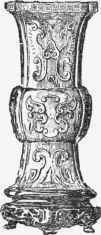
Lupis-luzuli Vase, with ornaments in relief. Antique Chinese work.
The effigy is now no longer open to doubt, fully agreeing with that on the medallions of King Chosroes, who occupied the throne of Persia from 531 to 579. The supposed precious stones have now also been reduced to their proper character of coloured glass and colourless crystal.
But we now come to the year 622, the memorable date of the Hegira. Islamism makes its appearance and is about to overwhelm all the countries of the East, violently supplanting the hitherto prevalent forms of belief. Many artistic works perished in this impetuous torrent, and it may be asked what are the Mussulmans destined to give us in return for all they have destroyed? Very little it must be confessed, for while sparing some edifices, at first by adopting as types of their coins those of the nations whose commerce was firmly established, they rapidly enough contrived to make their iconoclastic doctrines prevail by substituting legends and geometrical combinations for figures and emblems on their seals and engraved stones, as well as on other objects in current use. Still there were exceptions to the general practice, for the Paris cabinet of medals possesses a carnelian talisman on which we see King Solomon seated on his throne, with demons and genii above and at his feet men and the animals subject to him. To the right and left is the legend "Solomon, son of David," and round about is the passage on the throne from the second Sura of the Koran. The gems engraved by the Arabs are generally handled with a firmness implying a complete mastery of the processes. The legends are neatly and elegantly executed, and embellished with delicate arabesques. For the devout Mussulman the highest form of Art is caligraphy, as the means of perpetuating and disseminating the sacred words of the Koran. Hence it is not surprising that Altun, engraver to Tamerlane, acquired such renown that his name has been handed down to our time.
Continue to:


My Books

