


Gems of The East. Part 2
Description
This section is from the book "A History Of Furniture", by Albert Jacquemart. Also available from Amazon: A History Of Furniture.
This section is from the "" book, by .
Gems of The East. Part 2
We have just remarked that the Arabs had to some extent spared the monuments of the civilisations they had conquered. They even became subject to their influence, thus in many cases we see the Byzantine style of ornamentation, slightly modified by their taste, appearing upon their works. As an instance we may refer to the fine rock crystal vase (buire) preserved in the Louvre, and which may date from the tenth century. On its elegantly' modelled oval body with truncated base are developed arabesques and foliage, supporting two sparrow-hawks disposed face to face. Above, encircling the neck which expands into a spout, is the legend in Cufic characters: - "Blessing and happiness to its possessor." This curious piece had been given by Thibaud, Count of Blois, to Suger, who in his turn presented it to the Abbey of St. Denis, where it has been preserved. Nor is this an isolated case, but rather a typical illustration of a whole class. We have seen an analogous piece in which the arabesques, of a more capricious character, exhibited a more decided Oriental influence, the lateral faces showing a group composed of an eagle vanquishing an antelope, that is to say, one of the most favourite subjects of the Asia Minor and Persian artists. This vase we are assured had formed part of the treasures of Aix-la-Chapelle. A third, belonging to the museum of natural history at Florence, and, like the first, inscribed with good wishes, is characterised by two ducks affronted and separated by an arabesque ornamentation in the Moorish style, which must have been executed in the wonderful workshops of Palermo.
Diligent search would doubtless bring to light in Persia other vessels of a similar description, or at least bottles for containing wine. But Oriental works are still so rare that we are unable to credit that country with anything besides cups, mirrors and sword-hilts. The cups are no doubt marvellous; cut in rock crystal or jade, they are slender, elegantly lobed and often set off with incrustations of gold and precious stones, disposed in elegant bouquets with flowers of rubies and emerald foliage. We meet with this arrangement in a pretty rose-water sprinkler, fashioned like a gourd somewhat bent at its extremity, and bearing the iris with small flowers encircled by a mass of leaves with stalks of gold. Notwithstanding their skill in the treatment of glass, it is well known that the Persians have never employed for their mirrors any but common plates of small size. Rut in recompense for this defect they lavished on the framework of these articles of the toilet all the most seductive charms ever inspired by wealth or taste. Here is the description of a mirror that has gone the round of several famous collections. It consists of a rectangular plate furnished with two lateral pivots allowing it to be inclined at various angles, doubtless on supporting columns. The ground is of white jade, divided by an arabesque net-work of black jade incrusted with rubies. Each medallion of the net-work is embellished with a bouquet set in gold, and formed of an iris of Ceylon jacinth with leaves of transparent green jade. With a slight stretch of the imagination, one might fancy such a mirror copied from that which figured amongst the presents of Aladdin to his royal bride. Many Persian pieces in a blackish green jade are wonderfully set off by these incrustations of gold and precious stones.
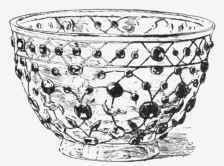
Cup of rock crystal, incrusted with gold and precious stones. Persian work of the Sixteenth Century. (Louvre).
These descriptions might be unduly protracted were we to speak of the jade or rock crystal sword-hilts. Here we should meet with pommels fashioned from the block into heads of lions or horses, and we should see running along the blade bouquets of roses copied from nature with coloured stones, or arabesques heightened with emeralds, rubies and diamonds.
But we must pass on to the Indians, who perhaps excelled even the Persians in boldness and patience. No others ever dared, as they did, to reduce a gem to the last possible limits, and thus risk the fruits of much labour in order to add to a miracle of cutting, a no less surprising miracle of incrustation in gold, set off with precious stones, in which a luxuriant vegetation encircles flowers of topaz growing on hyacinth stems, or a ruby iris with emerald leaves. We may remark as the surest means of distinguishing Persian from Indian works, that political and religious revolutions brought about no change in the taste of the Hindu artists. When we examine their workmanship, we detect a purity of conception in the general form accompanied by a delicacy in the treatment of the details fully worthy of classic art. This is owing to the fact that all the traditions of the past were kept alive by this immutable race, amongst whom might be discovered the first germs of many perfections attributed to the genius of the Greeks. Observe in their jade vases the masterly manner in which the acanthus is treated; see how in the modelling of the handles, in the knobs of the cups, and in the varied reliefs on the surface of the vases, how the various prominences are subordinated to the necessities of the whole This is at once rich and simple, the result of a firmness of composition which is the exclusive dower of consummate artists.
We must now cross the Himalayas and penetrate the extreme East, in order, in company with Marco Polo, to visit those regions of wonders and incalculable wealth. As already stated, and as everyone knows, the East is the country of the finest precious stones. China abounds in quartz, agates, and rock crystal is here found in considerable masses, while jade of every variety would seem to form the mountains, and to pave the beds of the rivers. Hence the employment of these various materials could scarcely fail to become one of the principal local industries. One might almost say that cut stones form the most prominent feature in the decoration of the temples and palaces of the grandees. On their altars the "tings" (incense burners), the sacrificial vases, the lights are of jade worked with marvellous skill. In the state apartments are screens, flower vases, curiously wrought cups, rare groups adorning the stands (etagcres), and challenging the admiration of the visitor. Occasionally large masses of jade of exceptional form have been left in their rough state, the artist contenting himself with inscribing some lengthy legend on them, or at their base hewing out a grotto in which a recluse is seen expounding to sages the precepts of the ancient volumes. Surprising also are the graceful and intricate forms of the vases, for we see that it must have taken years to carve them in all their endless details, to perforate the meanders of their lids, to detach from the mass and fashion into movable rings the appendages to their handles and rims, or in places to isolate the branches twining over their surface, thus giving rise to pliant and tender foliage, to flowers and fruits, which one feels tempted to pluck.
Continue to:


My Books

