


Henri II. And The Second Half Of The Sixteenth Century. Part 3
Description
This section is from the book "French Furniture", by Andre Saglio. Also available from Amazon: French Furniture.
Henri II. And The Second Half Of The Sixteenth Century. Part 3
In the dressers made in the reign of Henri IV. we see the final collapse of the school of Du Cerceau but a few years after the death of the founder of the Ile de France school, whereas in the so-called Louis XIV. style can be traced its derivation from the true Gallic art originated by the architect-craftsman of Dijon.
The Museum of Besancon owns two pieces of furniture that are supposed to be the actual work of Hugues Sambin - a table and an armoire. Although the design is far more complicated than that of the door of the Archives or the choir-screen of the chapel of the Palais de Justice at Dijon, the authenticity of which is fully established, these works were certainly either executed by him, or at least, which is much the same thing, produced after his designs under his superintendence, so that we feel justified in briefly describing them as typical examples of the Burgundian style. The master was, it is well known, at Besancon in 1581,.and took up his residence with a carpenter and painter belonging to the Gauthiot d'Ancier family. Indeed, the two pieces of furniture in question figure in the inventory of that house, and the armoire bears the date 1581. The table is upheld by two fan-shaped supports, the central portion of which is a terminal ending in the head of a grinning satyr, whilst the sides are two volutes ending at the bottom in lion's claws and at the top in rams' heads, rather clumsy for the size of the table, but well carved; the massive rests are decorated with foliage, and the edgeof the table with carved ornamentation.
The armoire is, perhaps, unique amongst the furniture of the second half of the Renaissance, on account of its complicated structure, although simplicity was never a characteristic of that time. It bears some resemblance to a dresser by a pediment upholding the central portion, which is of semi-circular form, and is further supported by brackets jutting out from a single console, the base of which now represents a chimaera that replaces a "satyr holding a cow-herd's horn," referred to in the old inventory; on either side is a two-storied wardrobe, separated by a drawer. Architectural motives are carved along the top, and on a pediment upheld by female figures are the arms of the Gauthiot family, and a bas-relief of various trophies. To wind up a description that may serve to give some idea of the lavishness of Burgundian ornament we may add that on the front, which is divided by columns, and along the top of the armoire eight mythological figures, representing Lucretia, Mercury, Flora, Ceres, Pan, Envy, Apollo, and Orpheus, are painted in cameo picked out with gold.

Plate XIV. CUPBOARD. Middle of XVI Century.
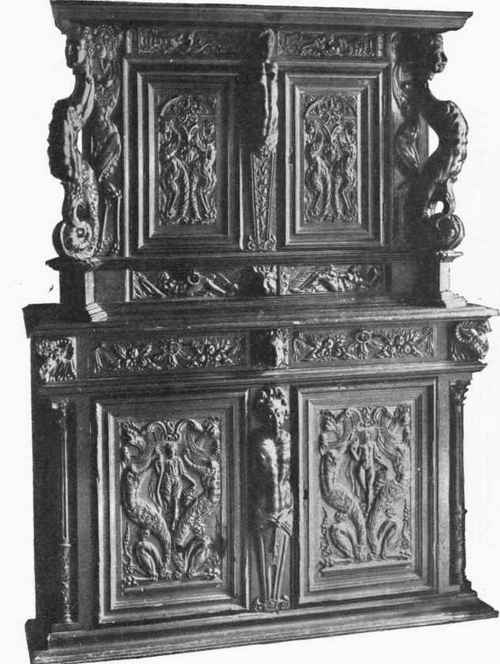
Plate XV. SIDEBOARD. Epoch Francis I. Cluny Museum.
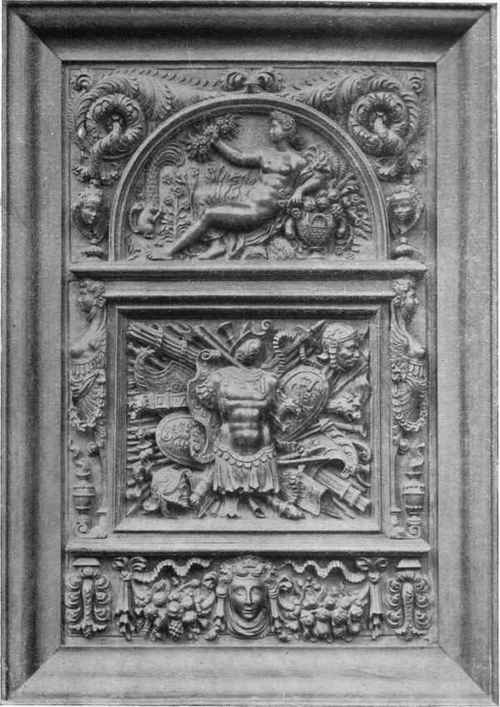
Plate XVI. PANEL OF CUPBOARD. School of Hugues Sambin. Middle of XVI Century. Boy Collection.
As we have had occasion to refer to paintings on the work of Sambin, we must warn our readers that the impression produced at the present day by furniture of earlier date than the seventeenth century with what may be called the beautiful patina of the old wood, polished by the action of time till it looks like antique bronze, is quite unlike what it was in mediaeval and Renaissance times. There is no doubt that all these pieces of furniture were originally covered with paintings which would have seemed garish in modern rooms. But before we criticise this vanished fashion we must bear in mind that the way of looking at things differs very much at different periods - a fact that should never be lost sight of in dealing with the art of the past. The Greeks, for instance, to quote but one example, painted the marbles of Phidias, and indeed all their sculptures, with purely conventional colours. Moreover, it must be remembered that in old France, rooms were very large and scantily furnished, whilst the walls were hung with tapestries of gorgeous colouring, so that if the natural colour of the wood of the sideboards, wardrobes, and tables, the dark shining tones of which we now admire so much, had been left untouched, the effect would have been cold and gloomy.
We give a reproduction of an armoire belonging to Mme. la Comtesse Arconati-Visconti, which is specially valuable because it retains traces of painting and gilding that leave no doubt as to the brilliancy of the colours used to embellish the work of cabinet-makers.

Plate XVII. TABLE. Second half of XVI Century. School of Hugues Sambin.

Plate XVIII. CHEST. Middle of XVI Century. Carnavalet Museum, Paris.
We will not pause long over the remarkable personalities of Du Cerceau and Sambin, who were really great enough to dominate half a century. The illustrations accompanying our remarks will do more to bring out the strength of their influence than the descriptions we have felt bound to give, and our necessarily arbitrary classification of a subject that has already been treated by many others.
Simultaneously with the engravings of these two masters, many drawings, some of which have been preserved, were circulated in the ateliers and elsewhere throughout the whole of France. Some few, and those by no means the least artistic, were the work of their disciples. The name of one only has come down to us, that of Etienne de l'Auln, who worked chiefly in the reign of Henri IV.; but now and then part of some good design happened to fall into the hands of a clever artist with little imagination, who would simply content himself with reproducing it exactly on all the panels of some piece of furniture. This was the case with one of the best decorated armoires of the end of the sixteenth century which passed from the Spitzer to the Salting collection, and has on each of its folding-doors a carving of the antique Laocoon, the pose being simply reversed.
Continue to:


My Books

