


VI. The Excretion Of Acetone Bodies - Fasting and Undernutrition
Description
This section is from the book "Part 8.2. Inanition (Fasting) And Fattening Cures - On the Pathology and Therapy of Disorders of Metabolism and Nutrition", by Prof. Dr. Carl von Noorden. Also available from Amazon: Clinical Treatises On The Pathology And Therapy Of Disorders Of Metabolism And Nutrition V8: Inanition And Fattening Cures (1910)
VI. The Excretion Of Acetone Bodies - Fasting and Undernutrition
A knowledge of the laws governing the excretion of acetone bodies during fasting is theoretically interesting and practically important. Sometimes acetonuria is a serious danger signal, at other times it may be simply one of the harmless consequences of faulty diet arrangement; in the latter case it would be very wrong to interpret the appearance of acetone bodies in the urine as evidence of threatening autointoxication. In order to understand the significance of acetonuria it becomes necessary to understand its relation to the quantity and the quality of the diet ingested.
The most important source of the acetone bodies are no doubt the lower fatty acids. These, provided they are not introduced pre-formed with the food, are derived within the organism from the catabolism of higher fatty acids. For reasons that are not yet fully understood the presence of carbohydrates is necessary, in order to promote the proper splitting and oxidation of the lower fatty acids. Possible that the co-operation of the carbohydrates in this process constitutes a "contact effect," possible that the fatty acids form a chemical combination with the carbohydrate molecule as a preliminary step to normal disassimilation. Whereas in process of normal degradation in the presence of carbohydrate, butyric acid forms in rapid succession oxybutyric, acetic acid and finally as end products carbon dioxide and water, this oxybutyric acid, in the absence of carbohydrate, forms diacetic acid and then acetone and water. The smaller the proportion of available carbohydrate the larger the proportion of fatty acids that is disassimilated by this route; and under these circumstances the destruction of the oxybutyric acid that is formed as an intermediary product also suffers, so that a certain amount of the latter acid also makes its appearance in the urine. The following formulae illustrate the normal and the pathological disassimilation of butyric acid:
1. ch3
CH3 = Butyric Acid
CH2 (Common Mother Substance)
COOH
2. From butyric acid is generated by the addition of
1 atom of O
CH3
CHOH = B-oxybutyric Acid ch3
COOH
3. From here two paths are open, the one the normal and the other the pathological:
Normal
3 a. Still another atom of O is added while at the same time the chain is split, so that two molecules of acetic acid are formed.
ch3
COOH
=2 molecules of Acetic Acid ch3
COOH
4 a. The readily combustible acetic acid is oxydized by the aid of 8 atoms of oxygen to 4 molecules of COa and 4 molecules of H20.
Pathologic
3 b. By the aid of one atom of O, 1 molecule of H20 is split off - diacetic acid remaining.
ch3
CO + H20 = Diacetic Acid and Water ch2
COOH
4 b. The diacetic acid either maintains its integrity or is decomposed to ch3
CO = Acetone and Water
It has been mentioned above that an individual completely fasting very rapidly consumes his glycogen reserves. Under these conditions carbohydrate becomes deficient in the liver cells where the degradation of the lower fatty acids chiefly, if not exclusively, occurs. In the absence of carbohydrate from the hepatic cells the decomposition of the lower fatty acids consequently occurs according to the pathological formulae delineated above. Inasmuch, however, as all the carbohydrate groups that are split off from the proteids still remain at the disposition of the organism in inanition, acetone bodies are excreted only in moderate quantities. Enough of acetone bodies is, however, excreted to produce a definite acetone and diacetic acid reaction in the urine by the second day of fasting. On the third and fourth days of fasting the intensity of this reaction increases considerably. On the second day one can demonstrate the presence of oxybutyric acid in the urine with methods, it is true, that are somewhat complicated.
Quantitative investigations show that the absolute quantity of acetone bodies excreted by a fasting subject fluctuates in each individual. The exact cause of these differences is not yet understood. The values fluctuate during the first four days of starvation as follows:
From 0.5 -2.0 g of acetone + diacetic acid and from 2-13 g of oxybutyric acid - pro die
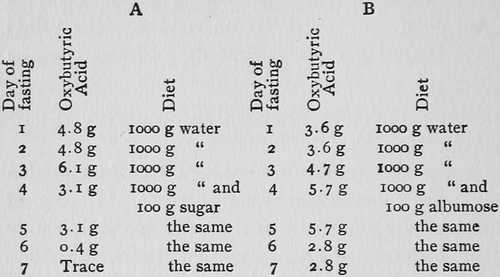
It can readily be demonstrated that in inanition ketonuria is due to lack of carbohydrate. If 100 g of carbohydrate are given to a fasting individual, only 410 calories are being supplied with the food and the subject consequently remains in a condition of advanced undernutrition. This is demonstrated in the case report given below (Case A) where 100 g of carbohydrate nevertheless suffice to rapidly reduce the excretion of acetone or to completely suppress it. In Case B, below, the sugar was replaced by an equal quantity of pure readily soluble protalbumose made out of fish (trade-mark "Ribo"). This pabulum was completely absorbed and, although the quantity of proteid represented exactly the same caloric value, namely 410, as the carbohydrate administered in Case A, its administration exercised only a very slight effect upon the excretion of acetone bodies. This slight reduction in the excretion of acetone bodies is attributable to the fact that in process of degradation all proteids split off a certain amount of carbohydrate, varying according to the nature of the albumen. In interpreting the following tables it must be remembered that for the sake of clearness the total amounts of acetone bodies are calculated as oxybutyric acid.
The importance of carbohydrates in the normal disassimilation of fatty acids is so great that abundant quantities of the acetone bodies are formed and excreted even when a proteid-fat diet is administered that provides a sufficiently high caloric value to supply the caloric demands of the organism. One of my former assistants performed the following experiment on himself:
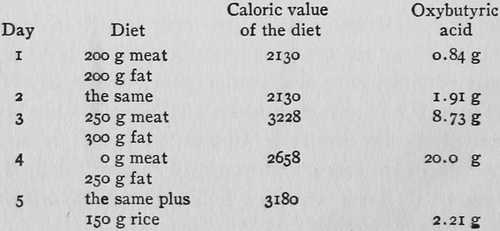
The weight of this individual and the amount of labor performed by him called for a caloric supply that was estimated as not to exceed 2300. Although the diet during the first two days incorporated nearly this number of calories and exceeded this figure on the two succeeding days, the excretion of oxybutyric acid nevertheless increased, owing to the lack of carbohydrate in the food; as soon as carbohydrate was added to the food on the fifth day, the excretion of oxybutyric acid promptly decreased.
Under these conditions it is not surprising to discover the development of acetonuria in a diabetic individual whose diet is suddenly changed from mixed feeding to feeding with a carbohydrate-free diet. This acetonuria in diabetes is frequently only a result of such a change in the diet and a phenomenon that is by no means specific of diabetes, but one that would occur in any healthy subject submitted to a similar change of diet. It is characteristic of diabetes, however, to see abnormally high degrees of acetonuria, and especially to see this large excretion of acetone bodies persist despite the addition of carbohydrate pabulum to the food. In the same sense the excretion of large quantities of acetone in patients suffering from high fever, severe acute gastric catarrh, gastric hemorrhage, uremia, etc., need not surprise us, nor should it be considered specific of any of these diseases; for some of these patients are incapable of ingesting more than a little meat broth and most of them eat nothing at all, so that one is dealing here with an acetonuria due to inanition or to lack of carbohydrates.
In chronic undernutrition even of long standing and when accompanied by advanced degrees of emaciation we relatively rarely encounter clearly demonstrable acetonuria. This is due to the fact that individuals taking small amounts of food as a rule eat a relatively large proportion of carbohydrate material. At first the amount of fat that is taken becomes reduced, then the proteid ingestion becomes smaller as the appetite sinks and the possibility of giving an adequate amount of food becomes less; not until the degree of undernutrition approaches actual abstinence from all food, fasting, does the intake of carbohydrates become so small that the fatty acids can no longer be disassimilated in a normal manner and acetone bodies are formed. When this point is reached, acetonuria constitutes a danger signal; and it is high time to employ all possible measures that can be directed towards preventing further undernutrition. Otherwise toxic conditions are very liable to develop that closely resemble diabetic coma. To this category belong so-called coma carcinomatosum, coma dyspepticum, etc. In all such cases, in which the introduction of food in sufficient quantities by mouth or by rectum becomes impossible, I advise infusion of a 10% solution of dextrose or levulose (1 liter a day). Such solutions introduced either subcutaneously or intravenously are very well borne.
Continue to:


My Books

