


1. Proteids - Fattening Foods
Description
This section is from the book "Part 8.2. Inanition (Fasting) And Fattening Cures - On the Pathology and Therapy of Disorders of Metabolism and Nutrition", by Prof. Dr. Carl von Noorden. Also available from Amazon: Clinical Treatises On The Pathology And Therapy Of Disorders Of Metabolism And Nutrition V8: Inanition And Fattening Cures (1910)
1. Proteids - Fattening Foods
Proteids do not possess great fat tening value and no other class of foods requires so large an expenditure of energy on the part of the digestive apparatus in proportion to the calories placed at the disposal of the organism. On a mixed diet, as we have seen, about 8% of the energy incorporated in the food must be charged to this account. In the case of the proteids, however, as much as 12 to 15% must be charged to the labor of digestion itself. In addition, proteids act as a bellows upon the oxydative processes (so-called dynamic action of proteids, M. Rubner). A proteid diet, therefore, stimulates a useless consumption of a part of the total energy that it is intended to force the organism to store. This peculiar action is very considerable and may lead to a destruction of almost half of the energy contained in the surplus diet, provided the latter is administered exclusively in the fo.rm of albuminous pabulum.
An individual fed on an ordinary maintenance diet ingests daily an average of 100 g of proteids. Practically it is impossible to increase this quantity above 150 g, and we thereby gain an increase of only
50 x 4.1 = 205 calories.
Even 150 g of albumen given daily are frequently too much, and are rarely tolerated for any length of time, even by individuals who are originally heavy meat eaters. Subjects who are undergoing an artificial fattening cure are usually afflicted with a weak appetite. Large quantities of albumen still further damage the appetite, probably because they impose more labor upon the gastric function than any other article of food and because the stimulus of appetite emanates more from the stomach than from the intestine. If large quantities of albumen, therefore, are given, it usually becomes a difficult matter to incorporate in the diet the desired increased quantities of other articles of food, and it is precisely these other articles of diet that must be utilized to increase the total caloric intake. I can hardly advocate the plan of administering concentrated albumen preparations with the object in view of increasing the proteid ration without giving too large volumes of albuminous food. I am particularly averse to the use of insoluble albumen powders (Nutrose, Plasmon, Roborat, Tropon, etc.). Whenever I have been induced to utilize these preparations, I have always found them to be rather a detriment than an advantage in any attempt to increase the total intake of caloric values. A somewhat more favorable verdict can be expressed in regard to soluble albumen preparations. While the total calories that one can introduce with them is not very great (often corresponding only to 20 g of dried albumen or 84 calories), they are nevertheless useful and convenient in practice, because in such small quantities they act as a distinct stimulus to the appetite. Just why this should be so remains for the present undetermined. There is a great variety of these soluble albumen preparations. My personal experience is essentially limited to Somatose (an albumose made out of meat) and to Ribo (a readily soluble albumose made out of fish, but yet not on the market). The latter product is tolerated better than Somatose and it does not possess the disagreeable property of producing diarrhoea. It is possible to increase the daily intake of Ribo up to 6o or 80 grammes, and this particular albumen preparation is almost completely absorbed.
The optimum of the albumen intake in fattening cures lies in my judgment between 100 to 120 g. Such quantities are usually incorporated anyhow in the diet that one uses in fattening cures (meat, fish, eggs, milk, etc.); if not, this amount can easily be supplied by one of the preparations mentioned above.
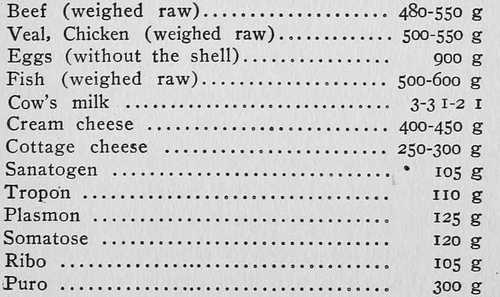
I herewith submit a small table giving the quantities of several articles of food containing 100 g of albumen:
Continue to:


My Books

