


2. Carbohydrates - Fattening Foods
Description
This section is from the book "Part 8.2. Inanition (Fasting) And Fattening Cures - On the Pathology and Therapy of Disorders of Metabolism and Nutrition", by Prof. Dr. Carl von Noorden. Also available from Amazon: Clinical Treatises On The Pathology And Therapy Of Disorders Of Metabolism And Nutrition V8: Inanition And Fattening Cures (1910)
2. Carbohydrates - Fattening Foods
Carbohydrates have always enjoyed great popularity as a means of fattening. Most of them can be prepared in a very palatable form and there is an almost unlimited variety. In the preparation of this class of foods, the tastes of the patient, as well as the digestive powers of the stomach and intestines, can to a wide extent be considered. Aside from diabetes mellitus and certain forms of fermentative dyspepsia, there is no disorder in which these foods cannot be used extensively in order to produce a gain of weight. Nevertheless one should expect occasionally to encounter difficulties when they are given in large quantities, for the power of the digestive apparatus to absorb carbohydrates varies greatly in different people. Individual and geographic peculiarities and habits have to be considered. In Southern Germany and in Austria-Hungary and in most of the Romanic countries almost twice as much carbohydrate is eaten by the natives as in Northern Germany, Scandinavia and large parts of Russia. Among the former one can figure on a daily adult consumption of 400 g of carbohydrate, among the latter of 200 to 300 g. The consumption of fat is exactly the reverse.
One important element must be considered in the administration of a one-sided carbohydrate diet that often hinders attempts to produce fattening by this means, namely, that most carbohydrates, if prepared in a palatable form, become so bulky that their volume is out of all proportion to the caloric value that they incorporate. It is true that there are certain foods made of flour that incorporate a high percentage of carbohydrate, as for instance, bread and other bakery goods (averaging 60 to 70% carbohydrate), and rice and macaroni with an average of from 30 to 40% carbohydrate (in a properly prepared form). Unfortunately these highly concentrated foods made from flour are not of great value in fattening cures, because they are too filling. In fattening cures the available carbohydrate foods must be calculated to contain on an average not more than 20% carbohydrate (either in the form of flour or in the form, of sugar). For this calculation of averages the following articles of food have been considered: milk, soup, gruel, purées, dishes made from flour, desserts, fruit, cheese, fruit sauces and fruit.
The average voluntary ingestion of carbohydrate in an individual that is to be fattened probably does not exceed 180 g. If the carbohydrate foods are properly distributed over the different meals, and if the proper amount of carbohydrate food is selected, this amount can without great difficulty be increased to about 320 g during the course of the fattening treatment. This signifies an increase of 140 g, containing 570 calories, certainly a considerable sum; 320 g carbohydrate, however, require a volume of 1600 ccm of ingesta. This is not too much, for there are included in this volume the greater part of the fats that are to be taken. It is difficult from the standpoint of the cook to include more than a small portion of the albuminous foods in this volume. To administer them a further increase of the volume of the food becomes necessary.
If now one attempts to give still more carbohydrate then the volume of the food increases so much that difficulties in its administration arise. Under direct medical supervision and under the régime of a sanatorium, etc., it is possible, of course, to give even greater quantities of carbohydrate. Kussmaul, for instance, was in the habit of giving enormous quantities of carbohydrate (in the form of soup, gruels, mushes, etc.) in his fattening cures; in fact he gave as much as 400 to 500 g of amylaceous foods. As soon, however, as the patients were dismissed from the institution and were no longer forced to eat these large quantities of carbohydrate food, they lost the accumulated flesh because they reduced their food intake. I have often witnessed a disappearance of fat accumulated in this way by one-sided carbohydrate feeding within a short time. The volumes of food are too great I should consequently advise not to exceed 300 to 320 g of carbohydrate in general. In this way an introduction of from 1230 to 1310 calories is always assured. Only in those cases in which saccharine fruit juices can be employed would I advise as practical the attempt to introduce more carbohydrate. I am thinking in particular of unfermented grape juice, a bottle of which is generally willingly taken during the day. This beverage is very refreshing and nourishing and at the same time possesses mild laxative properties, an effect that is very desir able in many patients. The pasteurized grape juice from Istria (A. Cerovas in Bruck a. d. Mur) contains 18% of inverted sugar and incorporates in a bottle of 750 ccm not less than 550 calories. I have frequently prescribed a bottle of this preparation as the sole fattening addition to the diet with good results in cases in which it was otherwise impossible to increase the food above the maintenance diet. A result of this kind is not surprising when we consider that the 550 calories of surplus furnished in this way imply a daily fat deposit of about 60 g.
In addition to the ordinary carbohydrate foods that are available in any ordinary bill-of-fare, there are a large number of other preparations containing abundant carbohydrate on the market. An old-established adjuvant is malt extract. One can easily add 50 g of Hoff's Malt Extract to the milk each day without spoiling its taste. One of the cereal preparations called Kufeke's Children's Flour (100 g = 370 calories) that is so popular in pediatric practice may become a welcome addition to the diet in difficult cases, particularly in the beginning of a fattening cure. In general too little use is made of these artificial carbohydrate foods. In America a much greater variety of these products is available than in Germany. In the United States, as well as in many regions of England, it is customary to eat a cereal for breakfast, usually with thick, sweet cream. Such a mixture constitutes a very nourishing and readily digestible food. I mention in particular porridge made from oatmeal, then a thick gruel made from hominy (a mais preparation) and also Grape Nuts, a preparation that has recently become very popular. The latter is made of slightly roasted wheat. I have learned to appreciate this preparation as a particularly useful adjuvant in fattening cures. A very practical and nutritious method of preparing it is the following: About 40 g of Grape Nuts are heated with a little water for 15 minutes in a water bath, then thoroughly mixed with 40 g of butter and served with 60 cc of thick. (40 per cent.) cream. This very palatable dish incorporates in a small volume not less than 650 to 670 calories. All these preparations are useful, less on account of their inherent nutritive value than on account of the facility with which large quantities can be given together with fat. The more butter, cream, etc., a food of this kind can absorb without revealing the taste of fat, the more useful it is in a fattening cure. In this respect Grape Nuts occupy first place.
I cannot endorse the popular recommendation of cocoa as a fattening means, for cocoa rather destroys than stimulates the appetite and it does not equalize this defect by a very high nutritive value. In addition, cocoa frequently predisposes to constipation. Of the preparations of cocoa that I am familiar with, Rademann's nutritive cocoa (containing milk sugar) and Meinl's Maltine Cocoa form an exception. They stimulate peristalsis and, while possessing higher nutritive value than ordinary cocoa, do not satiate so much. Both permit the abundant addition of butter and cream.
The greatest possible increase in carbohydrates is of particular importance in cases in which it is desired to increase the albumen content of the body; for the albumen sparing influence of the carbohydrates, that has been pointed out in particular by Voifs school, is, from a practical standpoint, more important than the retention of albumen that may be forced by an exaggerated increase of the albumen intake.
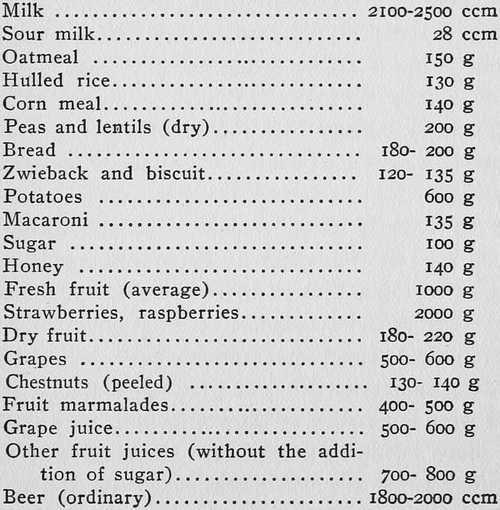
The following table demonstrates what quantities of different important articles contain 100 g of carbohydrate in addition, of course, to other substances:

Continue to:


My Books

