


Wine Of The First Quality
Description
This section is from the book "Mrs. Charles H. Gibson's Maryland And Virginia Cook Book", by Charles H. Gibson. Also available from Amazon: Mrs. Charles H. Gibson's Maryland And Virginia Cook Book.
Wine Of The First Quality
Carefully pick the grapes from the stems, rejecting all green and decayed berries. Crush them in an ordinary apple crusher; should you desire the wine to be light colored, with delicacy of taste, press lightly in an ordinary cider press. If it is desired to make a red wine, with full body and astringency, mash the grapes and let them stand in a cask or vat, covered with cloth, for twenty-four hours, before pressing. The longer the fermentation of the mash and must continues the more astringent and rough the wine will be, and the sooner and lighter he presses it the less character will the wine acquire, though it will be much more delicate and smooth. Before filling the vessels they should be perfectly clean and sweet, without the slightest mouldiness. It is best, where wooden kegs or casks are used, to dip a strip of canton flannel in melted sulphur and igniting it, hang it by a wire in the bung-hole of the barrel, and after letting it stand bunged up with the vapor of sulphur in it for an hour or so, rinse well with clean water. The best ripe juice put in a musty barrel will make only a spoiled wine. Should the barrel hold twenty gallons put in forty pounds of grape sugar or glucose - the best is that made by the Buffalo Grape Sugar Co. from corn starch - that made from potato starch is apt to give an earthy taste to the wine. In no case use cane sugar, for the vinous fermentation of cane sugar always produces rum, while that of grape sugar produces wine.
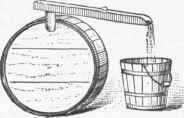
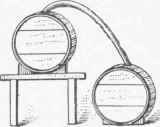
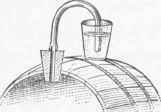
As soon as the fermentation commences let the skins, seeds, and froth work out of the barrel. This is best accomplished by having a tin gutter adapted to a bung piece. As you keep the barrel and bung piece full to an overflow, all the impurities will work out. When clear, the first fermentation may be said to begin. Place the barrel in a cool cellar, and set it up high enough so that it can be drawn out by a siphon into another barrel at will, without disturbing the sediment. Insert in the bung a plug, say four inches long, into the centre of which is placed a tube. It is essential to wax around the bung and tube, so as to force all the carbonic acid gas, that results from the fermentation, through the tube and into the tumbler of water in which the tube is immersed. If the wine is thus put away, say about the 1st of September, the first fermentation will last until about the 15th of October, at which time the barrel must be filled up with juice and bunged up tight. It is well to look at it every two or three weeks, and fill up the barrel. It is essential to success to keep the barrel full, so that as little air as possible shall act upon the surface of the wine. In the Spring, say April, when the vine is again in bloom, the second fermentation will begin.
Second Fermentation.
All that is necessary to be done is to loosen the bung and let the barrel have vent. The fermentation will be over May 1st, when it will require to be filled again to the bung and tightly closed. By the 15th of June the wine will be settled clear, when it may be bottled for use.
Continue to:


My Books

