


3. Menispérmum [Tourn.] L. Sp. Pl. 340. 1753
Description
This section is from the book "An Illustrated Flora Of The Northern United States, Canada And The British Possessions Vol2", by Nathaniel Lord Britton, Addison Brown. Also available from Amazon: An Illustrated Flora of the Northern United States, Canada and the British Possessions. 3 Volume Set..
3. Menispérmum [Tourn.] L. Sp. Pl. 340. 1753
High climbing vines, with small whitish panicled flowers. Sepals 4-8, arranged in 2 series, longer than the 6-8 petals. Stamens 12-24. Anthers 4-celled. Pistils 2-4, inserted on a slightly elevated receptacle and generally accompanied by 6 sterile filaments. Drupe nearly globular, or ovoid, laterally flattened, the stone curved into a spiral and crested on the sides and back. [Greek, moonseed.]
A genus of 2 species, the typical one native of eastern North America, the other of eastern Asia.
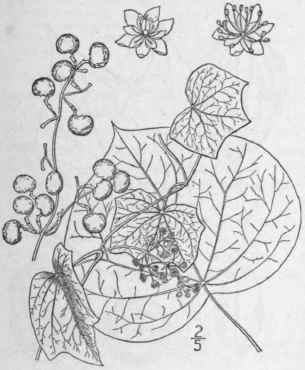
1. Menispermum Canadénse L. Canada Moonseed
Fig. 1964
Menispermum canadense L. Sp. Pl. 340. 1753.
Stem climbing over bushes or walls, 6°-12° in length, slender, slightly pubescent, or glabrous. Leaves slender-petioled, very broadly ovate, 4'-8' wide, cordate or sometimes nearly truncate at base, acuminate, acute or obtuse, entire or with 3-7 lobes, pale beneath, peltate near the base, although the petiole is sometimes inserted so near the margin that this character is not apparent; flowers white, 2" wide; panicles loose, bracteolate; drupe globose-oblong, 3"-4" in diameter, the stone spirally curved.
In woods along streams, western Quebec to Manitoba, south to Georgia, Nebraska and Arkansas. Ascends to 2600 ft. in Virginia. Bunches of fruit bluish black, with the aspect of small grapes. Texas or yellow sarsaparilla. Yellow parilla. June-July.
Continue to:


My Books

