


![next page: 3. Menispérmum [Tourn.] L. Sp. Pl. 340. 1753](../../../images/nav/page_next.gif)
2. Epibatèrium Forst. Char. Gen. 107. 1776
Description
This section is from the book "An Illustrated Flora Of The Northern United States, Canada And The British Possessions Vol2", by Nathaniel Lord Britton, Addison Brown. Also available from Amazon: An Illustrated Flora of the Northern United States, Canada and the British Possessions. 3 Volume Set..
2. Epibatèrium Forst. Char. Gen. 107. 1776
[CÉbatha Forsk. Fl. AEgypt. 171 Hyponym. 1775.]
[Cocculus DC. Syst. Veg. 1: 515. 1818.]
Climbing vines with small dioecious panicled flowers. Sepals 6, arranged in 2 series.
Petals 6, shorter than the sepals, concave. Stamens 6; anthers 4-celled or 4-lobed. Pistils 3-6, sometimes accompanied by sterile filaments; styles erect; stigma entire. Drupe globose or ovoid, the stone flattened, curved. [Greek, referring to the climbing habit.]
A genus of about 11 species, mainly of tropical regions, two or three in the temperate zones. Type Species: Epibatcrium pendulum Forst.
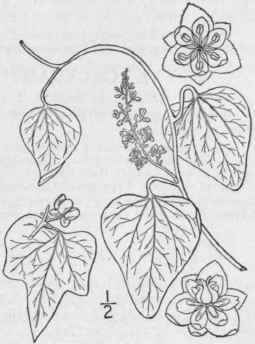
1. Epibaterium Carolinum (L.) Britton. Carolina Moonseed
Fig. 1963
Menispermum carolinum L. Sp. Pl 340. 1753. Cocculus carolinus DC. Syst. Veg. 1: 524. 1818. Cebatha Carolina Britton, Mem. Torr. Club 5: 162. 1894.
A slender vine, trailing, or climbing to the height of several feet, the stem glabrous or pubescent. Leaves broadly ovate, 2'-4' long, cordate or rounded at the base, entire or lobed, acute or obtuse, sometimes densely pubescent beneath, mainly glabrous above; petioles slender, 1'-4' long; panicles axillary and terminal, loose, 1'-5' long; flowers about 1" broad; drupe red, laterally flattened, 2"-3" in diameter, the stone curved into a closed spiral, crested on the sides and back.
Along streams, Virginia to Illinois and Kansas, south to Florida and Texas. Red-berry moonseed. June-Aug.
Continue to:


My Books

