


Pattern Making For Amateurs. XII. A Small Hand Wheel
Description
This section is from the book "Amateur Work Magazine Vol4". Also available from Amazon: Amateur Work.
Pattern Making For Amateurs. XII. A Small Hand Wheel
F. W. PUTNAM
Fig. 76 shows a small hand wheel for a rapid-acting woodworker's vise, and Fig. 77 the pattern for same. It will be noticed that a hole | in. in diameter is to be bored through the hub, and a small key-way cut out. This is done after the casting is made and does not concern the pattern maker. This pattern may be made from one piece of stock 6 1/4 in. square and I 3/4 in. thick. A circle 6 3-16 in. is marked on the block; and after the block has been cut to this circle it is placed on a screw center, and one side is turned up. The side which is turned first is the side A, Fig. 77. A templet should be made to fit the hollow at B. A templet to lit the arc of the circle at C will also be found useful. Care must be taken in hollowing out at B to get the depth exactly 1/4 in. After the first side has been turned and sand-papered, a center mark is made at the center of the hub to serve for the hole for the screw center when the pattern is turned around. The opposite side is now to be turned, the rim being finished first. It will be noticed that the rim takes the shape of a 3/4-in. circle; and it will be found advisable to finish this before the hollow at B is cut in. There should be left a thickness of 1/4 in. for the arms or spokes of the wheel. The pattern is to be drawn out from the sand in the direction shown in the arrow and the hub should, therefore, receive a little draft. When the pattern has been finished in the lathe, the next thing to do is the marking out of the four arms. The grain should run parallel with two of the arms, thus leaving but two of the arms with cross grain. The top view of Fig. 77 gives the dimensions for marking out the hole necessary to form the sides of the arms. The arcs of circles at D may be bored, preferably with a Forstner bit. This bit has no spur and therefore the stock - which is but 1/2 in. thick - will not split so readily as it would if a bit with a spur were used. A small key-hole saw may be used for cutting away the remainder of the wood. The arms are to be round, as shown in the section at E, Fig. 77. This is done with a small half-round file. Care must be taken in filing the two arms having cross grain so as not to cause them to split. All holes should be bored before any extra material is removed. The filing is done after all surplus material is removed. The surfaces cut away should finally be sandpapered, and the pattern finished as usual. This pattern might have been made with inserted arms, as was done in the case of the small hand wheel described in the December number of Amateur Work.
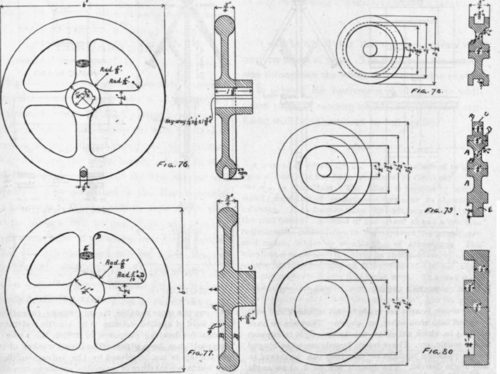
Fig. 78 shows the casting for a small wheel cut out at the rim to receive a small, round belt. This pattern requires a special sprue in molding, and the method of using this sprue will be taken up in a later article. The pattern, which is shown in Fig. 79, is to be turned first, and then the block is turned around so that the other half may be turned. Both sides of the pattern are alike and care must be taken to make all measurements the same on both sides. This pattern is molded so that the parting ine between the cope and nowell comes at B, Fig. 79. A little draft will be necessary both on the surface C and at D. This pattern is much smaller than the one just described for the hand wheel, and trouble may be experienced when the block is turned around on the screw center for the turning of the second side, because of the running out of the block. If this trouble is experienced the block had better be chucked.
Fig. 80 shows the corebox which is used with the pattern shown in Fig. 79. The right end view is a section drawing made to show the shape of the body of the ring. A core made in this sort of a corebox is known as a ring core. It will be noticed that the core print, E, projects out from the pattern 1/2 in. The width of the core itself is 3/4 in., showing that the casting is to have a recess of 1/4 in to receive the belt. Care must be taken in turning the corebox on the screw center to have a little draft so that the core may be readily withdrawn from the box. The measurements must be exact. If the corebox were made a little too large, the core would not set down into the mold made by the pattern. For a pattern of this kind it is found desirable to use mahogany instead of pine, as the block is apt to warp after the first side has been turned up.
Continue to:


My Books

