


Handy Hints For Amateurs
Description
This section is from the book "Amateur Work Magazine Vol3". Also available from Amazon: Amateur Work.
Handy Hints For Amateurs
Contributions are solicited for this department, and for each accepted article the sender will be given the choice of any one-subscription premium from our premium offers.
bench trimmer and saw block.
R. G- Griswold
One of the handiest devices for use in the amateur's shop is a small bench trimmer, such as is shown in Fig. 1, It will repay one a hundred times the time taken to make it well. The sliding knife is simply a small block plane, working on its side.
The base, a, should be made of apple or maple, well dried or seasoned and dressed perfectly flat. The edge, e, is planed and perfectly straight. A piece, d is then glued to it so that an edge or shoulder is left at e just the thickness of the side of the plane. The blade will then cut to the bottom of the piece. The surface of a and d must be truly parallel. They are glued as a whole to the bottom of e and four screws are put in to prevent the thrust of the plane knocking it off. This bottom also acts as a stop against the edge of the bench.
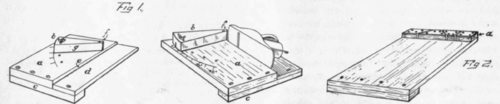
The block, b, is also made of maple or apple, is pivoted on a f in. pin at /, which passes through a snug hole in a and is riveted to a 1/8 in. plate underneath, the latter being securely fastened to a with four screws. The hole in b must also fit this pin very snugly. At the other end a circular slot encompasses a thumb screw which engages with holes in a so that b can be clamped in any position desired. The face, g, must stand at a true right angle with surface, a.
A vertical line is then scratched with a fine point on the end of b and by the aid of a protractor placed against the face of the plane when the latter is square against the edge, e, several divisions are scratched in the base, a, indicating angles of 90°, 60°, 45°, and 30°, or any other intermediate angles desired. These scratches are then filled with a black wax or other pigment and these settings are afterwards quickly made.
The pivoted end of b should just touch the bit as it passes, and this will give a support to the wood so that the bit will not break it. The piece is held against b with the thumb of the left hand while the plane is moved to and fro with the right. Exceedingly good work may be done with this trimmer and the joints made by it will fit nicely providing the device has been well made. In Fig. 2 is shown a saw block which may set on the end of the bench. It is very handy when small blocks or strips are to be cut off at either 90° or 45°. The strip, a, which is made of maple, is glued to the base. Then a 1/16 in. brass strip two inches wide is cut into pieces, as shown, so that the angles are exactly 90° and 45° with the facing edge. These are then screwed down with flat head screws and form guides for the thin back saw, whose thickness determines the width of the slots. These brass plates form guides that do not readily wear out, and the device really forms a fair mitre box but is quicker and less in the road. The block, a, may be made any height, but 1 1/2 in. has been found to be a very convenient height, as pieces any thicker than 1 in. had best be cut in a mitre box.
Continue to:


My Books

