


Tests Of Tensile Strength. Part 4
Description
This section is from the book "Welding And Cutting Metals By Aid Of Gases Or Electricity", by L. A. Groth. Also available from Amazon: Welding and cutting metals by aid of gases or electricity.
Tests Of Tensile Strength. Part 4
Brazing, Lead Burning, and Soldering.
Brazing consists in uniting metal parts by flowering melted brass, technically called spelter, between them. It is practically identical with soldering except that spelter is substituted for solder and that a much greater degree of heat is necessary. In the greater heat required to melt spelter lies one of the advantages which brazed work possesses over that which is soldered, the finished work enduring more heat without breaking or weakening, but the chief advantage lies in the superior strength and its applicability to a large variety of uses.
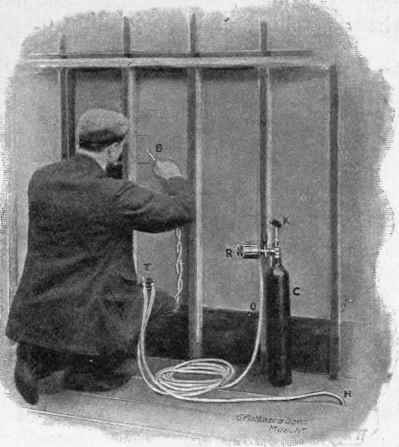
Fig. 28.
Lead burning is often made by autogenous welding, using hydrogen or coal gas as the combustible gas in conjunction with oxygen. Hydrogen is largely used abroad for welding of lead accumulators; more convenient, however, is the use of coal gas, as generally more easily obtainable.
The oxy-coal gas blowpipe introduced by the British Oxygen Company is now extensively used by lead burners. It is constructed on the injector principle. By its use oxygen, delivered under slight pressure from a trade cylinder, is caused to draw coal gas direct from the ordinary town supply, and then eject the mixed gases in the right proportion through the nozzle of the blowpipe. The use of pure oxygen instead of air for combustion with this blowpipe enables coal gas to be employed instead of hydrogen, as the combustible gas.
It is suitable for ordinary flat work, horizontal and upright joints, overhead patching, and the jointing of ordinary lead piping.
The illustration (Fig. 28) shows a man fully equipped with everything required by this system for a day's lead burning in any place where a supply of ordinary town's gas can be obtained.
Relative Advantages of the Systems.
(1) Economy.
To supply the requirements of one lead burner the comparative cost per week of the two systems is approximately as under: -
Hydrogen-Air System | £ | s. | d. |
Zinc and sulphuric acid . | 0 | 11 | 0 |
Boy's wages . | 0 | 10 | 0 |
Total . | £1 | 1 | 0 |
Oxy-Coal Gas System. | £ | s. | d. |
Oxygen delivered in cylinder on the user's works ... | 0 | 10 | 0 |
Coal gas from town supply | 0 | 0 | 6 |
Total saving per week | £0 | 10 | 6 |
(2) The hydrogen generator is dispensed with.
(3) The air bellows is dispensed with, and consequently the services of a boy are not required.
(4) Instead of having to move a heavy hydrogen generator and air bellows from one job to another, it is generally only necessary to move a light cylinder containing the oxygen required.
(5) No apparatus to get out of order, involving expensive delays and repairs.
(6) As no zinc or sulphuric acid are used, there is no deleterious matter to be carried through the blowpipe to act injuriously on the lead seam.

Fig. 29. - Oxy-Coal Gas Blowpipe.
(7) No pre-warmer or "fou-fou" required on heavy work. The blowpipe flame is so hot that even heavy lead in wet and cold positions can be burned in situ without pre-heating.
(8) No gas generated when the blowpipe is not in use, and consequently there is no waste of gas, and no charge to withdraw overnight.
(9) In places where a supply of town's gas is not available, coal gas or hydrogen can also be obtained from the British Oxygen Company in cylinders, or the oxygen may be used advantageously with a hydrogen generator.
In the oxy-coal gas system of lead burning compressed oxygen takes the place of air, and ordinary town's gas takes the place of the hydrogen used in the old system.
The blowpipe is an ordinary lead burner's blowpipe with two inlets, one for oxygen (0) and the other for coal gas (H).
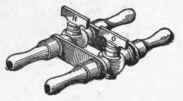
Fig. 30. - Shoulder Taps.
The oxygen inlet is constructed in the form of an injector, by means of which the pressure of the oxygen (about 15 lbs. per square inch) coming from the cylinder through a regulator (Fig. 31) is made to suck the necessary supply of coal gas through the inlet H of the blowpipe, and deliver the gases well mixed and under sufficient pressure to the burner nozzle. The blowpipe (Fig. 29) is constructed in two sizes, each being provided with two nozzles and a wind shield, the full equipment being capable of dealing with all weights of lead.
Continue to:


My Books

