


Automobile And Cycle Rims. Part 6
Description
This section is from the book "Welding And Cutting Metals By Aid Of Gases Or Electricity", by L. A. Groth. Also available from Amazon: Welding and cutting metals by aid of gases or electricity.
Automobile And Cycle Rims. Part 6
Bosses for water gauge fittings are welded on when required.
The joints of rails have principally been welded by "Thermit" as mentioned on page 70, but it may also be done by electrical means. An electrically welded joint is made by welding steel blocks to the rail end. A steel block is placed on each side of the rail at the joint, and a heavy current is passed through from one block to the other. This current is so great that the electrical resistance between the rail and steel block causes that point to become molten. Current is then shut off, and the joint allowed to cool. There is in this case a true weld between the steel blocks and the rails.
An electric welding outfit being expensive to maintain and operate, this process is used only where a large amount of welding can be done at once. Current is taken from the trolley wire, a rotary converter set takes
500 volt direct current from the trolley wire, and converts it into alternating current. This alternating current is taken to a static transformer, which reduces the voltage and gives a high current at low voltage, the latter current being passed through the blocks and rails in the welding process. A massive pair of clamps is used to hold the blocks against the rails, and to conduct the current to and from the joint while it is being welded. These clamps are water cooled by having water circulated through them so that they will not become overheated at the point of contact with the steel blocks.
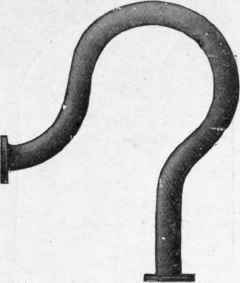
Fig. 75. - Corner Expansion Bend.
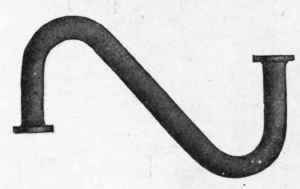
Fig. 76. - "S" Expansion Bend.
Cost of Electric Welding. - A few examples giving actual figures may be of interest.
(a) Ordinary Articles. - The cost of an universal machine for electric welding, size 3, for sections up to 3,000 mm.
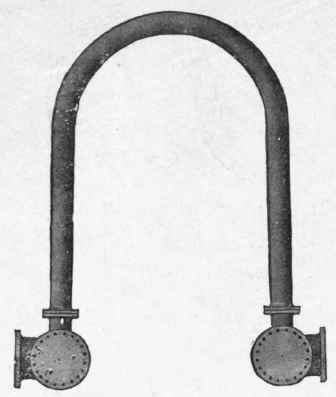
Fig. 77.
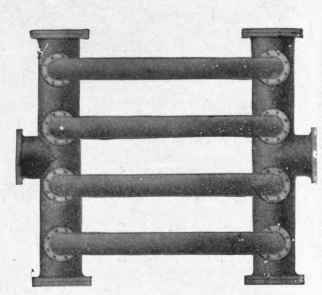
Fig. 78.
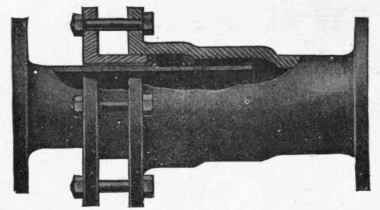
Fig. 79.
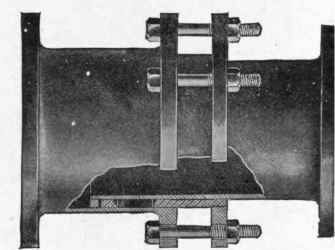
Fig. 80.
Figs. 77 to 80. - Compound and Sliding Expansion Joints, Electrically Welded.
(about 45 square inches), is about £170; add to this 15 per cent. for interest and depreciation, equal to £25 10s., or an expense of 1s. 7d. per working day. With this machine three welds of maximum section can be made in two minutes tools, making a total cost of 31s. 9d., or a difference of 18s. 8d. in favour of electric welding.
(fifty seconds of which being actually absorbed by the welding alone), making 900 welds every ten hours, requiring roughly 125 h.p. hours or 75 kilowatt-hours, or about 7s. 6d. for electric energy, and with a man at 4s. a day, a total cost for 900 welds would be 13s. 1d.
Assume that two men can make, in average, by fire, one weld in two minutes, or 300 welds per day, it would take them three days to make the 900 welds, earning thereby 24s.; add to this 1.5 cwt. of coal at 1s. 6d. per day = 6s. 9d., and 1s. for
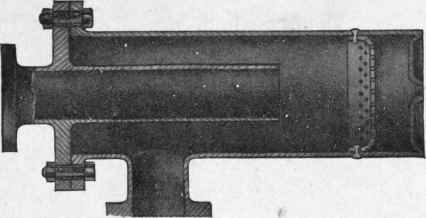
Fig. 81. - Steam Dryer, Electrically Welded.
The above figures refer to welding of ordinary articles, but the advantages of electric welding are still more prominent in complicated articles, the handling of which is difficult, if not impossible, for welding by fire.
(b) Water-pipes. - An able smith with two assistants can in the best case weld fifty ordinary water-pipes a day; the same man can easily with an electric welding machine make 300 such welds per day.
(c) Chain Welding. - A skilled chain-smith can weld two links per minute. At Jserlohn one man welds with an electric chain machine seventeen links per minute, or eight times as much as the chain-smith.
The great saving of cost in management, time and labour; the easy and often automatic manipulation of the machines, which do not require skilled labour; the cleanliness, there being no dust or smoke from fire; and the absolute freedom from danger, there being only secondary currents of low tension; and, in addition thereto, special machines for almost any conceivable article, offer to electric welding advantages of far greater extension and importance than those obtainable by any other welding system.
Continue to:


My Books

