


A Marine Aquarium
Description
This section is from the "The American Girl's Home Book of Work And Play" book, by Helen Campbell. Amazon: The American girl's home book of work and play.
A Marine Aquarium
This is made on much the same plan as the fresh-water one, save that there should be a shallow, slanting, false bottom. The glass is set in a grooved frame, as with the first described; but the cement used is different, a form being given in the"Scientific American."
"Cement for Marine Aquaria. - Take ten parts by measure, litharge, ten parts plaster-of-Paris, ten parts dry white sand, one part finely powdered resin, and mix them, when wanted for use, into a pretty stiff putty with boiled linseed-oil. This will stick to wood, stone, metal, or glass, and hardens under water. It resists the action of salt water. It is better not to use the tank until three days after it has been cemented."
Clean cinders make very pretty rock-work; and it is well to build and cement a small arch, through which the fish will dart, and against which they can rub, using an old oyster-shell for top-piece. At least an inch and a half of sand must be put in the tank, which is then to be filled with salt water from the sea, and not manufactured.
Let it stand a day or two, and then put in your plants, selecting pebbles on which bright seaweeds are growing. Too much light will kill them. The back and sides may better be painted green, and never let the sun strike directly upon the aquarium. Hermit-crabs and fiddlers, with their one big claw always waving in protest or mischief, eels, the beautiful sea-anemones, will give unfailing pleasure.
Tadpoles afford more amusement than any other specimens, save hermit-crabs and sticklebacks, but need a vivarium, or a tank which is part earth, part water. I do not know of any thing more interesting for the river aquarium or vivarium than to watch the metamorphosis of the tadpole from the spawn to the fully developed frog, toad, or lizard. The eggs may be found in ponds or ditches during the months of March or April. The following is a drawing of spawn found on the 4th of March, showing the different stages of the larvae form.
First the external gills appear (tiny tufts on each side of the head), then two legs sprouting near the tail; after that, the fore-legs make their appearance; when the tail is gradually absorbed into the body, and the little fellow hops nimbly to the nearest leaf or rock, and finally quits the water altogether. First, they breathe by external gills ; secondly, by rudimentary lungs and gills ; thirdly, on leaving the water, by lungs alone. In every form, these erratic"wriggle-woggle-bobbas"are as active as interesting ; not the least so as a microscopic object, the circulation of the blood in the tail being a most exquisite and wonderful sight.
Do not overstock the aquarium, as then the inhabitants will pine and die. Feed on finely chopped clams or oysters, or raw meat, or prepared food, with which directions come. If the water evaporates, remember that the salts in it do not, and simply make up the loss with fresh water. Be careful to skim out all uneaten food, and keep the top covered with glass to keep out dust. Stir the water daily for a minute to give more air.
Low tide at the seashore will give you many curious things. Wear very old shoes (as salt water ruins good ones) and old clothes also. Carry wide-mouthed bottles or glass preserve-jars in a basket, and use a little dip-net, which can be made of mosquito-netting. Barnacles are very interesting; for, if you watch, they suddenly put out a curious hand-shaped part that grasps after any thing near it. And in a morning you can get enough of all sorts of things for a dozen aquaria.
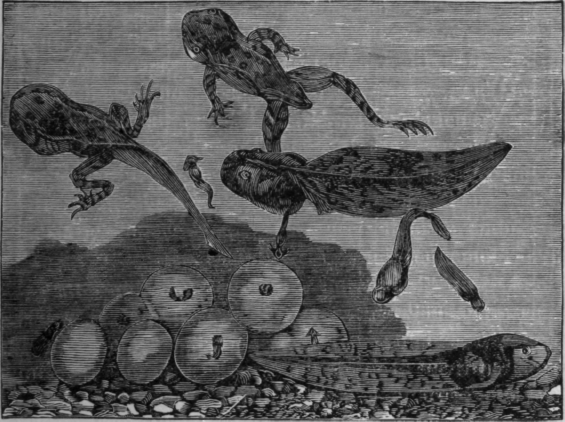
Fig. 50.
Marine worms in these cases are very brilliant; and you will find the fullest description of this beautiful sea-life in a book by the Rev. J. G. Wood, the full title of which is on p. 412. Where a more elaborate tank is needed, the best form ever made is that of the slope-back tank, - an English patent, but for sale also in this country. Time, labor, money, and anxiety are saved by their use. After many years' trial they are proved to be lasting and satisfactory : they enable the greatest number of animals to be healthily maintained in the smallest space, and therefore at the least expense; because the water is advantageously spread out, not piled up, and every portion is turned to good account. One great secret of success is the"dark-chamber"principle. Every tank is provided with a sloping back, upon which the rockery is cemented, for the accommodation of animals, plants, and that portion of water visible to the spectator. The under part contains water in a state of darkness, and therefore clearness: the two are made to communicate by several small holes; so that the circulation of water is constant, though slow. When we remember that an aquarium is a limited portion of unchanged water containing animal and vegetable life, which must necessarily throw off decaying matter, the extreme value will be felt of a reserve store, within the tank itself, of cool, clear water, which, being free from corrupting animal and vegetable matter, keeps up a constantly purifying influence upon the fluid in front. Should the water in the outer chamber become foul, green, brown, or white, the pure water behind may be made to take its place more actively by a small pump or syringe inserted in a hole left in the upper corner for the purpose. This hole must be always carefully covered with a loose bit of stone, lest any animal should enter, and destroy the object of the under partition, which is"to allow no organic matter to enter, and to let no light be admitted to it, so that any water placed there rapidly becomes deodorized and colorless."This arrangement was considered by Mr. Lloyd (in 1861) next best to having a constant stream in an aquarium.
Continue to:


My Books

