


A Marine Aquarium. Continued
Description
This section is from the "The American Girl's Home Book of Work And Play" book, by Helen Campbell. Amazon: The American girl's home book of work and play.
A Marine Aquarium. Continued
The engraving is a sectional view of one of his slope-back tanks,"the invention of which has largely helped to revolutionize aquarium science." a is the dark water-chamber; b, aquarium proper; c, plate-glass front; d, glass cover in two pieces, fitting in a groove on the top, leaving an inch of open space to allow a free current of air; e, hole for the syringe; f, bottom and back of slate. The two ends are of the same material, thus giving strength and solidity to the whole; and, being opaque, they prevent the admission of light through the sides.
Aquatic organisms require modified light, always obtained through the surface. Seas and rivers are illuminated in this way; and, as our object is to follow nature as closely as possible, those tanks which have three sides opaque, and one only of glass (reserved for the observation of the contents), must be better than any other variety.
Some of the accidents that may happen are given here, and the rules that naturally made themselves as protection against such catastrophes.
First, a thunder-storm turned the water white. Secondly, fish and shrimps jumped out, apparently boiled. Thirdly,"special pets died the morning after a party. Fourthly, the sand became black. Fifthly, stones fell down, and broke the glass. Sixthly, creatures devoured or killed one another. Seventhly, weeds died. Eighthly, conferva choked the tank. Ninthly, the water was often changed. Tenthly, the climax was reached by the bursting of the largest bell-glass, in a most mysterious manner, at six o'clock in the morning. All I know is, that on the drawing-room carpet was a heterogeneous mass of frightened shrimps, fish, crabs, anemones, starfish, sand, stones, glass, and ten gallons of sea-water. A coroner's inquest was held on the remains. The verdict returned (for want of further light on the subject) was,"Spontaneous combustion."
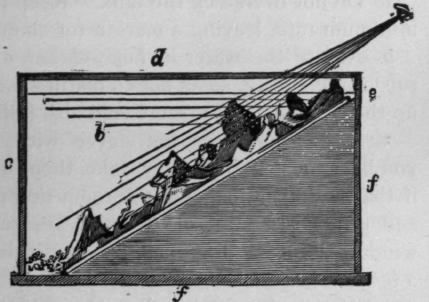
Fig. 51
Now you stand a much better chance of success. Have we not learned how to avoid these calamities ?
1. Do not overstock the tank. Keep the animal life at a minimum rate, leaving a margin for emergencies.
2. Aerate the water in hot weather, always remembering to syringe gently, so as not to disturb the animals, or to stir up the sediment. Extreme cold also kills delicate animals.
3. Dissipation does not agree with"water-babies."If you have an evening party, take them out of the room ; or if that be impossible, and the room becomes heated with fire and gas, keep a wet cloth round the tank, throw open the window the last thing at night, give a dose of fresh air and a few strokes with the syringe.
4. Watch the sand well. Do not allow any burro wing-creature to go away into a cranny to die. Remove the first speck of black, or the least sign of white, film that sometimes spreads over the bottom.
5. Cement the rockwork together when possible, or use clinkers. Portland cement is sometimes employed, or white lead putty covered with shellac dissolved in naphtha. Or, better still, use a compound of red and white lead, litharge, umber, and boiled oil.
6. Make a division of species. A small tortoise will kill a large gold-fish ; fish eat tadpoles ; tadpoles eat any thing ; sticklebacks eat (almost) every thing else that does not eat them ; crassies and antheas sting and eat fish, shrimps, etc.; shrimps eat starfish; starfish eat young anemones; and so it goes round.
7. Never import plants, but allow them to grow of themselves, to purify the water, and keep the animals healthy: grow enough for this, and no more.
8. Give little light. Shade with blue blinds or screens, or curtains, and cover the tank entirely whilst the sun is out.
9. Choose the coolest and shadiest aspect available :. north is the best, or even underground. Keep the temperature from 450 to 6o° F.; but with a stream, fountain, or motion, 70° or even 8o° need not be feared. Avoid sunshine, and remove any dead or decaying matter. Keep a stick of charcoal in the water: it acts as a deodorizer or purifier. Aim at an even temperature, and avoid extreme cold.
10. Never use a bell-glass of great size, but employ shallow vessels, and tanks with only one side of glass, and the other three opaque, made of some non-corrosive substance, such as enamelled slate; avoiding all metallic materials, such as bronze, iron, lead, etc.
11. Never change the water : regard it as an indestructible medium for sustaining life. Find out how much it will maintain under given circumstances; keep that much, and no more. A small still aquarium can be self-sustained as well as larger ones with a large service of water and circulating machinery.
12. The best proportion for a tank is that having the largest surface and smallest depth proportionate to the size of the animals. It does not matter so much how the aeration is obtained, as long as it is sufficient.
For small domestic aquaria, five or ten minutes' daily attention, paid regularly, is enough to keep any well-regulated tank in order. Besides this, I used to give mine about an hour once a week. Skim the surface with a cup, strain it through muslin, add the amount of fresh water necessary to supply the loss by evaporation, mix the fresh well with the salt water, and before returning it to the tank rub the glass side or sides to keep down the growth of weed, which is sure to obscure the glass unless frequently rubbed off. A bit of sponge or rag tied firmly around a stick answers perfectly. For feeding anemones, etc., a small pair of wooden forceps are desirable. Never handle or tease any of the creatures.
Continue to:


My Books

