


Free Weaving. Series I. Elementary First Year
Description
This section is from the book "Raphia And Reed Weaving", by Elizabeth Sanborn Knapp. Also available from Amazon: Raphia and Reed Weaving.
Free Weaving. Series I. Elementary First Year
Material required for entire course of twelve models, five sheets of 48-pound laid antique book-cover paper (of contrasting colors) cut into strips one inch wide.
Model I. Ground Form Or Foundation
Material. - Two strips of red or scarlet. Three strips of fawn.
Fold red strips across the width through the middle. Fold the fawn color through the middle, tear and fold again and lay these pieces on the desk.
Lay the two folded red strips on the desk; long edge extending from left to right, with upper piece extending about two inches beyond left end of the lower piece, open ends toward the left; have the open ends of the lower piece toward the right. Much future trouble will be avoided if the teacher requires this same arrangement at each lesson.
Now taking one of the short pieces, or weavers, in the right hand, beginning at the top and left end pass the two ends of the weaver outside the top and inside the lower double strip, drawing the loop ends up close; now with the second weaver work in the same manner from the bottom upward; then with another weaver work from the top and so on, until all the strips are used. The teacher may easily judge if all weaving is correct by asking the pupil to hold up the work and at the same time turn it, after each weaver is inserted, as both sides will be alike if correctly woven.
The work is tightened by palling the opposite ends of the horizontal strips, and every two of the weavers, until the work is flat.
To hold the weaving securely in place, open the free ends and place the paste inside, using a thin, flat pasting stick.

Ground Form Or Foundation.

Model II. - Book Mark
Material. - Two strips of fawn. Four strips of red.
(Waste of material will be avoided if the two colors are used alternately in the long strips.)
Weave as before, and after pasting, notch the ends of the weavers close to the long strip, leaving the free ends of the long strip about three inches in length. Notch these also.
Model III. - Napkin Ring
Material. - Two strips of red, four strips of fawn.
Using fawn for weavers, proceed as for bookmark, and after tightening and pasting, cut all weavers close to the long strips, and cut the end of the long strips so as to leave 1 1/2 inches extending. Cut corners from these ends, and bringing the two ends of weaving together insert each free end under the second square on the opposite end. Glue should be used to hold this in position, placed under the two outside squares.
Model IV. - Match Safe
Material. - One strip of red, two strips of fawn.
Use red for horizontal strips, tearing into two and folding.
Make four weavers from other strips. Insert the weavers and cut close all free ends at the top. Fold at each square, pressing flat to secure sharp edges. Insert the long ends into the opposite side and shape to oblong box. Overlap the free ends on the bottom, cut to length and glue. Cut from cardboard of some harmonious color, a piece 4 x 3 inches, and glue the box to this near the lower left corner. Cut a piece of No. 1 sandpaper 1 x 2 inches and fasten it to the right of the box. Perforate the top of cardboard in two places and pass ribbon through for hanging.
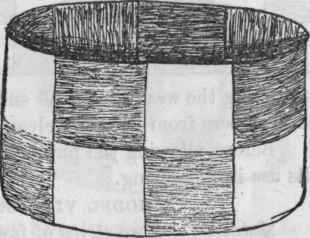

Model V. - Ruler
Material. - Four strips of scarlet, six strips of fawn. Glue together each two of the scarlet strips, and use the fawn for weavers. Weave strip twelve inches long, and after fastening the weaving cut all ends close and mark each square in numbers from one to twelve.

Before allowing the pupil to take this model home, teach its use in measuring.
Model VI. - Cubical Box
Material. - Two strips of fawn, four strips of scarlet.
Using scarlet for weavers, make a strip eight inches long. Glue the ends, and cut close all weavers on the top edge. Fold at every two squares, creasing well, and then join the ends by inserting under opposite squares. Now interlace the other ends of the weavers for bottom of the box, and glue to position.
Model VII. - Picture Frame
Weave as for ruler, making four strips, each twelve inches in length. Cross ends for frame, and fasten at each corner with round head Magill fasteners. Cut a piece of cardboard to size, and glue to the back, leaving an opening at the top. In this cardboard perforate holes, through which pass ribbon far hanging.


Model VIII. - Round Box
Material. - Four strips of fawn.
Seven strips of scarlet.
After gluing the fawn strips so as to make two long ones, use the scarlet for weavers and make a strip fourteen inches long. Fasten the ends of the weavers at the top and cut close. Bring the opposite ends of the woven piece together, and fasten by inserting loose ends under the opposite square. Bend up the remaining ends of weavers for the bottom of the box, and cut two circular pieces of cardboard to fit the bottom; glue one outside and one inside the box.
Model IX. - Oblong Box
Material. - Six strips of scarlet. Eleven strips of fawn.
Weave band sixteen inches long for box (cover separate). Fasten all weavers on the top edge and cut close. Count two inches from one end and fold for the end of the box; then six inches for one side, and again two for the end. Glue into shape and fit oblong piece of cardboard both inside and outside of box. Weave a strip six inches long for the cover; punch holes one inch in from both ends of the cover and the box and hinge with ribbon.

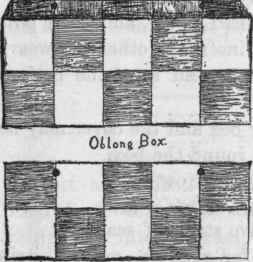
Cover.
Model X. - Box With Handle
Material. - Sixteen strips of fawn. Six strips of scarlet.
Using fawn for weavers make a band twenty inches in length. Cut the top ends close and glue to shape, five inches on a side. Fit a double bottom of cardboard and weave the strips for the handle, fastening the handle to the box by using Magill paper fasteners.
Model XI. - - Cubical Box With Coyer Woven Ok
Material. - Five strips of scarlet. Three strips of fawn.
Use scarlet for weavers, but keep two of them full length, tearing the others into halves and folding. Weave first with four short weavers, then insert two long ones. Do not pull these two down close but let them remain far enough above the woven strip to allow the insertion of two fawn-colored strips, and then pull down to position and insert the other two weavers. Fasten into shape and form the bottom as for Model VI.
This makes a very pretty candy box and the cover may be fastened by tying a band of ribbon round the box.
Continue to:


My Books

