


Chapter Twenty. Line, Shape And Composition
Description
This section is from the book "Arts And Crafts In The Elementary School", by Joan Dean. Also available from Amazon: Arts And Crafts In The Elementary School.
Chapter Twenty. Line, Shape And Composition
The business of putting a picture together is a complicated one. It requires ability to put many elements together in a satisfactory relationship. We have already discussed relationships of pattern and texture, of colour and tone. A picture or design also includes relationships of line and shape. Just as some relationships of colour are satisfactory to the eye and others are not, so also some line and shape relationships are more pleasing than others. Children need to be encouraged in their picture and pattern making and in their craft work, to look critically at the relationships of lines and shapes that they are making.
While the business of looking critically should start in the Infant school, however, I am certain that children are not ready for conscious investigation and discovery of relationships within a picture until they reach the top of the Primary school, and only then if they have a good background of experience, and some skill in many media and plenty of experience of picture making. This kind of work should be a making conscious and a collecting together of knowledge which has already been discovered through experience. Children should enter the artistically self-conscious period of adolescence with a body of knowledge about art and craft, as well as experience and skill.
In carrying out this kind of investigation of composition facts, I find it useful to use collage methods frequently, so that shapes can be placed in a number of different relationships, before one is finally decided upon. It is also a good idea to do a number of abstract pictures, so that the children's whole attention can be turned to the problem under consideration, without the distraction of problems of representation. When the facts have been discovered, then the knowledge can be applied to pictorial work.
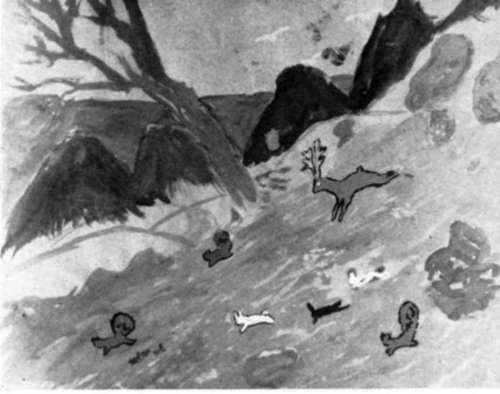
10-year-old. The earthquake. This child has used diagonals to add to the idea of urgency and instability which her picture was intended to express. She has balanced it with a tree going in the opposite direction. Diagonals create this unstable feeling in any picture, however, and can be unsatisfactory when instability is not intended (Chapter 20)

7-year-old. Snow scene. This picture would have been pleasanter with the house either completely in or completely out of the picture (Chapter 20)
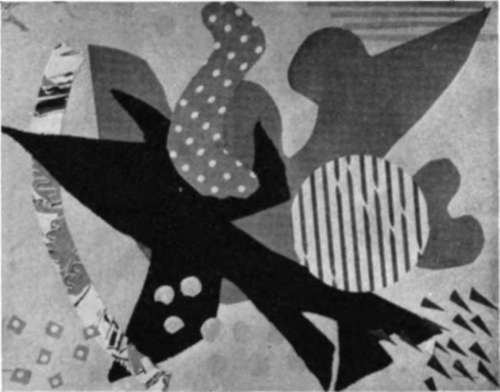
Student's work. Abstract design showing variety of shape and texture
(Chapter 20)
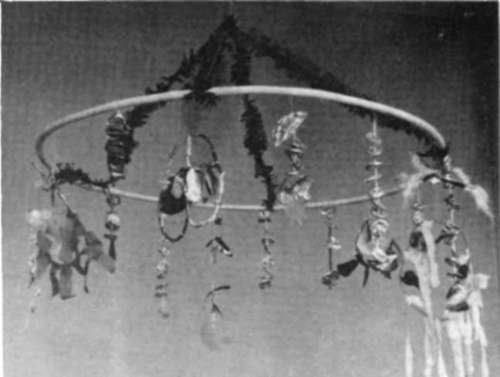
Mobiles(Chapter 21)
The following facts could form the basis of work on composition :
1. A picture or design needs a variety of line and shape if it is to be interesting to look at.
2. A picture or design should be related to the paper on which it is painted or to the shape which contains it. There are some wonderful examples of this sort of relationship in heraldry, where animals are drawn to fit the containing shape. It is often useful to let some lines in a picture echo the edge of the paper, or the shape.
3. Balance is needed in a picture or design. A heavy shape in a colour of medium tone can be balanced by a similar shape in a dark tone. Equal-sized shapes of different tones can be balanced by the way in which they are placed within the picture. A group of small shapes within a picture can balance a large shape.
4. Diagonal lines and lines parallel to the diagonals of a picture are usually unsatisfactory in appearance, giving the impression that the picture is in two parts.
5. The eye can be led into the picture and to important places by lines. A point of particular importance can be emphasized by making lines converge. Conversely, lines which converge require something important at the point where they meet.
6. Important objects are best placed approximately a third of the way up, down or across a picture. It is rarely satisfactory to place the horizon line exactly half-way.
7. Objects half out of a picture arc not satisfactory. They give one an uncomfortable unfinished feeling.
8. Line and shape have certain emotional values in a picture. A jagged line or shape, for example, suggests life, vigour, possibly anger and cruelty. Smooth curves and lines suggest peace and calm. Lines and shapes can also arouse feeling because of the associations they suggest. Thus a sinuous writhing line might suggest a snake and arouse in the spectator the same sort of feeling as the snake itself.
Continue to:


My Books

