


Chapter Thirteen. Pattern Making And Fabric Printing
Description
This section is from the book "Arts And Crafts In The Elementary School", by Joan Dean. Also available from Amazon: Arts And Crafts In The Elementary School.
Chapter Thirteen. Pattern Making And Fabric Printing
Making patterns is a very old and fundamental human activity. The rhythm of repeating lines and shapes gives pleasure to children to day as it did to our earliest ancestors.
What do we hope children will gain from pattern making, apart from the fun of doing it? Pattern is an integral part of our daily lives. Our clothes and our furnishings are frequently decorated with printed patterns and woven patterns, and we are surrounded on all sides with a wealth of textures. Our ability to select and relate materials for use in our homes, and for our clothes, with taste and discrimination, depends in some measure upon our appreciation of pattern and texture and their relationship. Our teaching about pattern, therefore, must help children to discover and enjoy good relationships of shapes, colours and textures. It must make them aware of the variety of pattern in the world around them—not only the man-made patterns on fabrics, and the patterns made by bricks, paving stones, walls and fences, but the patterns which are all around us in the natural world—the veins on a leaf, the markings on animals, fish, birds and insects, the grain of wood, the patterns made by frost—an endless variety. Our teaching should, in fact, develop children's natural interest in pattern into knowledge and taste.
Satisfactory relationships in pattern are not easy to define. Much experiment and discussion is needed, and much encouragement to observe, to touch and to enjoy the feel of materials, before a sound knowledge of these relationships can be built up. Just as the deeper knowledge of colour relationships and relationships in composition grows while we are ostensibly experimenting to discover something else, so real knowledge of pattern relationships will grow while we are exploring the different ways of making patterns. It is, on the other hand, necessary to keep the idea of "does it look right?" constantly before children and discussion of this should be frequent.
There are three basic ways of making patterns. These can be combined in many ways, with happy results. Each has something of its own to offer, and children need to explore all three if they are to acquire a wide knowledge of pattern.
1. Patterns can be made by painting with brush, fingers, sponge, and with stencils, or by drawing with pen, pencil, crayon, chalk or pastel. Pattern work in these media has already been discussed in an earlier chapter, but it may be a good idea to repeat the maxim that whichever of these media is chosen, work should be carried out directly in it. A pattern should not be drawn in pencil and then painted, for the brush stroke itself contributes to the finished pattern.
2. Patterns can be made by cutting and folding paper so that a number of similar shapes result. There will, in fact, be two sets of shapes— the shape, as it were, and the paper left over. These can be arranged to make a number of different patterns, and it is possible to try out a large number before committing oneself to any of them. I find it is usually necessary to insist that the shapes are not stuck until adequate experimenting has been done. Generally children also need encouragement to place shapes sufficiently close together—there is a tendency to lose the effect of the shapes left on the background of the paper, and these too need to be considered. Children will easily discover interchange patterns in this way and they will probably discover also a number of other arrangements. "Texture" made with chalk, paint, ink, or crayon can be added and children can be encouraged to find textures which contrast happily with the clear-cut paper shapes. There are, of course, a great many other ways in which patterns can be produced by folding and cutting paper. A strip of paper can be folded into pleats and pieces cut out of each side. When the paper is unfolded, stripes are produced. Tissue paper and cellophane folded and cut produce a range of new shapes and colours where the pieces overlap. When a sheet of paper is folded in half or into quarters, the pattern cut from one side is repeated on the other. All these forms of cutting can also be arranged on textured, patterned or contrasting backgrounds.
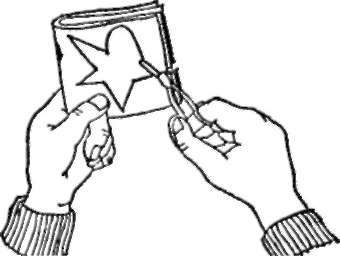
Cutting folded paper to make a repeating pattern.
3. Patterns can be made by printing—with almost anything which comes to hand. The usual blocks—potatoes and lino, are well known. Prints can also be made with other vegetables. Interesting blocks can be made from felt or from pieces of old inner tube cut out and glued on to a piece of wood. These offer good contrasting shapes, the felt printing with a fluffy edge and the inner tube with a clean edge. Thick string, glued on to a block, also gives an interesting contrast. Many kinds of fabric screwed into a ball or glued to wood, are useful for printing. Prints can be obtained from oddments such as cotton-reels, match boxes, toilet-roll centres, pipe cleaners and pieces of corrugated card. Small blocks can be made with plaster, or plasticine, or wood. These can be marked with tools or scratched with a knife. Prints can also be made with paper and with strawboard, although a roller, rather than the pad described below, will be needed to ink these. Children can be encouraged to look for new things to print with and to try to find good relationships of texture. They should also discover the effects of allowing each print to touch the next and the effect of overlapping. All these blocks can be printed fairly satisfactorily with powder colour in the following manner:
Each child should have a palette or saucer and a small piece of felt or folded thick material. Paint should be mixed in the saucer and the pad saturated in it. The block can be pressed on to the pad and then on to the paper or material. The block should be pressed on to the pad for each print—thus a rhythm is set up and the prints are fairly even. This will be found to be a quicker and more satisfactory method of working than the method of painting the block with a brush. It can also be used for all the blocks mentioned, and it is much more even in its results. Thin, cheap paper is the most satisfactory for printing, and it will be found that the best results are obtained if the paper is allowed to become damp between sheets of damp blotting paper. This is not essential, however. Printing is more satisfactory if the surface to be printed is well padded. Newspaper does this very adequately, but you must avoid printing over creases in the paper, as these will show up.
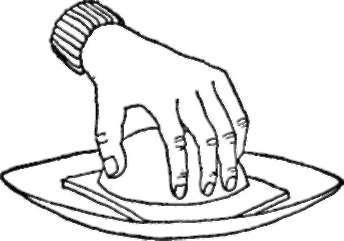
Saucer and pad for printing
Continue to:


My Books

