


Around Lake Garda. Part 8
Description
This section is from the book "Lake Garda - John L. Stoddard's Lectures", by John L. Stoddard. Also available from Amazon: John L. Stoddard's Lectures 13 Volume Set.
Around Lake Garda. Part 8

Street Musicians In Riva.
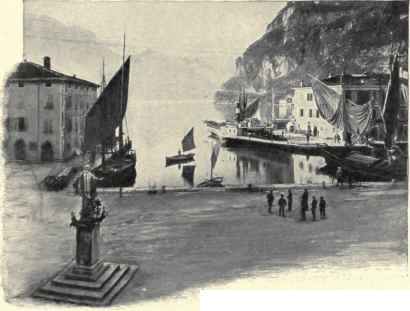
The Harbor Of Riva, Lake Garda.

Ruins Of Schloss Gre1f-Enstein, Near Botzen.
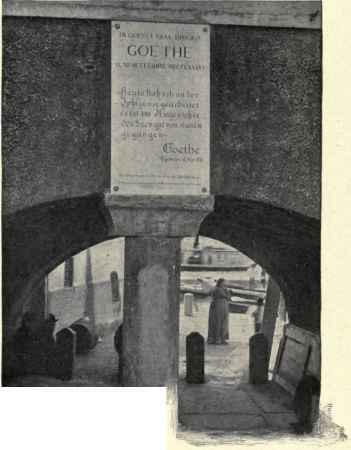
The Goethe Memorial.
"High in fair Italy there lies a lake, Under those Alps which gird the Teuton's land, Beyond Tyrōl; Benacus is its name".
(L' Inferno, Canto 20).
Catullus, sweetest of the Roman, and Tennyson, best beloved of English, lyric poets, have, as we soon shall see, identified themselves forever with its lovely promontory of Sirmione; while at this northern end of the lake, in the village of Torbole, accessible from Riva in half an hour by boat or carriage, we find an interesting souvenir of Goethe. In front of a now humble house in Torbole has been inserted a memorial tablet, on which we read not merely the statement that in September, 1786, the German poet had his lodgings there, but also find recorded in the marble the following passage from his journal:
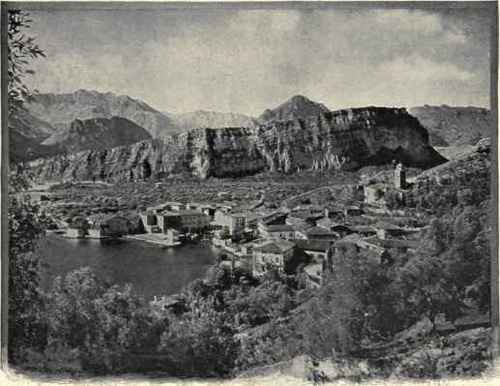
Torbole.
"To-day I have worked on 'Iphigenia,' and in presence of the lake it has gone forward finely".
Later, also, when in Rome, Goethe wrote further of his having penned the first lines of the new work "on the Gardasee, when the strong wind at noon drove the waves upon the shore".
The noon wind of which he speaks was not peculiar to his time, but is an interesting daily phenomenon, perhaps as old as the lake itself. This midday southern breeze, which comes with almost as much regularity as the ocean tides, is called the Ora, and is a perfect blessing to the "lake dwellers" of to-day, since it brings warmth in the winter; while in the summer, freshened by its passage over the water, it bears upon its wings invigorating coolness. With equal punctuality, also, a north wind springs up about midnight, and blows for several hours for the benefit of sailing vessels bound for southern ports While I have been writing the preceding lines the Ora has been growing stronger. The sparkling surface of the Gardasee is flecked with whitecaps, and wavelets lap impatiently the marble stairway of the hotel terrace. Directly opposite, on the western side of Riva's dainty harbor, the mountain driveway, called the Via Ponale, is already in shadow, and offers a delightful combination of pure air and pleasing shade, together with magnificent views of the lake from an elevation. A quarter of an hour's sail in the little boat, lying invitingly by the garden wall, will bring us to the starting-point of the ascent, where many an expectant driver will await our patronage. Andiamo! Riva's Via Ponale, which might be called a diamond edition of the Cornice Road, commences at the limit of the town, and is at first cut out of vertical cliffs for a considerable distance, like a slanting shelf. Later, it twists and turns through tunnels and ravines, like a long, sinuous serpent, continually climbing higher and higher toward the falls of the Ponale River, which gives the thoroughfare its name. Thence bending sharply to the right, it leaves the lake, and passes up the pretty Ledro Thal. From time to time, alighting from the carriage, we leaned upon the broad, stone parapet, and gazed upon the sapphire plain hundreds of feet below our path. A pebble, dropped from my extended hand, fell to the water, unobstructed by a crag. Meanwhile, above us, on the other side of the route, gigantic precipices rose to dizzy heights, and not infrequently bent over us, like porticos. As we curved in and out of the indentations of this mountain wall, Lake Garda offered us a constant series of surprises. Each vantage-point disclosed a new variety of beauty, for the descending sun lit up with glory the stupendous mass of Monte Baldo on the opposite bank, and scattered broadcast such a wealth of colors as I have never seen surpassed. As far as the shadow of our mountain crept, the lake was of the deepest blue; but from that violet penumbra stretched away a labyrinth of exquisitely graded hues, whose fundamental tones were ultramarine and emerald, yet with which there were blended numberless other shades, caused by the swift, light touches of the wind and sun.
Continue to:


My Books

