


Lake Como. Part 26
Description
This section is from the book "Lake Como - John L. Stoddard's Lectures", by John L. Stoddard. Also available from Amazon: John L. Stoddard's Lectures 13 Volume Set.
Lake Como. Part 26
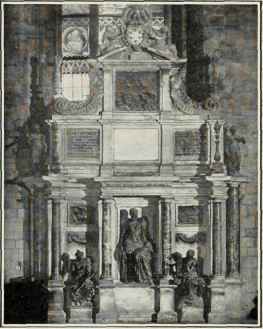
Tomb Of IL Medeghino, Milan Cathedral.
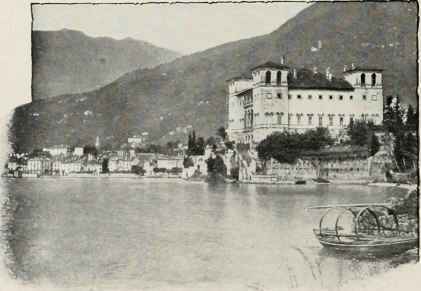
The Palace Of Cardinal Gallic.
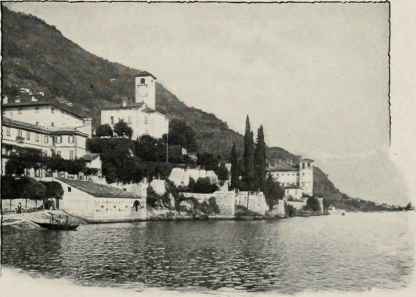
Gravedona.

Elaborate Chalice, Fifteenth Century.
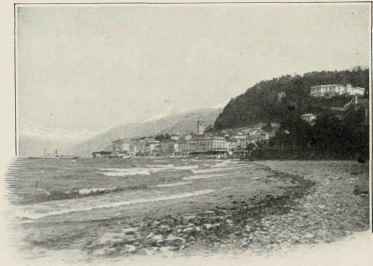
When The Breva Blows.
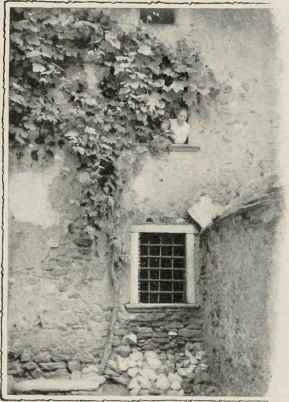
A Passing Glimpse.
For though the passing traveler may admire from a distance many well-placed homes, embowered in shade, he can have little idea of their delightful gardens, rarely visible from the boat. These play, however, an important role in Larian life. For here in the Old World, where one has still some leisure, and all who can spend hours daily in the open air, gardens are not mere grounds to be exhibited, but places to be lived in. I do not now refer, of course, to public parks, where many congregate for health and pleasure; but to those sweet, arboreal retreats, half consecrated to the muses, half to flowers, where one can read, reflect, and dream in undisturbed seclusion. To sit within such walled enclosures, screened from the world by roses or wistaria, and shaded by majestic trees, impervious to the solar rays and always free from wilting heat, and thence to look forth on the dimpled bosom of the lake and its surrounding mountains, must rank among the first of life's se-rener joys. Ah, how one comes to love these sylvan shelters in a land of ardent suns! A thick-leaved, spacious tree becomes at last a friend, - restful as music, faithful as a dog, and silent as a book. In such unchanging, mute companionship how many of life's sweetest hours can be passed! The pioneer in a savage country may regard a tree as something hostile to his interests, - a thing to be uprooted and destroyed as soon as possible. But, in proportion as we acquire civilization, we inevitably treasure trees, dislike to see them felled, and look on forestry as a fine art. Particularly is this true of Italy, where negligence or wanton waste has brought to bankruptcy so many sun-scorched hills. One can say truly of this richly dowered land that any lack of charm that it possesses, comes from want of trees. Perhaps one ought to add - and dearth of birds. For in a country where bird-snaring and bird-killing have attained such skill that many regions are as ominously silent as a tomb, this also is a serious blemish. It seems incredible that man can be at once so stupid and so heartless as to kill the song-birds of the world! However eager he may be to slaughter all the other animals which share with him the habitable globe, one might suppose that he would spare these innocent and harmless creatures, whose presence is revealed to him by nothing harsher than the passage of bright plumage or a burst of song, and whose sole weapon of defense against his greed or cruelty is an appealing strain of melody. But a desire to slay, even without the chance of selling or devouring the game, is still more powerful than pity among millions of the so-called civilized. Warnings have recently been issued by scientists in France that at the present rate of slaughter the birds in many parts of Europe will be soon exterminated. An illustration of their reckless massacre is the fact that thousands of larks are sometimes killed, and sold at five or six cents a dozen! Even then the carnage is so monstrous and unnecessary that quantities of birds, which their destroyers cannot sell, are thrown away. Of course, one noticeable result of this atrocious practice is the increasing number of destructive insects, usually kept in check by birds. But, happily, every Larian garden is a place of refuge for the feathered warblers, and in these leafy concert - halls they pour forth such roulades and joyous trills, that one feels certain they are showing gratitude for kindness and protection. Nowhere have I heard nightingales sing so fervently and constantly as in these groves, and with a quality of tone as sweet as if the songsters had first dipped their beaks within the dewy chalice of an opening rose. Many an evening I have sat for hours listening to their dulcet notes, which stir the heart and haunt the memory with their passionate ardor; while in the intervals between their nocturnes the silence has been broken only by the inarticulate murmur of the fountain or the soft lapping of the sleepless lake. How glorious are nights like these within the gardens of Lake Como, when blue meets blue, and lake and mountains blend in dreamy indistinctness, roofed by a heaven pulsating with stars! Or, when the harvest moon emerges from a jet-black mountain range, and - hanging like a full-blown yellow rose against the dark blue vault - transforms the rippled water into gold! Then, in the rustling solitude, perchance a leaf falls shyly to the earth, to touch its wrinkled face with a caress; from some invisible boat there steals across the waves the wordless music of a plaintive song; the soft air trembles with the slow vibrations of a deep-toned bell, mellowed by distance to a golden chime; and, standing ghost-like, in an arbor of luxuriant foliage, the statue of a pensive faun seems to be one of the old gods, whose worship was the poetry of the world.
Continue to:


My Books

