


Florence. Part 16
Description
This section is from the book "Florence - John L. Stoddard's Lectures", by John L. Stoddard. Also available from Amazon: John L. Stoddard's Lectures 13 Volume Set.
Florence. Part 16

Mrs. Browning's Tomb.
Even if you refuse to purchase, she will at least contrive to slip a nosegay into your hand or toss a bunch of roses into your carriage, and if you accept them, she considers you thereafter her patron, and expects to keep you supplied with flowers during your sojourn in the city. For these she frequently accepts no pay whatever at the time, relying on your generosity, when you depart, to give her more than she would otherwise receive. Thanks to the floral paradise in which it lies, Florence in May is enchanting; and I know of no city on earth more thoroughly delightful than this, when her historic streets and squares are white with the splendor of the moon, and the perfume and fascination of springtime are over all. Florence, it is true, is always charming; but it is in the youth of the year that we can best appreciate "The vines, the flowers, the air, the skies that fling Such wild enchantment o'er Boccaccio's tales Of Florence and the Arno".

In The Gardens Of The P1tt1.
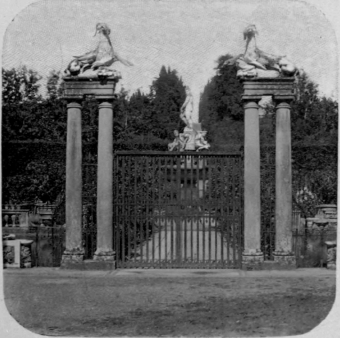
A Gate In The Bobol1 Gardens.
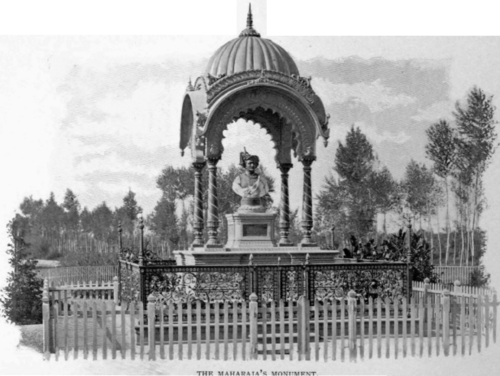
The public park of Florence, known as the Cascine, is a delightful place in which to walk and drive, and corresponds to the Parisian Bois de Boulogne. In the afternoon, especially, it is the rendezvous for all the gay and fashionable life of the city, and near the Casino, where refreshments are served and music is furnished by a military band, the Florentine gentlemen come and go from carriage to carriage, making little social visits, as they are wont to do among the boxes at the opera. A singular feature of this park is the imposing and half-Oriental funeral monument of the Maharaja of Kolhapur, who died in Florence, in 1870, and was cremated on the spot where the memorial stands.
Far more interesting and attractive, however, than this promenade of fashion, are the other suburbs of Florence.

Undulating Hills.
The city is surrounded by-soft, undulating hills, dotted with white-walled castles and innumerable villas, and green with cypresses and olives. There is an indescribable charm for me in olive trees. They cannot be called graceful or symmetrical, but even when their trunks are twisted and decayed, they wear a crown of silvery foliage that makes them beautiful, and that for centuries has been regarded as the emblem of peace.
To drive or walk upon the hills surrounding Florence is a constant source of pleasure, not merely from the charming landscape thus disclosed, but from the fact that on these pretty slopes are houses which have formed the homes of men and women who have filled the world with their renown. Thus -not to mention the residences once occupied by Lorenzo the Magnificent, Machiavelli and Boccaccio - the Brownings lived for several seasons on these heights, above the Tuscan city and its summer heat, extending hospitality to many friends; here Hawthorne spent some months, while writing portions of the "Marble Faun"; the famous tenor, Mario, also, and his equally celebrated wife, Giulia Grisi, made this their home for years; and here reside, to-day, the novelist "Ouida" and the tragedian Salvini. Several American sculptors, too, have found upon these hills a place of residence thoroughly congenial to their tastes and work. Fortunate men! What more delightful and stimulating mode of life can be imagined than that of a sculptor, living on one of the terraces of this historic amphitheatre, steeped in the glorious Italian sunshine, and drawing inspiration from the classic and artistic atmosphere of Florence!

The Arch Of Galileo.
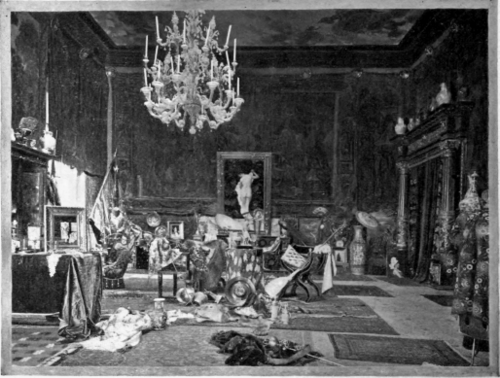
A Florentine Studio.
I have greatly enjoyed visiting the studios of artists in Florence, for I love to watch a painter or a sculptor at his work. It has always seemed to me, however, that sculpture in clay must be more fascinating even than painting. To cause lines of symmetry and beauty to grow out of formless earth; to see curve, dimple, and contour appear as by the touch of an invisible enchanter's wand; to be able by the half-caressing imprint of the thumb or finger to accentuate the arch of an eyebrow, or to impart smiling, immortal sweetness to motionless and silent lips; to reproduce with tiny strokes expressions borrowed from the face before him, the droop of an eyelid, the curve of a nostril, or the cleft in a stern chin; to see likeness, all at once and as if by magic, spring out of what was until then merely an uninteresting mass of clay; to watch the concrete beauty of the individual blossom out of the abstract of the race; and, finally, to realize the possession of creative power, in having called into existence a shape which, but an hour ago, was without form and void, - surely this must be one of the most divine of pleasures, linking the sculptor, in a way, with his Creator, and giving him a wonderful appreciation of the joy which moved the morning stars to sing together, when, far away in the dawn of the universe, God called the earth out of primeval chaos, and made from it the crowning act of His creation.
Continue to:


My Books

