


India. Part 8
Description
This section is from the book "India - John L. Stoddard's Lectures", by John L. Stoddard. Also available from Amazon: John L. Stoddard's Lectures 13 Volume Set.
India. Part 8
Many of the statues, schools, and public institutions of Bombay have been the gifts of that remarkable portion of its population known as Parsees. Thus, one of them contributed seventy-five thousand dollars toward establishing the Elphinstone High School, one of the most beautiful edifices of the city; another founded here the school of art; two of them built a hospital for natives; two others endowed an equally fine establishment for women and children; while another has erected several handsome fountains in the principal streets; and Parsees were most influential in giving to Bombay its beautiful marble statue of the Empress of India.
It is interesting to remember that these Parsees are entirely unlike both Hindus and Mohammedans. They are descendants of another race, - professors of another faith. Their prophet was the philosopher of Persia, Zoroaster. Their coming here is easily explained. About eleven centuries ago, the followers of Mohammed, issuing from Arabia, swept round the Mediterranean in their path of conquest, till one point of their sparkling crescent pointed toward the Bosporus, and the other glittered star-like over the Spanish towers of Granada. Not satisfied with this, the Moslems hastened eastward into Persia, - giving the populace, as usual, their choice between the sword and the Koran. The most, of course, accepted the Koran. But some, intensely loyal to their fathers' faith, left Persia and fled into India. The descendants of those exiles are the Parsees of to-day. As they marry only among themselves, the purity of their race is preserved, and, like the Jews, they can be easily recognized by at the close of day, just as the sun was sinking into the blue Arabian sea, I beheld Parsees standing on the shore, facing the west, and apparently sending forth their evening prayer to the departing luminary over a rippling path of gold.

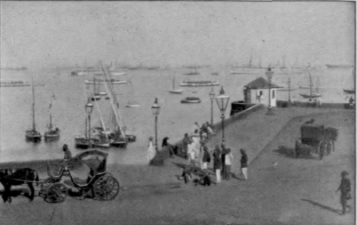
Harbor Of Bombay.
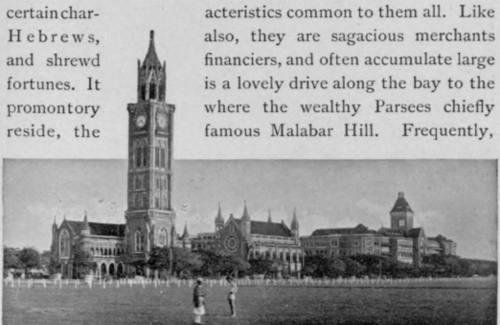
The High Court And Other Public Buildings.
Parsees are called " Fire-worshipers ; ' but that is a name which they themselves repudiate. They are devout believers in one God, the symbol of whose glorious majesty is the sun, - that radiant, never-failing source of heat and light, without which our revolving planet, frozen to the heart, would soon roll through its gloomy orbit, lifeless and deserted. But this grand emblem of divinity is far too dazzling for mortal gaze; hence its immediate substitute on earth is fire. Who cannot understand this silent adoration of the Infinite, awakened by the contemplation of our own and countless other suns, strewn broadcast through the shoreless ocean we call space? Compared with the sickening idolatry of Hinduism the Parsee faith is purity itself. It tolerates no images, and even its temples are entirely empty, save for the altar on which burns the sacred fire. This flame, which the attendants never suffer to expire, is really a continuation of the fire brought hither by the exiled Persians centuries ago.
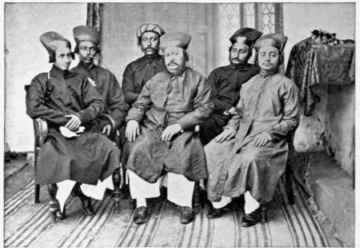
A Group Of Parsees.
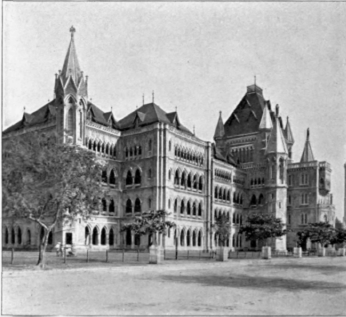
The Elphinstone High School.

A Canal.
The Parsees are in some respects the best inhabitants of England's Indian Empire. They constitute, numeri-cally, only about one-tenth of the population of Bombay, but their intelligence and enterprise have made their influence supreme. Some of them have been knighted for services rendered to the British Government. They are Bombay's wealthiest citizens and most important merchants; their deeds of charity are unsurpassed; they are all finely educated, and speak the English language fluently; they are thoroughly loyal to Great Britain; and (being a small minority, which under native rule might easily be crushed between the upper and nether millstones of Hinduism and Mohammedanism) they gain from England's liberal rule religious toleration and protection for their property.

Along The Shore.
Continue to:


My Books

