


India. Part 14
Description
This section is from the book "India - John L. Stoddard's Lectures", by John L. Stoddard. Also available from Amazon: John L. Stoddard's Lectures 13 Volume Set.
India. Part 14
After minute inspection of these scenes during several hours, we landed at one point to see the so-called "Well of Purification." It is a tank, about thirty feet in depth, supposed to have been dug originally by the Hindu deity, Vishnu, and to be, even now, partially filled with his perspiration. After inhaling one good whiff from it, I was quite ready to believe the statement; for it absolutely reeks with the effluvia of rotten flowers and the impurities of dirty millions who bathe themselves in the well before they step into the sacred stream itself. Yet I saw at least a dozen people drink this loathsome liquid. Priests serve it out by the ladle-ful in exchange for money. A single swallow of that putrid mixture, it is affirmed, is warranted to drive out every particle of sin from the vilest criminal on earth; and I must say, it appeared to me strong enough to do so.

Cremation At Benares.
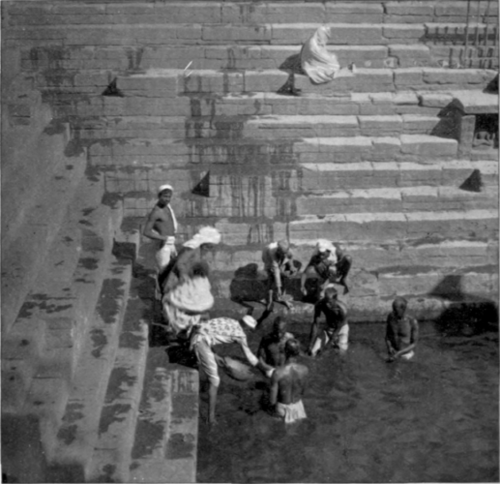
The Well Of Purification.

Indian Scenery.
I do not wish to make these facts unnecessarily revolting, but one must describe them in order to give a truthful picture of Benares. They are precisely what I saw, and what every tourist will see, if he explores this capital of Hinduism. Nor are these exceptional features, to be found with difficulty; they are the principal sights, - the important characteristics of Benares and its worshipers. All of the idols on the banks of the river are hideous; some are obscene; while a few are distinguished by the expression which one is apt to assume when the photographer asks one "to look pleasant." In all the narrow streets of Benares, one sees on sale thousands of idols, made of brass or stone, some of which are said to be manufactured in Birmingham, England. Many of those that have their origin in India are too disgusting to be illustrated, and some of the carvings on the temples of Benares are too vile to be described. Pictured and read of on the other side of the globe, viewed through the long perspective of a score of centuries, discussed in a transcendental way in a "Parliament of Religions," and judged of merely by its original sacred writings, the Hindu faith appears to some a fine and wonderful religion. Like all religions, it certainly has some fundamental truths. But scrutinize it practically, face to face, in India, and it becomes the most repulsive exhibition of idolatry, fanaticism, and filth that one can well imagine; while the incessant demands for money made by the insatiable priests fill one with unspeakable pity for their deluded victims. The superiority of Par-
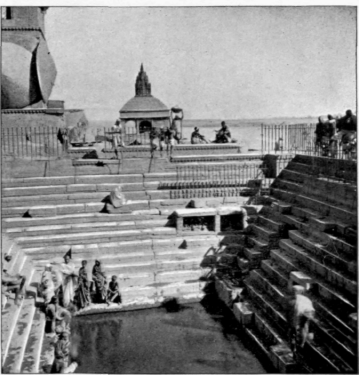
A Paradise Of Microbes.

"But how," the reader naturally asks, "can educated Brahmins, such as have recently been in this country, uphold and defend such a religion as Hinduism?" They do so by dwelling on its philosophical and metaphysical characteristics. Some of its sacred books, written thirty-five hundred years ago, are noble aspirations. Moreover, that early faith was free from the idolatry and caste which are its curse to-day. But how refined, intelligent men can have the slightest sympathy with the Hindu religion, as it now exists, is more than I can understand; for it should be carefully remembered that members of the very small society of the Brahmo-Somaj (which may be called a party of Unitarian, free-thinking Hindus) are not fair representatives of that great religion of Siva, Vishnu, Kali, and a thousand othergods,which holds within its cruel grasp two hundred millions of the human race.
One of the most famous temples at Benares is the shrine of Arnapurna, the patroness of beggars. No wonder she is popular in India! We could not, with any consideration for ourselves or our clothing, advance three feet beyond the threshold of this sacred shrine. Why?
Because a multitude of sacred bulls and cows were wandering over the marble pavement, and most of the enclosure was filthier than a pig-sty. Nor is this loathsome state of things confined to this one edifice. I walked repeatedly among the most revered and celebrated temples here, and these or similar disgusting features characterized nearly all of them. The singular part of the matter is, that to the assembled pilgrims we were spiritually just as vile as they were physically vile to us. Even the most repulsive of them shrank from us, as much as we from him; since, if a Christian or a Mohammedan touches a Hindu while engaged in his sacred duties, he must return immediately to the Ganges and take another bath. The sacred bulls and cows that roam about the temples of Benares are the luckiest animals in the world. They are petted, as well as worshiped, all day long, their appetites being tempted constantly with every dainty dear to bovine taste, from fruit and clover up to rose-leaves and confectionery. They even stroll about the bazaar and eat whatever they fancy in the traders' stalls. Around their necks and horns garlands of fragrant flowers are often hung. Some of these creatures, however, are diseased; yet, since it is a crime to kill them, they wander about here with the rest. But in these narrow streets, forever crowded with humanity, such animals are horribly obnoxious, and the bulls are often dangerous. So true is this that, some years ago, the British authorities hit upon the scheme of kidnaping a few of them at a time and turning them loose into the jungle. Once there, they never returned; for Indian tigers, so far as heard from, have no religious scruples about eating meat. It is not enough, however, to let sacred animals stroll through the streets and temples of Benares at their own sweet will - some of them even have sanctuaries of their own. We visited, for example, what is called the Monkey Temple. It is a rather handsome building of red sandstone, situated in a grove of stately trees; yet this is the home and playground of five hundred monkeys, all thought to be divine, since they are representative of Hanuman, the monkey god. Attendants sold us cakes and nuts with which to feed these apes, and soon a mob of long-tailed, simian deities were gathered round us. Whole families at a time were represented,- from old asthmatic grand-fathers, who looked sufficiently wise to be the ancestors of Darwin, down to the younger generations, who seemed horribly human as they blinked their eyes, fought and chattered for the sweetmeats, and pulled each other's tails in a most ungodly manner. The Hindus worship monkeys, and the Chinese eat them. I hardly know, if I had to choose, which I should prefer to do!
Continue to:


My Books

